
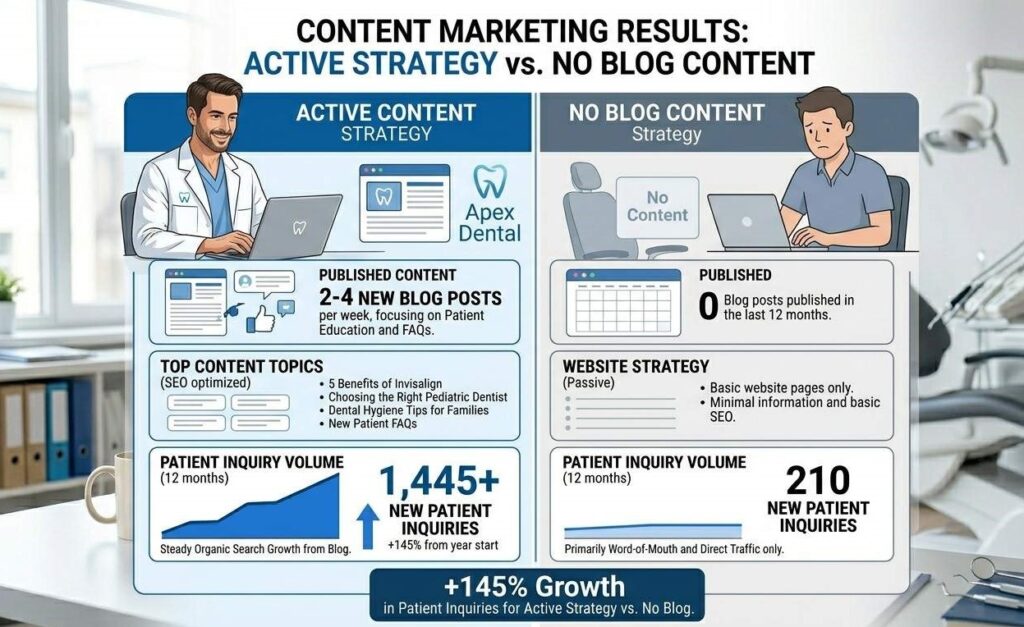
Quick Answer-A dental content marketing strategy is a planned approach to publishing educational content that attracts patients through search engines, online reviews and AI search platforms. It includes a procedure-focused blog, FAQ pages with schema markup, Google Business Profile posts and patient testimonial content. The core outcome is topical authority in your local market. Practices with active blogs generate 4.8x more inquiries than those without, according to healthcare SEO research compiled by Searchlab (2026). Strategy beats volume. Two well-structured posts per month outperform ten generic ones.
- Practices with active blogs generate 4.8x more patient inquiries than practices without published content, and organic search accounts for 54% of all healthcare website traffic (Searchlab, 2026).
- 97% of consumers read online reviews before choosing a local business, and 31% now require a minimum 4.5-star rating before making contact, up from 17% the prior year (BrightLocal Local Consumer Review Survey, 2026).
- 71% of people run a search engine query before scheduling a dental appointment, making search visibility the primary patient acquisition channel (Patientdesk.ai, 2026).
- Content marketing strategies improve patient retention by 18% when practices publish educational materials that keep patients engaged between appointments (HubSpot, cited by Keevee, 2025).
- The average dental practice loses 15 to 20% of its active patient base each year through natural attrition, which means content-driven acquisition is not optional for maintaining practice size (Dental Practice Insider, 2026).
Most dental practices do not lose patients because their clinical work is inferior. They lose them because a competitor answered the question the patient typed into Google before the appointment was ever scheduled. Patients research before they book. They read, compare and form an opinion about a practice before a single phone call happens. After auditing dental client content at Adnnel, one pattern appears across every market: practices with thin websites and no published content consistently lose new patient search traffic to smaller competitors who produce even a modest volume of helpful, specific educational posts. Wajahat Amin covers SEO strategy and content marketing for healthcare and dental practices, drawing from that direct audit experience. The gap is not clinical. It is content.

What Dental Content Marketing Actually Means in 2026
Dental content marketing is the practice of publishing educational, search-optimized content that positions a practice as the most trusted local answer for the procedures and questions patients search before booking. It is not blogging for the sake of activity. It is building a searchable knowledge base that intercepts patients at the exact moment they are deciding where to go.
The shift that matters in 2026 is the AI layer. Google AI Overviews now appear in a meaningful share of health-related queries, and platforms like ChatGPT and Perplexity answer questions like “what is the recovery time for a dental implant” without sending the user to any website. Practices that appear as the cited source in those answers build brand recognition before the patient ever searches for a dentist by name. Practices that do not publish structured, citable content are invisible in that layer entirely.
According to research by the ADA Health Policy Institute, independent practices with disciplined acquisition systems outperform peers on collections per provider day and net owner income. Content is not a soft marketing investment. It is the infrastructure that makes acquisition systematic.
Why Most Dental Websites Fail at Content
Most dental practice websites rank on page four or worse not because their SEO is technically broken but because no one has built a content cluster around the procedures that bring in the highest-value patients. A single “Services” page listing implants, Invisalign and teeth whitening does not tell Google that this practice is an authority on any of them. Authority comes from depth, and depth comes from dedicated content.
The failure patterns repeat across every market:
Thin service pages with no supporting content. A page that says “We offer dental implants” and nothing else does not rank for any implant-related question. Patients searching “how long do dental implants last” or “dental implant cost” never see it.
No FAQ content. FAQ pages rank disproportionately for symptom searches and pre-appointment research queries. A practice that answers “why does my tooth hurt when I bite down” in a published FAQ captures a patient who is already highly motivated to book.
Ignored Google Business Profile. The GBP is the most visible piece of real estate a practice has in local search. Practices that do not post updates, respond to reviews or fill out service categories lose local pack positions to competitors who do.
No review strategy. Reviews are content. BrightLocal’s 2026 Local Consumer Review Survey found that 97% of consumers read online reviews for local businesses and 31% now require a 4.5-star minimum before making contact. A practice without a process for consistently generating reviews is losing patients to one that does.

The Content Strategy That Works for Dental Practices
A dental content marketing strategy that produces measurable patient acquisition results follows a specific structure. It is not complicated. It requires consistency and a clear understanding of what patients actually search.
Build Content Clusters Around High-Value Procedures
The highest-value dental procedures, typically implants, Invisalign, cosmetic work and sleep apnea treatment, should each anchor their own content cluster. That means a dedicated service page, two to three supporting blog posts answering related questions, and an FAQ page with schema markup. This cluster structure is what gives Google the topical depth signals it needs to rank a practice for competitive procedure keywords.
For a dental implant cluster, the supporting content might include: “dental implant recovery timeline,” “how much do dental implants cost without insurance” and “mini vs traditional dental implants.” None of those posts need to be long. They need to be accurate, specific and structured so that the answer appears in the first 50 words.
Publish FAQ Pages With Schema Markup
FAQ schema makes individual question-answer pairs machine-readable and dramatically increases the chance of appearing in Google AI Overviews and featured snippets for health queries. Each answer should be 50 to 80 words, self-contained and written in plain language. A patient asking “is tooth extraction painful” should get a direct answer in the first sentence, not a paragraph of context-setting.
At Adnnel, we rebuilt the FAQ section for a dental client in the Southeast in 2025, adding schema markup to 12 existing Q&A pages. Within eight weeks, three of those pages were appearing in Google AI Overviews for their target queries. No new content was required. The answers already existed. The structure did not.
Use Google Business Profile as a Publishing Channel
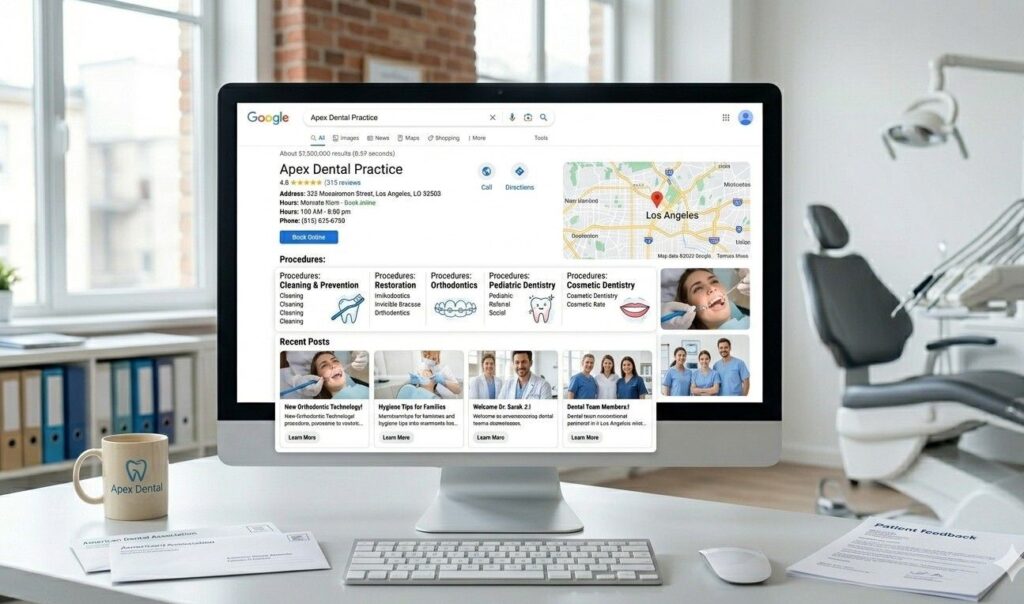
GBP posts appear directly in local search results and cost nothing to produce. A practice that posts one educational update per week, such as “what to expect after a filling” or “when to replace a crown,” builds a visible content trail that competitors relying on static profiles do not have. According to Google’s own guidance on local search, active, complete business profiles with regular updates perform better in local ranking than incomplete or inactive ones.
Build a Review Generation Process
Reviews are not a passive outcome of good clinical work. They require a proactive system. The practices consistently sitting at 4.8 stars with 100-plus reviews on Google did not get there by hoping patients would leave feedback. They use a post-appointment follow-up sequence, either SMS or email, that asks for a review within 24 hours of a positive visit. HubSpot’s healthcare marketing research consistently shows that the timing of a review request determines the response rate more than any other variable.
What Content a Dental Practice Should Publish and When
The frequency question almost always stops practices from starting. Two well-structured posts per month, consistently published over 12 months, produces better results than ten posts in one quarter followed by silence. Consistency signals to Google that a site is maintained and trustworthy. Sporadic bursts followed by inactivity do not compound.
A practical monthly cadence for a single-location practice:
| Content Type | Frequency | Primary Purpose |
| Procedure blog post | 2 per month | Organic rankings, AI citations |
| GBP update post | 4 per month | Local pack visibility |
| FAQ page update or addition | 1 per month | Featured snippets, AI Overviews |
| Review response | Every new review | Trust, local ranking signal |
| Patient education email | 1 per month | Retention, referral activation |
This calendar is achievable without a full-time marketing hire. The blog posts are the heaviest lift. Everything else takes under an hour combined per week.
The Procedures That Should Drive Your Content Strategy
Not all procedures deserve equal content investment. The procedures worth building content clusters around are those with high search intent, high lifetime patient value and enough patient anxiety to drive research behavior before booking.
The three highest-priority clusters for most practices:
Dental implants. Patients research implants for weeks before booking a consultation. They search cost, recovery, longevity and alternatives. A practice with a five-post implant cluster captures that research at multiple points. A practice with one generic implant page captures none of it.
Clear aligners and Invisalign. This category generates enormous search volume from patients who are comparison shopping between providers and between treatment types. Content that explains the comparison directly wins patient trust before the consultation begins.
Cosmetic dentistry broadly. Veneers, whitening and smile makeovers attract patients with high treatment acceptance rates and low price sensitivity. Educational content in this category converts readers into consultations at a higher rate than almost any other procedure category.
The dental SEO guide for 2026 covers keyword strategy and on-page optimization for each of these clusters in detail, including which search terms bring in the highest-value patients versus which ones attract price shoppers.
What Happens When Practices Ignore Content
The math on inaction is uncomfortable. The average dental practice loses 15 to 20% of its active patient base every year through natural attrition: patients move, age out, switch to a competitor after one frustrating scheduling experience. A practice with 800 active patients needs to acquire 120 to 160 new patients per year just to stay the same size. Without a content and search strategy, that acquisition depends entirely on referrals and paid advertising.
Referrals remain the highest-converting channel at a 3.74% conversion rate, but 71% of patients still run an online search before booking even after receiving a referral, according to data aggregated by Patientdesk.ai (2026). That search either confirms the referral or introduces a competitor. If the referred practice has no content and the competitor has a detailed, well-reviewed site, the referral goes elsewhere.
Paid advertising fills gaps but does not compound. Content builds domain authority, local ranking strength and brand recognition that continues performing after the initial investment. A blog post published today can generate patient inquiries three years from now. A Google Ad stops generating inquiries the moment the budget stops.
For a deeper look at how local SEO and content work together for healthcare practices, the local SEO guide for therapists and healthcare professionals covers the exact same structural principles applied to a healthcare compliance context.
Ready to Build a Content Strategy for Your Practice?
The practices growing their patient base in 2026 are not the ones with the best clinical outcomes visible online. They are the ones with the best content strategy. If your website is not appearing for the procedure searches your highest-value patients run before booking, that traffic is going to a competitor who figured out content first.
Adnnel’s full-service dental and healthcare marketing programs cover content strategy, local SEO, Google Business Profile management and review generation, built specifically for practices that want measurable patient acquisition results. For a conversation about what a structured content strategy looks like for your specific market and specialty, the contact page is the direct route.
Frequently Asked Questions
What is dental content marketing and how does it work?
Dental content marketing is the practice of publishing educational, search-optimized content that helps patients find your practice before they book. It works by building topical authority through procedure-focused blog posts, FAQ pages and Google Business Profile updates. Search engines reward practices that answer patient questions with depth and accuracy. Over time, this content builds rankings, review volume and brand recognition that paid advertising cannot replicate at the same cost per acquisition.
How much content does a dental practice actually need to see results?
Two well-structured posts per month, consistently maintained, produces better long-term results than bursts of high volume followed by inactivity. The minimum viable strategy for a single-location practice is two procedure blog posts per month, four GBP updates per week and one FAQ page addition or update per month. Practices that maintain this cadence for 12 months see measurable ranking gains and patient inquiry increases in the 6 to 9 month range for competitive procedure terms.
What type of content brings in the most dental patients?
Procedure-specific educational content targeting high-value treatments generates the highest-quality patient inquiries. Content that answers cost questions, recovery questions and comparison questions captures patients in active research mode, which is the highest-intent stage before booking. FAQ pages with schema markup rank disproportionately for the symptom and pre-appointment queries that patients search immediately before deciding which practice to contact.
Can small dental practices compete with DSOs through content?
Yes, and content is one of the few channels where a well-run independent practice consistently outperforms a DSO. DSOs produce generic, templated content across hundreds of locations. An independent practice can publish specific, locally-relevant content with real provider voice, patient stories and procedure outcomes. Google’s E-E-A-T framework rewards that specificity. A dentist-authored post about implant complications they have handled in their own practice ranks higher than a generic DSO content template on the same topic.
How does AI search affect dental content marketing in 2026?
AI search platforms like ChatGPT, Perplexity and Google AI Overviews now answer many dental questions directly without sending users to a website. Practices that appear as cited sources in those answers gain brand visibility before the patient ever searches for a practice by name. Getting cited requires structured content with direct answers in the first 50 words, named statistics and FAQ schema. The post on what answer engine optimization means for healthcare content explains exactly how to structure content for AI citation. This is the same structure that performs in traditional search, which means good content now works across both channels simultaneously.