
TL;DR:SEO for dentists in 2026 means ranking in Google’s local map pack, earning citations in AI Overviews and converting that visibility into booked appointments. According to Semrush’s 2025 data, Google AI Overviews appear on 88 percent of informational queries, including “dentist near me” and treatment-specific searches. According to Ahrefs’ AI Overview study, only 38 percent of AI citations come from top-10 organic results. The three highest-impact actions for a dental practice are: a fully optimised Google Business Profile, service pages built with answer capsules and LocalBusiness schema markup, and a steady review acquisition strategy targeting 50 or more Google reviews with a 4.5 or higher average rating.
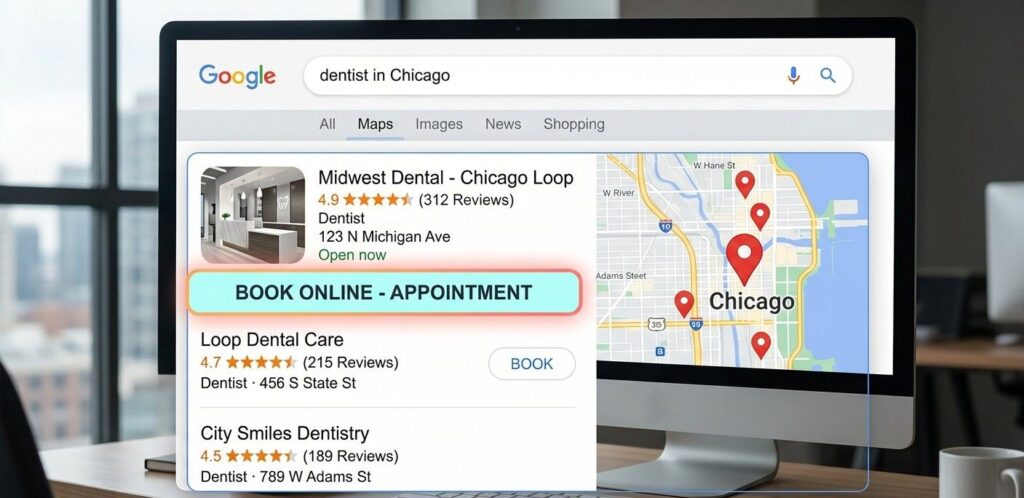
A patient with a cracked tooth or a parent looking for a children’s dentist does not browse page two of Google. They call the first practice that looks credible, has recent reviews and appears in the map pack for their postcode. Most dental websites miss at least one of those three requirements. The practices that consistently acquire new patients online treat their digital presence the same way they treat their clinical reputation: with specific attention to detail, regular updates and a clear structure that gives Google everything it needs to surface them first.
Why Dental SEO Is a Local Search Problem First
SEO for dentists is primarily a local search problem. The goal is not to rank nationally for “dental implants.” It is to appear in the map pack when someone two kilometres away searches “dentist near me” or “tooth extraction [suburb].” Local SEO and national organic SEO require different tactics, and most dental practices only need the local version.
Google’s local algorithm ranks dental practices based on three factors: proximity to the searcher, relevance of the practice’s Google Business Profile and online prominence measured through reviews, citations and backlinks. Proximity is fixed. Relevance and prominence are both buildable, and they are where most practices have room to improve quickly.
Why the map pack matters more than page-one organic rankings for dentists
A patient searching for a dentist in their area sees the map pack before any organic result. The map pack shows three practices with star ratings, phone numbers and distance. Most patients never scroll past it. Appearing in that block, rather than in organic position one below it, drives significantly more calls and appointment bookings for local dental practices.
How to Optimise a Dentist Google Business Profile
A fully optimised dentist Google Business Profile includes the correct primary category (“Dentist”), all relevant secondary categories (“Cosmetic Dentist”, “Orthodontist”, “Emergency Dental Service”), complete business hours including emergency availability, a direct booking link, at least 20 photos and weekly Google Posts covering treatments, team updates or patient education.
Google’s own Business Profile guidance confirms that profile completeness directly affects local search visibility. For dental practices, the fields most often left incomplete are: services list with individual treatment descriptions, Q&A responses and the appointment booking URL.
The Google Business Profile fields dental practices most often skip
- Services: List each treatment individually, including teeth whitening, Invisalign, dental implants and emergency appointments, with a 2 to 3 sentence description for each
- Attributes: Mark “wheelchair accessible”, “accepts new patients” and “online appointments” where applicable
- Products: Some practices use this section to feature specific treatment packages with pricing
- Posts: Publish one post per week covering a seasonal treatment reminder, a patient FAQ answer or a team milestone
According to BrightLocal’s 2024 Local Consumer Review Survey, 98 percent of consumers read online reviews for local businesses before contacting them. For dental practices, where trust and anxiety both run high, a Google Business Profile with 60 or more recent reviews and responses to every negative review outperforms a sparse profile regardless of how well the website ranks.

What Dental Service Pages Need to Rank and Convert
Dental service pages rank and convert when they answer the patient’s actual question in the first 60 words, use LocalBusiness and MedicalOrganization schema markup and include a clear booking call to action above the fold. A page that only lists what a treatment involves does not rank as well as a page that also answers “how much does it cost,” “does it hurt” and “how many appointments does it take.”
Each treatment deserves its own dedicated page. A single “Services” page listing teeth whitening, veneers, implants and Invisalign will rank for none of them against competitors who have built individual pages for each treatment with specific keyword targeting.
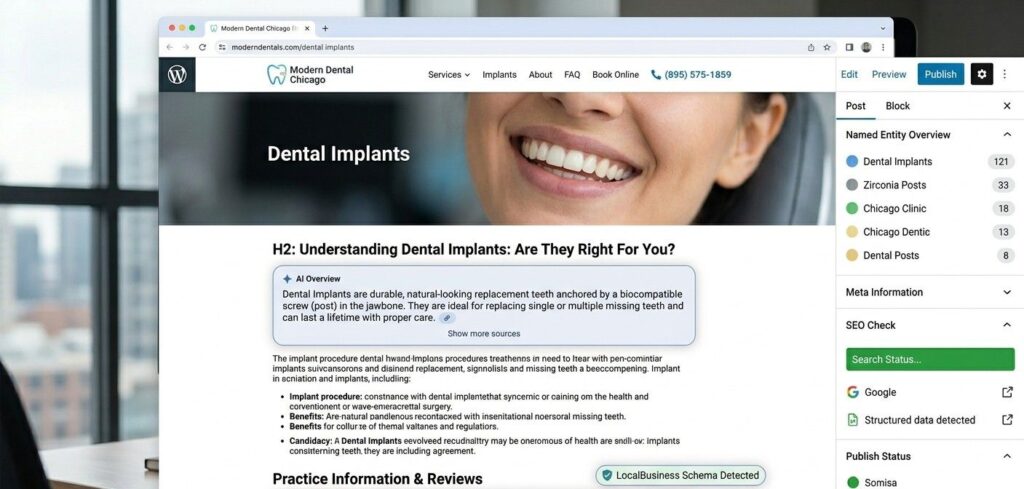
According to Google’s structured data documentation for dental practices, LocalBusiness schema with the correct type (“Dentist”) and valid address, phone and opening hours data improves eligibility for rich results and AI Overview extraction. Adding this markup to every service page and the homepage takes under two hours and produces measurable improvements in Google Search Console impression data within 30 to 60 days.
| Page type | Target keyword example | Schema recommended |
| Homepage | Dentist in [city/suburb] | LocalBusiness, Dentist type |
| Service: implants | Dental implants [suburb] | MedicalProcedure |
| Service: whitening | Teeth whitening [city] | MedicalProcedure |
| Service: emergency | Emergency dentist [suburb] | LocalBusiness, openingHours |
| FAQ page | Is teeth whitening safe? | FAQPage |
| About/team page | Dentist [name] [city] | Person, MedicalOrganization |
I cover schema markup and service page structure in more detail on my blog covering dental and healthcare SEO strategy.
Do Google Reviews Affect Dental SEO Rankings?
Yes. Google reviews affect dental SEO rankings in two direct ways: they influence map pack position through review count and average rating, and they generate keyword-rich user content that Google indexes as a trust signal. A practice with 80 reviews mentioning “Invisalign”, “gentle with nervous patients” and “great with children” earns relevance signals for those terms without any additional content work.
According to BrightLocal’s 2024 survey, 70 percent of consumers will leave a review when asked directly. The most effective dental review acquisition method is a post-appointment SMS or email with a direct Google review link, sent within two hours of the patient leaving the practice.
Responding to every review, including negative ones, also signals active management to Google and to potential patients. A practice that thanks reviewers by name and addresses complaints specifically earns significantly more trust than one that ignores its review feed.
Should Dentists Blog or Focus on Service Pages First?
Service pages first, always. For a dental practice with fewer than 20 properly structured service and location pages, blog content is a lower priority. Service pages target high-intent commercial queries (“dental implants [city]”). Blog posts typically target informational queries (“how long does teeth whitening last”) that generate reads but fewer bookings.
Once your core service pages are built and ranking, blog content builds topical authority and earns AI Overview citations. According to Princeton’s 2025 research cited by Search Engine Journal, content with named sources and statistics lifts AI visibility by over 40 percent. A blog post answering “what is the difference between composite and porcelain veneers” with specific clinical detail, named materials and a cited source is the kind of content AI engines extract and reference.
If you want to see how this service-first content architecture works in professional services verticals, my healthcare and dental SEO content services page outlines the approach I use for practice clients.
Want More New Patients From Google This Year?
Most dental practices I audit have the credibility to rank. They simply have an incomplete Google Business Profile, service pages without schema markup and no active review strategy. Fixing those three things consistently fills appointment books faster than any paid campaign. If you want a content and local SEO structure built specifically for your practice, take a look at my dental and healthcare SEO content services or get in touch directly. I will tell you exactly where your current setup is losing patients before we agree on anything.
FAQs
How much should a dentist spend on SEO per month?
A single-location dental practice should budget $1,000 to $2,500 per month for a focused local SEO and content programme. That typically covers Google Business Profile management, 2 to 4 new or updated service pages and a review acquisition strategy. Multi-location practices or those competing in high-density urban areas typically spend $3,000 to $6,000 per month. The return is measurable: one additional implant case per month at $3,000 to $5,000 per case covers most SEO investments entirely.
How long does dental SEO take to show results?
Map pack improvements from a fully optimised Google Business Profile and consistent review acquisition typically show movement within 60 to 90 days. Organic service page rankings in competitive city areas take 3 to 5 months. Suburb-level and treatment-specific pages with lower competition often rank faster, sometimes within 30 to 45 days of publication. The quickest wins come from fixing incomplete Business Profile fields and acquiring 10 to 15 new Google reviews, as these changes affect map pack visibility directly.
What is the best schema markup for a dental website?
The highest-priority schema types for a dental website are: LocalBusiness with the “Dentist” type on the homepage and contact page, MedicalProcedure on individual treatment pages, FAQPage on any page with a question-and-answer section and Person on dentist bio pages. According to Google’s structured data documentation, valid LocalBusiness schema with correct address, phone number and opening hours improves eligibility for rich results and AI Overview citations. Use JSON-LD format and validate each page with Google’s Rich Results Test before publishing.
Should dentists blog or focus on service pages first?
Service pages first. A practice without dedicated pages for its main treatments, namely implants, whitening, Invisalign and emergency appointments, should build those before writing any blog content. Service pages target high-intent patients ready to book. Blog posts target informational readers who may or may not convert. Once your 15 to 20 core service and location pages are live and indexed, blog content adds topical authority and earns AI Overview citations for treatment education queries.
Do Google reviews affect dental SEO rankings?
Yes, directly. Google’s local ranking algorithm uses review count, average rating and review recency as prominence signals for map pack placement. A practice with 80 recent reviews at 4.6 stars will outrank a practice with 20 reviews at 4.8 stars in most markets because recency and volume outweigh a marginally higher average. Reviews also generate indexable keyword content: patients who mention specific treatments by name in their reviews help the practice rank for those treatment terms without additional page content.