
TL;DR: Local SEO for therapists means aligning your Google Business Profile, service pages and specialty content so clients searching “trauma therapist near me” or “anxiety therapist Chicago” find you first. It rewards accuracy and clarity, not keyword stuffing. The ethics layer is real: APA Ethics Code 5.05 prohibits soliciting testimonials from current clients, and standard Google Analytics is not safe for handling protected health information. According to ICANotes’ 2026 SEO guide for mental health professionals, most practices see early improvements within three to six months. Getting the ethics right is not extra work. It is the work.

Every week, someone in your city searches “therapist near me” and does not call the first result. They scroll, they read, they compare. Then they book.
That search is your referral pipeline. For therapists who rely on word of mouth, local SEO fills in the gap between sessions. It keeps the phone ringing when your existing clients move, graduate or no longer need you.
This guide covers what therapy-specific local SEO actually involves. It covers what you cannot do because of your ethics code and what you can do instead. It draws on real work building content for mental health practices, so the examples here are grounded in clinical reality, not generic marketing advice.
Why Therapy SEO Is Different from Regular Local SEO
Local SEO for therapists operates inside a compliance framework that most marketing guides ignore entirely. That framework is not optional. Two specific constraints separate therapy SEO from plumber SEO or restaurant SEO.
The first is the APA Ethics Code. Section 5.05 of the APA Ethics Code states that psychologists do not solicit testimonials from current therapy clients or other persons who are vulnerable to undue influence. The ACA, NASW and NBCC all carry similar provisions. This does not mean you cannot have reviews. It means you cannot ask a current client to leave one.
The second constraint is HIPAA. Under the HHS HIPAA Privacy Rule, protected health information includes far more than a person’s diagnosis. A person’s name combined with the fact that they sought mental health care is itself PHI. Standard Google Analytics collects IP addresses and browsing behavior. If a client visits your site and navigates to your “trauma therapy” page, that behavior can constitute PHI. That matters for how you set up analytics and how you respond publicly to reviews.
Neither constraint makes SEO impossible. Both make it specific.
How to Set Up a HIPAA Aware Google Business Profile
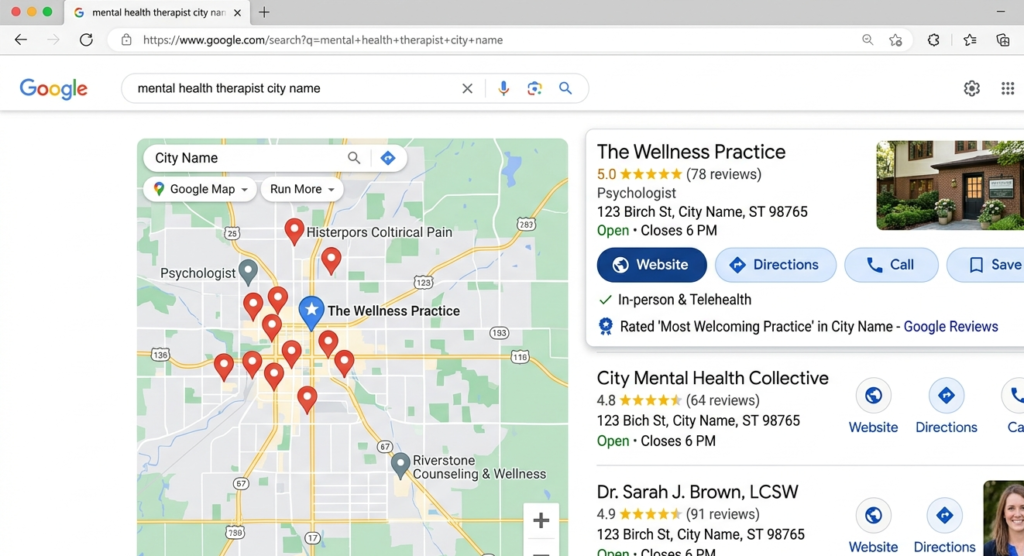
Your Google Business Profile is the single most important local SEO asset you have. It drives the map pack results. When someone searches “therapist near me” on a phone, that three-result block is where most clicks go.
Getting it right takes less than two hours the first time. Here is what matters most.
Name, address and phone number. Your NAP must be exact and consistent across every directory. “Suite 400” on your website and “Ste 400” on your GBP confuse Google’s matching algorithm. Pick one format and use it everywhere.
Categories. Set your primary category to “Mental Health Service” or the most specific match available. Add secondary categories for relevant specialties such as “Psychotherapist” or “Marriage Counselor.” Do not add categories that do not reflect your actual practice.
Services section. List your actual specialties here: anxiety, depression, trauma, EMDR, CBT, couples therapy. Use the language clients actually search. “Somatic therapy” is more searchable than “body-based intervention.”
HIPAA note on photos. Never post photos that could identify clients, session rooms visible in a way that discloses attendance or any image that implies a specific person received care. Staff headshots and exterior office photos are fine.
Reviews. You can display and acknowledge reviews passively. You cannot ask current clients to leave them. The ethical path is covered in detail below.
The Four Page Types Every Therapy Site Needs
Most therapy websites rank poorly because they have one service page that says “I offer therapy for anxiety, depression, trauma and more.” That is a weak page trying to rank for too many terms at once. It ranks for none of them well.
A well-structured therapy site needs four types of pages.
A clear homepage that states who you help, what you offer and where you are located. The H1 should include your specialty and location. “Anxiety Therapist in Austin, Texas” is better than “Welcome to My Practice.”
Specialty pages, one per core issue you treat. Anxiety gets its own page. Trauma gets its own page. EMDR gets its own page. Each page targets a specific search intent and answers the questions a prospective client actually has. More on this below.
Insurance and fees pages. These rank well because they answer a high-intent question: “Does this therapist take my insurance?” According to ICANotes’ 2026 SEO guide for therapists, insurance-related pages are among the most visited pages on therapy sites after the homepage.
A location or service area page. If you work in a single city, your location page targets “[city] therapist” and nearby neighborhood terms. If you offer telehealth across a state, you need a page targeting “[state] online therapist.”
Writing Specialty Pages That Convert
A specialty page earns its ranking by answering the real questions a client has when they search for help. It also earns a booking by making the person feel understood before they ever call you.
The structure works like this. Open with what you treat and who tends to come to you with it. Keep it specific. “Many adults with anxiety” is vague. “Adults who lie awake rehearsing conversations that have not happened yet” is specific. Specificity signals that you know this person’s experience.
Then cover what your approach looks like. For an EMDR page, explain what a session involves. For a CBT page, explain what the homework actually looks like. Clients are nervous about therapy before they start. A page that explains the process reduces that barrier.
Close with a practical next step. “If this sounds like what you are looking for, you can reach me here” is cleaner and more effective than a hard sales close.
The keywords that matter for specialty pages
Search terms like “trauma therapist near me,” “EMDR therapist [city]” and “teen anxiety therapist [city]” all carry strong local intent. Use your city name naturally in the page headline and once or twice in the body text. Do not force it. If the page reads naturally to a human, the keyword density is probably correct.

Insurance Panel Pages and Why They Rank So Well
Insurance pages convert because they answer a decision-stage question. A person searching “therapist who takes Aetna in Denver” has already decided to go to therapy. They want to know if you are affordable. That search has very high intent and relatively low competition compared to general therapy keywords.
Build one page per major panel you accept. Cover Aetna, BCBS, Cigna, United Healthcare and Optum as separate pages if your caseload supports it. Each page should answer three questions clearly: Do you take this insurance? What is the typical session cost after insurance? How do you handle billing and superbills for out of network clients?
These pages also answer a question Google cares about under Your Money or Your Life content standards. Google classifies healthcare content as YMYL, which means it holds it to a higher bar for accuracy and trust. An accurate, specific insurance page with your actual panel information signals E-E-A-T more clearly than a generic “contact us to discuss fees” approach.

How to Respond to Negative Google Reviews Without Violating HIPAA
This is the section most therapy marketing guides skip. It is also the section that can expose you to real legal risk if you get it wrong.
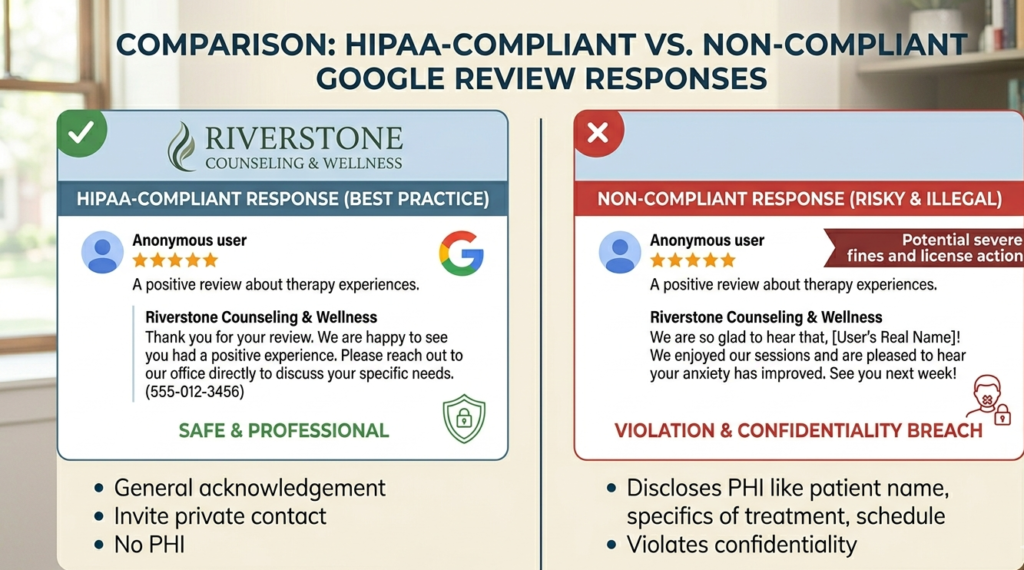
The rule is direct. According to Sam Knight’s April 2026 compliance guide at Search Engine Land, even acknowledging that a reviewer was a patient can constitute a HIPAA violation. This applies even when the reviewer has already disclosed their own patient status publicly. HIPAA regulates what the provider discloses. It does not regulate what the patient chooses to share.
That means a response like “We are sorry your experience did not meet expectations, Jane” is a potential HIPAA violation if it implies Jane received care at your practice.
A compliant response template
Here is a structure that protects you and still shows responsiveness to any prospective client reading your reviews.
“We take all feedback seriously and are committed to providing a supportive, professional environment for everyone who reaches out to us. We would welcome the opportunity to address your concerns directly. Please feel free to contact our office at [phone number].”
This response addresses the concern, moves the conversation offline and confirms nothing about the reviewer’s status as a client.
You can also flag certain reviews for removal. According to Search Engine Land’s compliance guide, you can report reviews that contain misinformation, offensive content or personally identifiable information about staff. Avoid reporting on grounds that the reviewer “was not a patient,” because making that claim publicly could itself be a HIPAA issue.
Tracking Without PHI Leaks: GA4 Setup for Healthcare
Standard Google Analytics 4 is not configured for HIPAA compliance out of the box. By default, GA4 collects IP addresses and can track browsing behavior at a granular level. When that browsing happens on a mental health practice site, identifiable behavior combined with a clinical context can constitute PHI under HHS definitions.
The core principle from the HHS HIPAA Privacy Rule is this: a covered entity cannot use or disclose PHI without proper authorization except in narrowly defined circumstances. Web analytics that inadvertently captures and transmits PHI without a Business Associate Agreement in place puts you at risk.
Practical steps for safer tracking
Turn off advertising personalization signals in GA4. Go to Admin, then Data Collection, then disable Google Signals. This limits behavioral profiling based on your visitors’ sessions.
Activate IP anonymization. In GA4, enable IP address anonymization in your data stream settings. This strips the last portion of each IP before storage.
Sign a BAA before using any analytics tool. Google does not offer a BAA for standard GA4. If you need compliant analytics, look at platforms that specifically offer a BAA for healthcare providers.
Avoid tracking specific page paths that disclose intent. A session that visits /anxiety-therapy/ followed by a contact form submission can imply clinical intent. Work with your developer to exclude specific page paths from being sent to GA4 if they carry PHI risk.
For questions about how to set up tracking for a healthcare site without exposing client data, the healthcare content writing service includes guidance on privacy-first site structure as part of onboarding.
Ready to Build a Therapy Content Strategy That Stays Ethical?
Mental health marketing works differently from every other niche. The ethics code, the HIPAA constraints and the YMYL content standard all require a writer who understands the rules before the first paragraph is written.
If you want content built with that understanding from the start, take a look at the healthcare content writing service. It covers specialty pages, insurance pages, blog content and Google Business Profile copy for private practice. If you want to talk through your specific practice needs first, you can start with a discovery call. There is no pitch involved, just a straight conversation about what your practice needs and what is realistic.
FAQs
Is Google Analytics HIPAA compliant for therapists?
Standard GA4 is not safe for tracking protected health information as configured out of the box. Google does not sign a Business Associate Agreement for free GA4 accounts. PHI includes any information that could identify an individual in connection with healthcare, including browsing behavior on a therapy site. Safe options include configuring GA4 with IP anonymization and disabled advertising features, or switching to a HIPAA-specific analytics solution that offers a signed BAA.
Can therapists ask for Google reviews?
Not from current clients. APA Ethics Code 5.05 prohibits soliciting testimonials from current therapy clients or anyone whose circumstances make them vulnerable to undue influence. The same restriction appears in the ACA, NASW and NBCC codes. You can request reviews from colleagues, referral sources and professional contacts who are not clients. Many therapists also generate reviews passively through signage in waiting rooms and general practice information, without directing a specific client to review.
How long does local SEO take to work for a therapy practice?
Most mental health practices see early improvements in three to six months and meaningful traffic growth in six to twelve months, according to ICANotes’ 2026 therapist SEO guide. Timeline varies based on how competitive your city is, how optimized your existing site is and how consistently you publish new content. One of the fastest wins is a complete, accurate Google Business Profile with correct categories and a filled services section.
Should therapists write their own blogs or hire a writer?
Hiring helps most therapists. The accuracy bar for mental health content is high. A generalist writer who does not understand HIPAA, clinical terminology or the ethical limits around client stories can create content that harms your credibility or creates compliance risk. A writer who specializes in healthcare and therapy content can produce posts faster than you can between client sessions, and without the clinical liability concern. If you want to understand what that process looks like, you can start at the why you need an expert SEO content writer guide.
Is local SEO worth it for telehealth-only practices?
Yes, but the strategy changes. Telehealth practices target state-level keywords like “online therapist in California” or “telehealth anxiety therapy Texas” instead of city-level terms. Your GBP service area should list the states you are licensed in rather than a specific office radius. Your specialty pages should include state names naturally and address the practical questions telehealth clients have, such as scheduling across time zones and what to expect from a video session.