
Key Takeaways: Answer engine optimization (AEO) is the practice of structuring content so AI-powered tools like ChatGPT, Perplexity and Google AI Overviews pull it as a direct, cited response. According to Ahrefs’ AI Overview study, only 38 percent of AI Overview citations come from the top 10 organic results, so ranking alone is no longer enough.
According to Semrush’s 2025 research, AI Overviews appear on 88 percent of informational queries. Because of this shift, AEO closes the gap by placing a clear, self-contained answer at the top of each content section, using question-based headings and citing specific data from named sources. Voice search pulls from the same signals. AEO is not a replacement for SEO. It is what makes SEO visible in 2026.
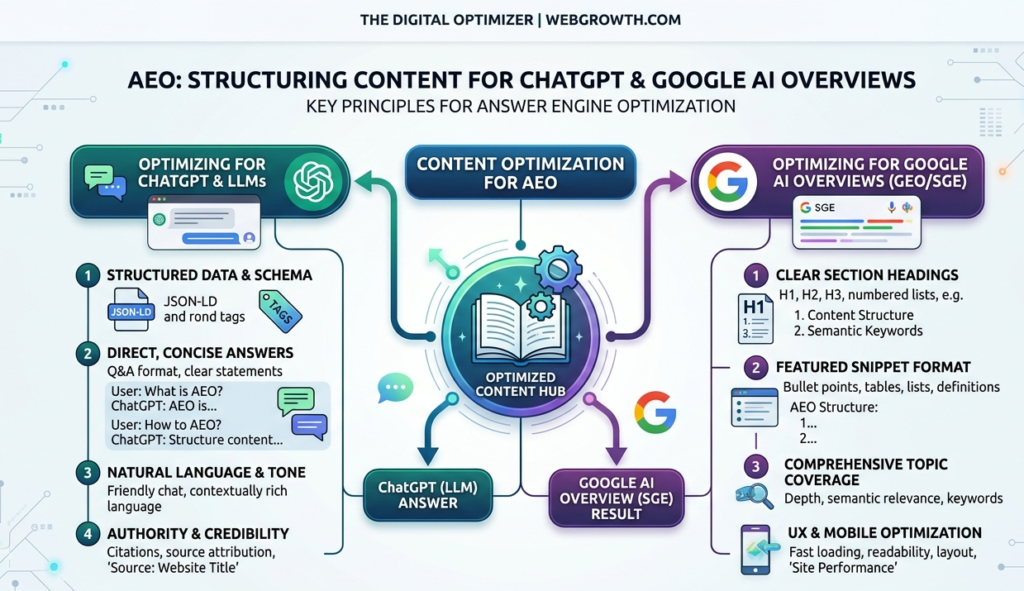
Google started giving direct answers before users had to click anything. That was 2014. By 2026, it is the default. AI Overviews now appear on 88 percent of informational queries, and tools like ChatGPT and Perplexity take answer delivery even further. Traditional SEO gets you into the results. Answer engine optimization gets you cited in the answer itself. If you have wondered why a competitor appears in AI responses and your site does not, the gap is almost always structural, not technical. This post covers what AEO is, how it differs from standard SEO and how to apply it to pages you already have.
What Is Answer Engine Optimization, Exactly?
Answer engine optimization (AEO) is the practice of writing and formatting content so AI-powered engines, including ChatGPT, Perplexity and Google AI Overviews, can lift it as a direct response to a user’s question. It focuses on answer structure, specificity and source credibility rather than traditional ranking signals alone.
People stopped typing short queries long ago. A voice user now asks “which therapist in Chicago specializes in anxiety and works on Saturdays?” That query needs a complete, structured answer, not a list of ten blue links to scroll through. AEO is how content meets that expectation.
According to Google’s featured snippets documentation, Google pulls featured snippets from paragraphs, tables and lists, so AEO formalizes this structure at every level of a page, not only at the top.
Every project featured on my website uses this same foundation, from therapy practices to B2B software companies. The principle does not change by industry.
How Does AEO Differ from a Standard SEO Strategy?
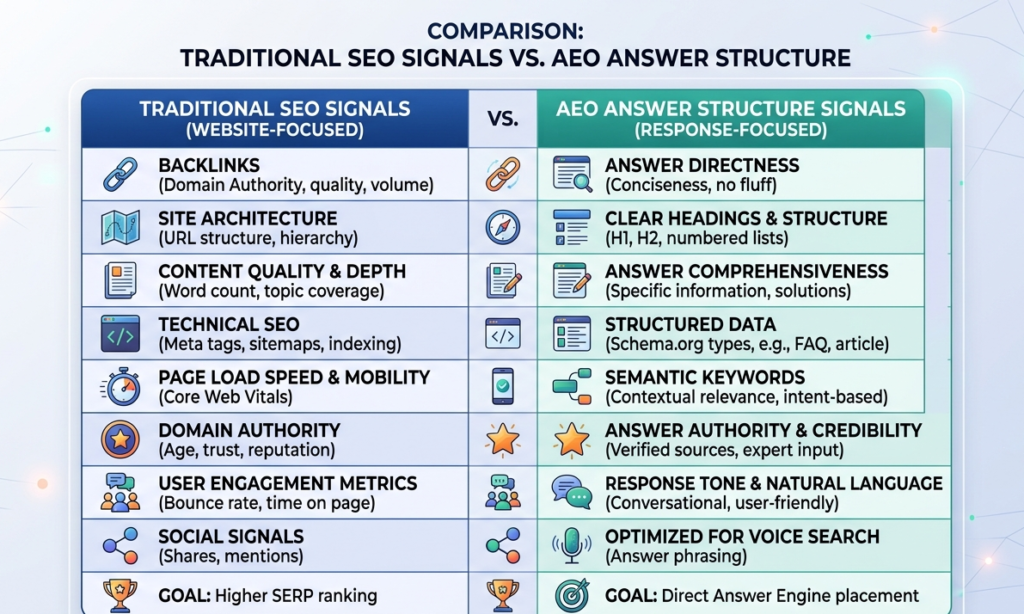
Traditional SEO focuses on ranking higher in a list of blue links so users click through. AEO goes further by making your content ready to be quoted directly. SEO asks “can Google index this page?” AEO asks “can Google, ChatGPT and Perplexity use this content as a direct answer right now?”
The difference matters because, according to Ahrefs’ AI Overview study, 62 percent of AI citations come from pages outside the top 10 organic results. So a page sitting on page two can get cited in an AI Overview if you structure it correctly. A page in position one can get skipped if it buries its main point in paragraph four.
This is also why the distinction runs through my SEO vs AEO vs GEO breakdown: AEO and SEO share the same technical base but serve different content goals.
| Signal | Traditional SEO | AEO |
| Primary goal | Rank in search | Get cited as an answer |
| Format priority | Keywords and word count | Answer structure and clarity |
| Key reader | Human clicking a link | AI parsing the page |
| Success metric | Organic position | Featured snippet or AI citation rate |
How Do You Structure Content for Featured Snippets?
To win featured snippets, open every section with a 40 to 60 word direct answer to the heading question. Write H2s as questions or bold declaratives. Include a specific statistic with a named source every 200 to 300 words. Format comparison data in tables and steps as numbered lists rather than burying them in dense paragraphs.
The most common mistake is burying the answer. Google and ChatGPT scan the first 60 to 100 words under each heading for an extractable response, so if your best point sits in paragraph three, they often skip the section entirely. Put the answer first, then expand below it.
Question-based headings do for AI engines what keywords do for Google’s crawler: they signal intent. “How do I structure content for featured snippets?” is far more citable than “Content Formatting Tips” because it mirrors what a real user typed or said aloud.
My Generative Engine Optimization guide for content teams goes deeper on what AI engines look for, including how paragraph length, entity density and source freshness all affect citation probability.
Does Voice Search Actually Use AEO?
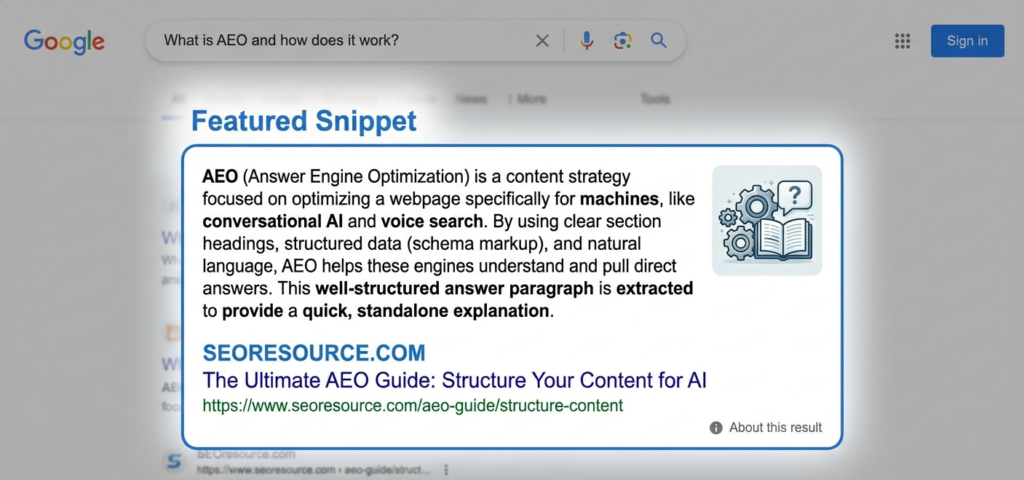
Yes. Google Assistant, Siri and Alexa pull their spoken answers from featured snippets and AI Overview results. Because voice answers are read aloud rather than displayed as a clickable list, they favor short, conversational and self-contained paragraphs. The same AEO structure that wins a text featured snippet also wins a voice result.
Voice queries tend to be longer and more conversational than typed ones. A voice user says “how do I get my blog cited in ChatGPT?” A typed user searches “AEO blog structure 2026.” Both resolve to the same content pattern: a direct opening sentence that makes sense without surrounding context.
That crossover is exactly why my guide on getting cited by AI in 2026 treats voice and text together. The optimization steps are the same because the content demands are identical.
How to Build an AEO SEO Strategy That Gets Results
An AEO SEO strategy combines question-intent keyword research, answer-first content structure and consistent inline citations from named sources. According to Princeton research (2025), adding citations to content lifts AI visibility by over 40 percent. Pages with 15 or more named entities have a 4.8 times higher AI citation probability, based on 2025 practitioner data.
Here is the full process, step by step:
- Find question-intent keywords. Use Semrush, Ahrefs or Google Search Console to filter by questions, “People Also Ask” boxes and long-tail queries above 5 words.
- Write an answer capsule under every H2. It must be 40 to 60 words, self-contained and start with the direct answer. This is the unit AI engines pull.
- Cite every claim. Format as “According to [Source, Year], [claim].” Named sources lift citation probability because they establish credibility.
- Reference named entities throughout. Tools, researchers and organizations all count. ChatGPT pulls about 48 percent of citations from Wikipedia-style structured sources, which shows that entity richness signals authority to AI engines.
- Refresh every 90 days. AI engines prefer pages updated in the last 6 months because recency signals reliability.
Also check two things on your current pages: does every H2 open with a direct answer paragraph? Does every claim include a specific number or named source? If the answer to either is no, most AI engines are not citing those pages right now.
My SEO content writing services build this structure in from the first draft, so nothing needs to be retrofitted later.
FAQs
What is the difference between AEO and SEO?
SEO focuses on getting a page to rank in search results so users click through to it. AEO focuses on getting content pulled and quoted directly by AI tools like ChatGPT, Perplexity and Google’s AI Overviews. In practice, both share the same foundation: quality content, real sources and clear structure. AEO adds one layer: every section must open with a self-contained answer paragraph that an AI engine can extract without surrounding context.
How do I structure content for featured snippets?
Start each section with a 40 to 60 word direct answer to the heading question. Write headings as questions or bold declaratives. Include a specific statistic with a named source every 200 to 300 words. Use tables for comparison data and numbered lists for steps. Because AI engines scan the first 60 to 100 words under each heading, avoid burying the main point in paragraph three or four.
Does voice search use AEO?
Yes. Google Assistant, Siri and Alexa pull their spoken answers from featured snippets and AI Overview results. Because voice answers are read aloud, they favor shorter and more conversational answer paragraphs over dense blocks of text. The same structure that wins a text featured snippet also wins a voice result, so there is no separate voice-only optimization needed.
How long should an AEO answer capsule be?
Between 40 and 60 words. That length is long enough to be a complete, useful answer and short enough to be pulled verbatim by an AI engine without editing. Because a good answer capsule must stand alone, a reader with no surrounding context should still understand it fully. If your answer paragraph needs the sentences before or after it to make sense, it is not yet a true answer capsule.
Is AEO a separate strategy or part of SEO?
AEO is an extension of SEO, not a replacement. You still need indexable pages, relevant keywords and authority signals. But AEO adds a structural layer: every section leads with a direct answer, every claim needs a named source and headings should mirror the questions your audience actually types. Think of SEO as getting your page into the results. AEO is what gets your content quoted in the answer. If you are ready to get started, the quickest path is to reach out through the contact page. I would be glad to take a look at what you are working on.