
TL;DR: Generative engine optimization (GEO) is the practice of structuring content so AI tools like ChatGPT, Perplexity and Google AI Overviews cite it in their generated responses. It is distinct from SEO, which targets Google rankings. According to Semrush’s 2025 data, AI Overviews appear on 88 percent of informational queries. According to Ahrefs’ AI Overview study, only 38 percent of those citations come from top-10 organic results. That means strong Google rankings do not guarantee AI visibility. GEO requires front-loaded answers, named entities, inline source citations and reference-style formatting. Small sites can compete with large ones if their content is more direct, more specific and better structured.
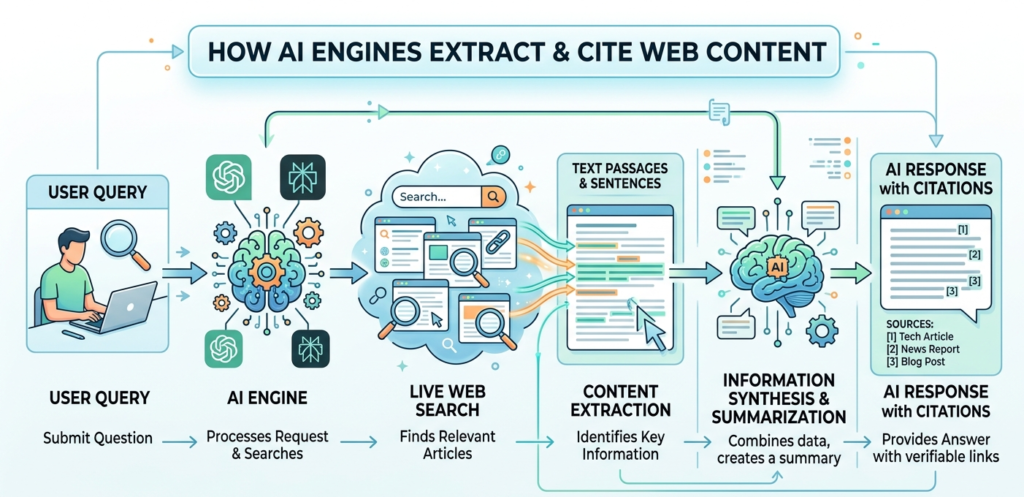
A visitor who asks ChatGPT which accountant to hire, which therapy approach to try or which marketing agency serves their city gets one generated answer. If your business or your content does not appear in that answer, you lose the inquiry before your website ever loads. That is the GEO problem. Most content creators optimise for Google clicks and ignore AI citations entirely. This guide explains what generative engine optimization actually requires, why it works differently from traditional SEO and how to start applying it to pages you already have.
What Is Generative Engine Optimization and How Does It Work?
Generative engine optimization is the practice of writing and structuring content so that AI language models extract it, trust it and cite it in their generated responses. GEO does not rely on keyword density or backlink volume. Instead, it relies on content signals that AI models use to assess credibility: named sources, cited statistics, direct answers and structured formatting.
AI engines like ChatGPT, Perplexity and Google AI Overviews do not rank pages the way Google does. They read content, assess its reliability and pull the most citation-ready passages into their responses. Because of this, a well-structured page on a modest domain can outperform a poorly structured page on a high-authority domain in AI answers.
Why GEO and SEO are related but not identical
SEO optimises for ranking signals: backlinks, keyword relevance and technical site health. GEO optimises for citation signals: answer clarity, entity density and source credibility. Both matter in 2026, but they require different tactics. A page can rank on page one of Google and never appear in a single AI Overview. The reverse is also true: a page with moderate organic traffic can earn consistent AI citations if its structure fits what language models look for.
What Content Signals Make AI Engines Cite You?
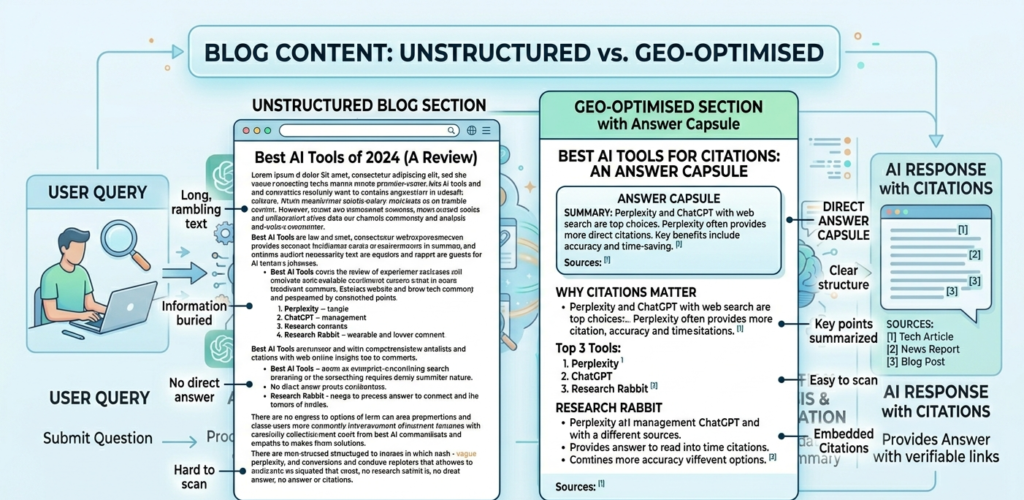
AI engines cite content that front-loads direct answers, names real entities and attributes claims to specific sources. According to Princeton’s 2025 research cited by Search Engine Journal, adding named sources and statistics to content lifts AI visibility by over 40 percent. Content that opens each section with a self-contained 40 to 60 word answer captures AI citations at a significantly higher rate.
The five signals that most reliably improve GEO performance are:
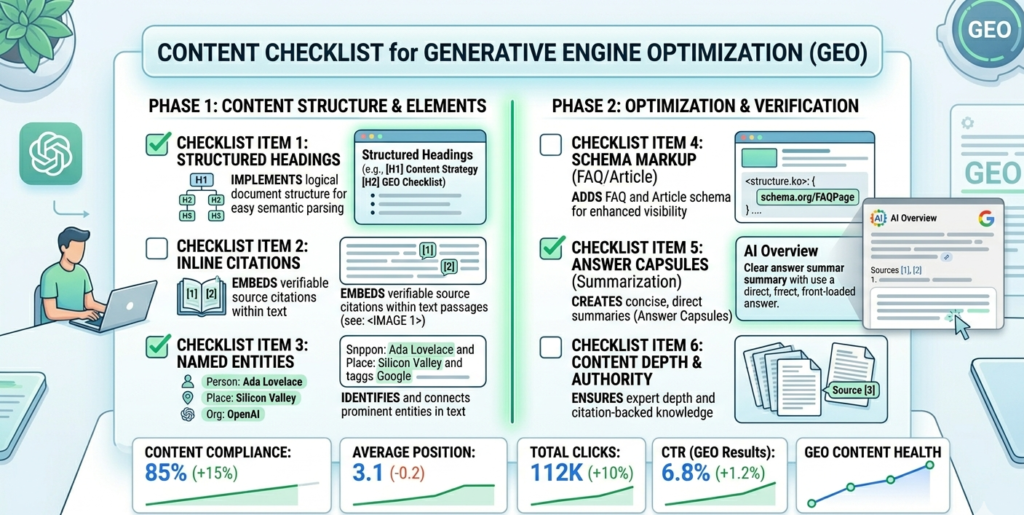
- Front-loaded answers: Put the direct answer in the first 60 words of each section, not at the end
- Named entities: Reference real tools, people, organisations and studies by name throughout
- Inline citations: Attribute every statistic to a named source with a year
- Structured formatting: Use H2 and H3 headings, bullet lists and data tables that AI can parse cleanly
- FAQ sections with schema markup: Direct question-and-answer blocks are among the most-cited content formats
ChatGPT pulls about 48 percent of its citations from Wikipedia-style structured sources, per the system prompt data in the AI search context Anthropic has documented. Perplexity pulls about 47 percent from community and editorial content. So the citation sources differ by platform, but the formatting principles overlap: clear, attributed, structured writing wins across all three.
How to Optimise for Google AI Overviews Specifically
Google AI Overviews pull from indexed web pages, so your GEO strategy for Google starts with content Google can crawl, parse and trust. Pages need proper structured data, fast load times and E-E-A-T signals including named authors, publication dates and cited sources.
According to Google’s own AI Overviews guidance, the system favours content that directly addresses the search query, uses clear language and attributes claims appropriately. That description matches the GEO principles above almost exactly.
What Google AI Overviews reward in practice
- An answer capsule in the first paragraph of each H2 section
- FAQ schema markup using Google’s structured data format for FAQ pages
- Specific numbers, dates and named sources rather than vague generalisations
- Clean heading hierarchy: H1 once, H2 for main sections, H3 for sub-topics
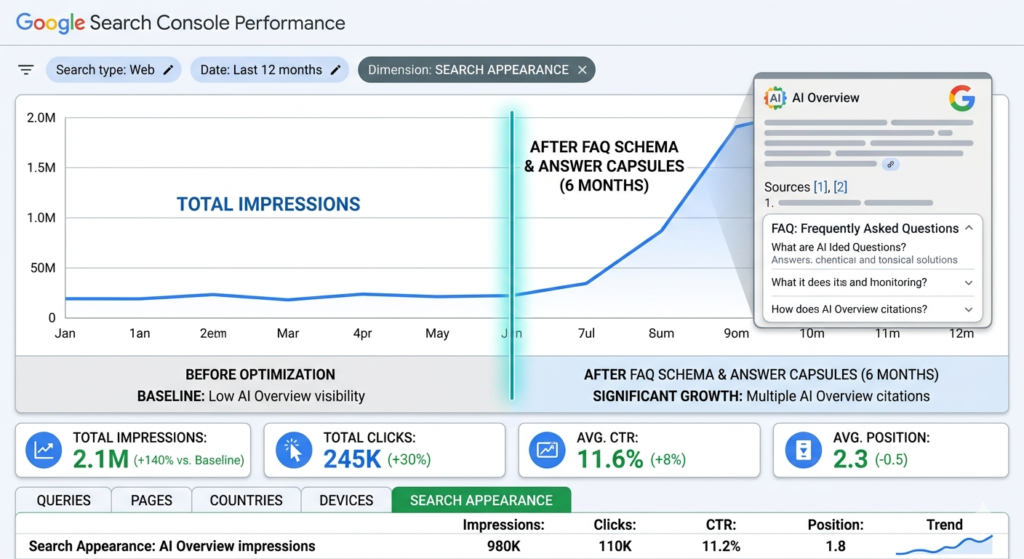
I apply this structure to every piece of content I produce, including work for Alpha Ahead and B2B clients through Juggernet Communications. The citation rate in AI Overviews for properly structured posts versus unstructured ones is not a subtle difference. It is visible within the first 30 to 60 days in Google Search Console impressions data.
Do Small Sites Actually Compete in AI Search?
Yes. Small and mid-size sites compete effectively in AI search when their content is more direct, more specific and better sourced than larger competitors. AI models do not apply domain authority the way Google’s PageRank system does. They assess the quality and parsability of individual passages.
This is the biggest practical opportunity GEO creates for independent publishers, freelancers and small business websites. A 1,200-word FAQ page on a three-year-old domain that answers a specific question with named sources and proper structure can earn AI citations that a 5,000-word generic guide on a high-authority domain does not.
| GEO signal | Small site advantage | Large site advantage |
| Front-loaded answers | Equal, depends on writing | Equal, depends on writing |
| Named entity density | Achievable with any content | Achievable with any content |
| Inline source citations | Equal | Equal |
| Domain trust for Google | Disadvantage | Advantage |
| Structured data markup | Equal | Equal |
| Community content (Perplexity) | Advantage if active | Neutral |
The table shows that most GEO signals sit within a small site’s reach. The one area where large sites hold an edge is domain trust for Google-specific AI Overviews. But even there, the gap narrows when small site content is structured correctly.
My blog covering AI search strategy goes deeper on entity optimisation and how topical authority affects citation rates for sites at different domain ages.
Do You Need an llms.txt File for GEO?
An llms.txt file is a proposed standard that tells AI crawlers which content on your site is available for training or citation. It is not yet a universal requirement. However, adding one signals to AI systems that your site actively supports machine-readable content access.
The more immediate GEO priority for most sites is not a technical file. It is content structure. A site without front-loaded answers, named entities and FAQ schema markup will not earn meaningful AI citations regardless of whether it has an llms.txt file. Fix the content first. Add the technical signal second.
You can see the full content structure approach I use for GEO-optimised posts on my SEO and GEO content services page.
Ready to Build Content That AI Engines Actually Cite?
Most websites already have the raw material for GEO. They just need it restructured: answers moved to the front of sections, sources named inline and FAQ schema added at the bottom of each page. If you want help applying that structure to your existing content or building new pages designed for both Google and AI visibility, take a look at my GEO and SEO content writing services or get in touch directly. One well-structured page often outperforms a dozen poorly formatted ones.
FAQs
Is generative engine optimization the same as SEO?
No. SEO targets Google’s ranking algorithm using signals like backlinks, keyword relevance and technical site health. Generative engine optimization targets AI language models using citation signals: direct answers, named entities, inline source attribution and structured formatting. Both matter in 2026, but they require different tactics. A page can rank well on Google and earn zero AI citations, or earn regular AI citations while sitting on page three of organic results.
Do I need an llms.txt file to do GEO?
Not as an immediate priority. The llms.txt standard is still in proposal stages and adoption is limited. The higher-impact GEO actions are content-side: front-load your answers, name your sources inline, use FAQ schema markup and structure your headings so AI models can parse individual sections cleanly. A site with excellent content structure will outperform a site with an llms.txt file but poorly organised content every time.
What types of content get cited most by AI engines?
Direct-answer content earns the most AI citations. That includes FAQ pages with schema markup, how-to guides with step-by-step structure, comparison pages with data tables and reference-style articles that name sources, tools and people throughout. According to Princeton’s 2025 research, content with named sources and statistics earns over 40 percent more AI visibility than unattributed content. ChatGPT specifically favours Wikipedia-style structured content, while Perplexity favours community and editorial sources.
How long does GEO take to work?
GEO changes become visible faster than traditional SEO. Google Search Console impressions for AI Overview appearances can shift within 30 to 60 days of restructuring a page to include answer capsules and FAQ schema. ChatGPT and Perplexity citation patterns are harder to track directly but tend to reflect content quality changes within one to three months. The fastest wins come from adding front-loaded answer paragraphs and FAQ schema to existing pages rather than creating new ones.
Can a small site compete with Wikipedia and Reddit for AI citations?
Yes, in specific niches and on specific queries. AI engines do not apply domain authority the same way Google’s PageRank system does. They assess passage quality. A focused, well-sourced answer on a modest domain can outperform a generic Wikipedia section or a scattered Reddit thread on the same topic. The key is specificity: a small site that answers one narrow question with direct, cited, structured content will earn citations that broad reference pages miss.