
Quick Answer-Topical authority is Google’s measure of how deeply and consistently a website covers a specific subject area. It is assessed at the domain level, not the page level, and it now outweighs raw backlink count for most ranking scenarios. To build it, you create a pillar-and-cluster content architecture: one in-depth page anchors each topic, supported by tightly interlinked posts covering every meaningful subtopic. Sites prioritizing topical authority over domain authority see ranking gains up to 3x faster, according to a SearchAtlas analysis of 400+ SEO campaigns (2026).
- Sites focusing on topical authority first see ranking gains up to 3x faster than those chasing domain authority, based on a SearchAtlas analysis of 400 or more SEO campaigns (SearchAtlas, 2026).
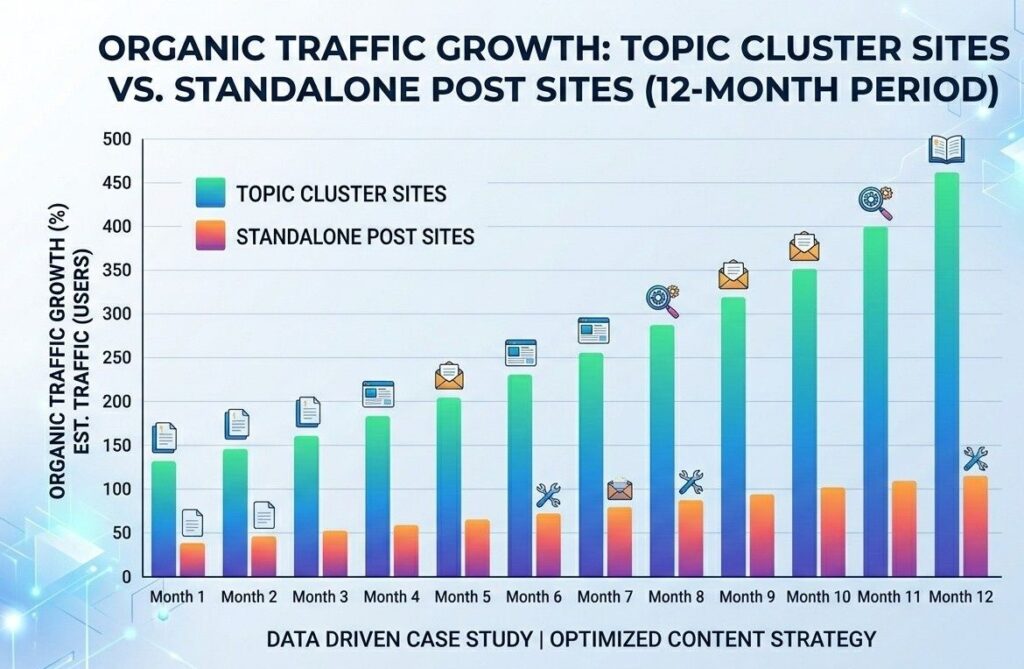
- Content grouped into topic clusters drives approximately 30% more organic traffic and holds rankings 2.5x longer than standalone posts not connected to a cluster structure (Whitehat SEO Ranking Analysis, 2026).
- 90.63% of all web pages receive zero organic traffic from Google, with a disproportionate share living on sites with adequate domain authority but thin, scattered content (Ahrefs, analysis of one billion-plus pages).
- Backlinks now account for approximately 13% of Google’s algorithm weight, down from 50% or more historically, while content quality and topical authority carry a greater relative share (First Page Sage Q1 2025 analysis).
- Google’s March 2026 core update caused nearly 80% of top-three positions to change rankings, with the biggest gains going to sites with deep topical focus and original first-hand expertise (SE Ranking via Search Engine Land, April 2026).
The sites growing organic traffic in 2026 are not necessarily the ones with the most backlinks. They are the ones that own a topic. Google’s shift from link-counting to semantic comprehension has been gradual, but the March 2026 core update made the practical implications clear: a site covering two topics deeply will consistently outperform a site covering ten topics shallowly, even when the broader site carries a higher domain rating. Running content strategy at Adnnel for clients across real estate, dental, restaurant and SaaS verticals has shown us the same pattern in every market: the sites that compound traffic year-over-year are the ones built around topical clusters, not keyword hit lists. Wajahat Amin covers SEO strategy, topical authority and AI search optimization here. This post covers what topical authority actually means, why it has displaced domain authority as the more actionable signal for most sites and the exact architecture that builds it.
What Topical Authority Actually Means and Why Google Weights It
Topical authority is Google’s assessment of how deeply and reliably a domain covers a particular subject area. It differs from domain authority in a fundamental way: domain authority is a link-based metric that reflects the strength of a site’s backlink profile. Topical authority reflects how deeply a site covers a specific semantic territory and how coherently its pages relate to each other.
A site with DR 25 that publishes 80 tightly interconnected articles on a single subject will routinely outrank a DR 55 general publication that covers the same subject in one or two posts, even when the larger site has far more inbound links. Google does not rank domains. Google ranks pages, and it evaluates those pages in the context of the surrounding content ecosystem on the site.
According to Ahrefs’ analysis of over one billion pages, 90.63% of all web pages get zero organic traffic from Google. The researchers noted that a disproportionate share of those dead pages exist on sites with reasonable domain authority but thin, scattered content that covers too many subjects with insufficient depth. That is topical authority failure, not link failure.
The distinction matters for strategy because the two problems have different solutions. Chasing domain authority means investing in link acquisition: outreach, PR, digital partnerships. Building topical authority means investing in content architecture: clustering, internal linking and depth of coverage. In 2026, the second investment compounds faster for most sites.
How the March 2026 Core Update Changed Topical Authority Signals
Google’s March 2026 core update was the most volatile named update in recent years. According to analysis by SE Ranking, shared with Search Engine Land, nearly 80% of URLs in the top three positions changed rankings during the rollout. Around 24% of pages that had ranked in the top 10 dropped entirely out of the top 100. The SEMrush Sensor peaked at 9.5 out of 10, among the highest volatility readings on record.
Three specific signals drove the most visible outcomes.
Information originality. The update re-weighted a signal researchers call Information Gain: a measure of how much genuinely new knowledge a piece of content adds relative to everything that already ranks for the same query. A post that restates what five competing pages already say offers no information gain. Google now actively deprioritizes it. A post that adds a framework, a real client result, a direct comparison not found elsewhere or a mechanism explanation that competitors gloss over offers information gain. Google rewards it.
Author expertise across platforms. The update strengthened Google’s ability to verify whether the person behind a piece of content has a demonstrable track record in the subject. Author pages with confirmed credentials, bylines that appear on recognized external publications and About pages with specifics outperformed anonymous or vaguely attributed content across every affected category.
Topical coherence at the domain level. A site covering ten unrelated topics shallowly is now assessed differently from one covering two topics deeply. A fractured topical identity suppresses domain-level authority even when individual pages are adequate. Sites that took a traffic hit in March 2026 almost universally shared one characteristic: a content archive that mixed unrelated topics without a clear subject focus.
The practical implication is that publishing on a topic you do not own through existing cluster content is now a higher-risk move. A single strong post on a subject your site has never touched before carries less weight in 2026 than the same post published on a site with 20 interlinked pieces in the same cluster.
The Pillar-and-Cluster Architecture That Builds Topical Authority
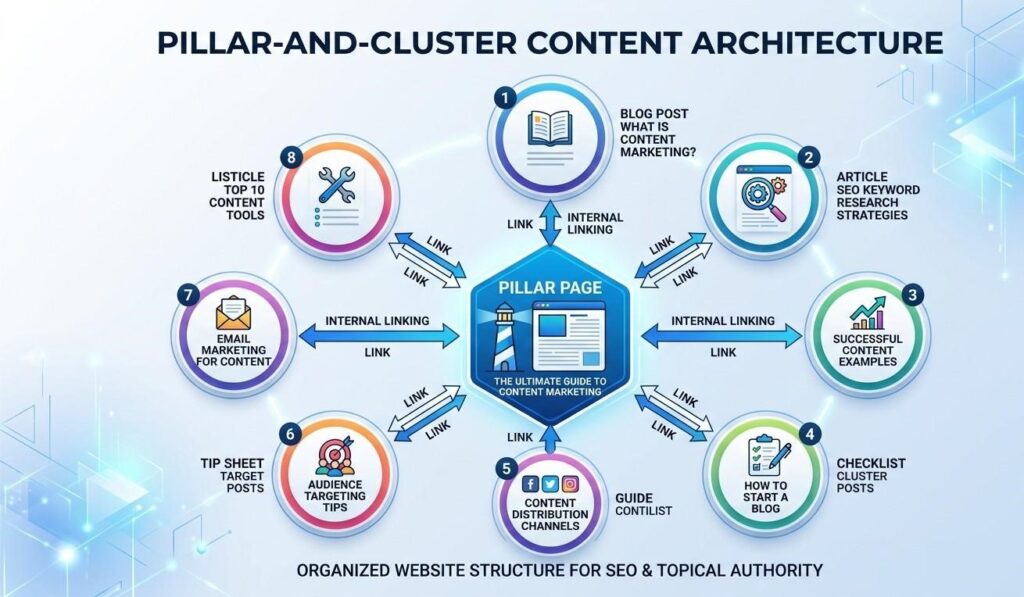
The pillar-and-cluster model is the most direct structural mechanism for building topical authority. Understanding it at a conceptual level is table stakes at this point. The details that most guides skip are the implementation specifics that determine whether the structure actually compounds.
How a Pillar Page Actually Functions
A pillar page covers a broad head term in enough depth to anchor the entire cluster. It links out to every cluster page, receives links back from every cluster page and serves as the canonical authority on the subject. Thin pillar pages undermine the entire cluster’s authority signal because they send a contradictory message: a pillar that does not cover its topic in depth tells Google the site does not own that topic.
Pillar pages typically run 3,000 to 5,000 words. The length is not the goal. The coverage is. A pillar page should answer the main question, surface every meaningful subtopic, acknowledge competing perspectives where they exist and link to the cluster pages that go deeper on each subtopic. The internal linking pattern is bidirectional: pillar to cluster, cluster to pillar, with descriptive anchor text that includes the cluster’s target term.
How Cluster Pages Compound the Signal
Cluster pages cover single aspects of the pillar topic in depth. Each one captures a specific long-tail query that the pillar page cannot rank for without becoming unwieldy. Each one links back to the pillar and, where genuinely relevant, to adjacent cluster pages within the same topic.
The compounding happens because Google reads the entire cluster as a single entity rather than a collection of separate pages. A site with a pillar on “restaurant marketing” and 12 cluster pages covering Google Business Profile, online reviews, social media strategy, catering marketing, delivery platform optimization and seasonal campaign timing signals restaurant marketing authority more convincingly than a site with 12 standalone posts on the same subjects that do not reference each other.
At Adnnel, the real estate marketing and SEO team rebuilt the content architecture for a client in Toronto in late 2025, converting 22 standalone blog posts into a structured cluster around three pillar topics. Within six months, organic sessions from the real estate marketing cluster increased 41% without any new posts being published. The posts already existed. The structure did not.
Topical Authority vs Domain Authority: The Practical Difference for Strategy
Most guides treat topical authority and domain authority as competing philosophies. They are not. They are different inputs that serve different functions in a ranking system.
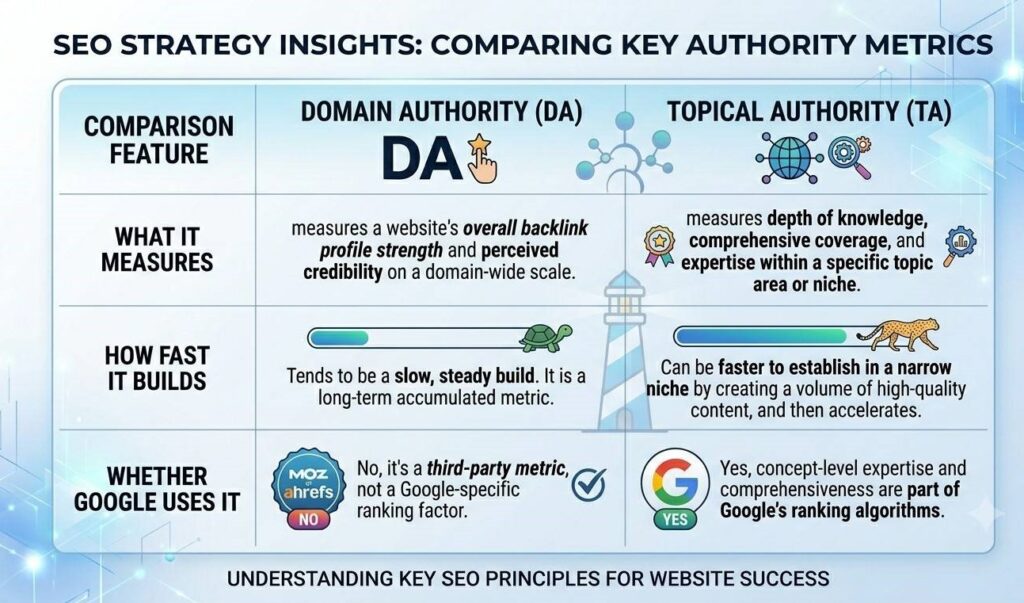
| Signal | What it measures | Who builds it | How fast | Google metric? |
| Domain Authority (Moz DA) | Third-party proxy for backlink strength | Link acquisition | Slow, months to years | No |
| Domain Rating (Ahrefs DR) | Backlink profile strength on Ahrefs scale | Link acquisition | Slow, months to years | No |
| Topical Authority | Depth and coherence of subject coverage | Content architecture | Measurable in 90 days | Referenced in Quality Rater Guidelines |
| PageRank (internal signal) | Link equity flowing between pages | Internal linking | Fast, days to weeks | Yes |
Google does not use DA or DR. Domain Authority was created by Moz in 2010. Domain Rating was created by Ahrefs. These are useful proxies, but Google’s ranking systems use PageRank, E-E-A-T signals and content quality assessments that no third-party tool measures directly.
The strategic implication: a focused site with DR 25 can outrank a general publication with DR 60 on any keyword within that site’s topical territory. That is not theory. It is the mechanism behind every niche site that has ever punched above its weight class in search. Backlinko’s large-scale ranking factor study found that pages ranking first have 3.8x more backlinks than pages in positions two through ten, but that pattern holds most strongly on commercially competitive head terms. For the long-tail and mid-tier queries that generate the majority of organic traffic on most sites, topical depth routinely outperforms backlink quantity.
The practical recommendation for 2026: build your topical cluster first, then amplify with contextually relevant backlinks once the cluster architecture is in place. Sites that reverse this order are acquiring links for pages that sit in a weak topical context, which limits how much authority those links can transfer.
The Content Gap Audit: Where Topical Authority Actually Gets Built
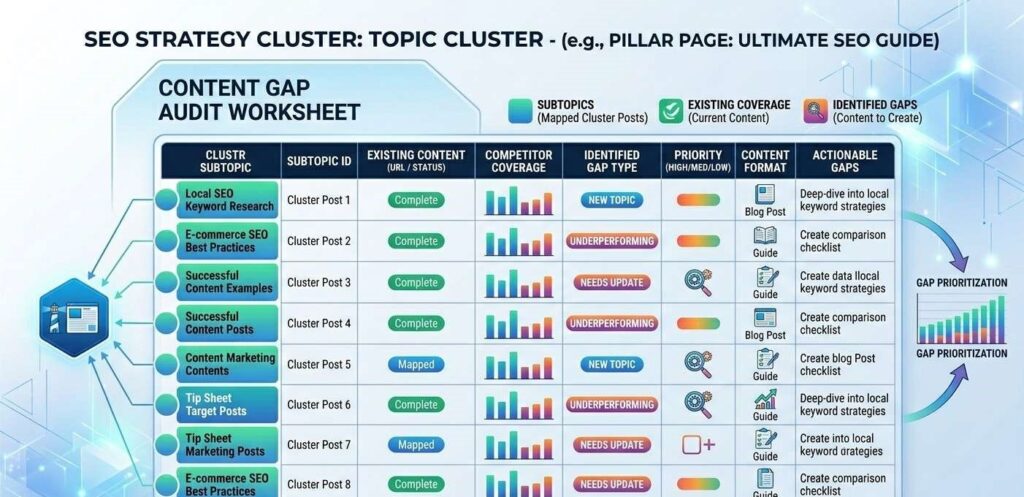
The most underused tool in topical authority strategy is the content gap audit. Most teams think about topical authority as a matter of quantity: publish more. The teams that build authority fastest think about it as a matter of coverage: identify what is missing from the cluster and fill it.
A content gap audit maps your existing posts against the full semantic territory of your pillar topic. The goal is to find the subtopics your cluster does not cover that a reader on your pillar page might naturally want to explore. Those gaps are both ranking opportunities and authority weaknesses.
The audit runs in three steps. First, map every existing piece of content in the cluster against the subtopics it covers. Second, compare your coverage against the top-ranking sites for your pillar term using a tool like Ahrefs Content Gap or Semrush Topic Research. Third, prioritize the gaps by search intent: informational gaps that catch patients or customers in research mode are typically higher priority than navigational gaps.
Google’s guidance on creating helpful content reinforces this directly: the Helpful Content system rewards sites that demonstrate first-hand expertise and thorough subject coverage. Content gaps signal to both Google and readers that the site does not fully own the topic. The post on what generative engine optimization means for content strategy covers the AI citation side of this same coverage principle.
For most sites, a 12-month cluster-building plan that fills three to five coverage gaps per month compounds more reliably than publishing new posts on unrelated topics. The authority signal strengthens with each addition to the cluster, not each addition to the site.
How Topical Authority Connects to AI Search Visibility
Topical authority and GEO (Generative Engine Optimization) are not separate strategies. They share the same content foundation. Google AI Overviews, ChatGPT and Perplexity all cite sources that demonstrate deep, coherent subject expertise. A site with strong topical authority in a defined area is more likely to get cited across that area than a site with scattered, disconnected coverage.
According to research compiled by Launchcodex (March 2026), brands cited in Google AI Overviews earn 35% more organic clicks and 91% more paid clicks than competitors not cited on the same queries. That citation advantage compounds as topical authority builds. The mechanism is the same: AI systems learn which sources reliably cover a subject and return to them. A site that owns a topic in Google’s assessment also tends to own it in the citation layer.
This is the reason building topical authority before optimizing for AI citations is the correct sequencing. A site without topical authority can apply all the GEO tactics and see modest gains. A site with strong topical authority that also applies GEO structure to its cluster content gets both the ranking signal and the citation signal from the same pages.
The full breakdown of GEO for small businesses covers how topical authority feeds AI citation visibility in detail. And the comparison of SEO, AEO and GEO as distinct but connected disciplines explains how they interact in a 2026 content strategy.
Ready to Build a Topical Authority Strategy That Compounds?
Topical authority is not a tactic. It is a structural commitment to owning a subject area that pays off in ranking stability, AI citations and compounding organic growth over time. If your content archive is a mix of disconnected posts chasing individual keywords, the architecture work is the highest-return investment you can make before publishing another word.
Adnnel’s SEO, GEO and AEO services include topical cluster strategy, content gap auditing and the internal link architecture work that turns a publishing calendar into a compounding authority asset. To talk through what a cluster-first strategy looks like for your specific market, the contact page is the direct route.
Frequently Asked Questions
What is topical authority in SEO and how is it different from domain authority?
Topical authority measures how deeply and thoroughly a website covers a specific subject area. Domain authority is a third-party metric that approximates backlink profile strength. Google does not use domain authority as a ranking signal. It does reference topical authority through E-E-A-T evaluation and semantic clustering signals. A site with lower domain authority but deep, coherent coverage of a niche will outrank a high-domain-authority site covering the same topic with thin or scattered content.
How long does it take to build topical authority?
Measurable topical authority gains typically appear within 60 to 90 days for a well-structured cluster in a low-to-medium competition niche. More competitive subject areas take six to twelve months of consistent publishing before cluster-level ranking gains become clear. The compounding is real but non-linear: the first five or six posts in a cluster produce modest gains, and pages eight through twenty produce disproportionately larger ranking improvements as Google’s systems recognize the depth of coverage.
How many posts do I need in a content cluster to build topical authority?
Research and practitioner analysis suggest that 25 to 30 high-quality, interlinked articles within a single cluster establish measurable topical authority for most competitive subjects, per SearchAtlas’s 2026 analysis of SEO campaign data. Narrower niches may require fewer. Highly competitive head terms with extensive SERP coverage may require more. The threshold is not a fixed number. It is the point at which your cluster covers the subject more completely than the current top-ranking competitors.
Can a new website with no backlinks build topical authority?
Yes. Topical authority is buildable without a prior backlink profile. A structured cluster campaign focused on a narrow subject area can produce measurable ranking gains within a quarter on low-to-medium competition queries. Backlinks accelerate and reinforce topical authority signals but are not required to begin building them. For new sites, publishing tightly interconnected cluster content from the start is the fastest path to initial organic visibility because it signals subject focus from the first crawl.
What did the March 2026 Google core update change about topical authority?
The March 2026 update reinforced three signals: information originality (how much new knowledge a post adds versus what already ranks), author expertise (whether the person behind the content has a verifiable track record), and topical coherence at the domain level (whether the site’s overall content reflects a focused subject area rather than scattered coverage). Sites with fractured topical identity, even with adequate individual page quality, saw domain-level suppression. The update made topical coherence a site-wide signal, not a page-level one.