
Quick Answer
A full-service marketing agency gives you a coordinated team covering strategy, content, SEO, paid media and analytics under one contract. A freelancer gives you a specialist for one function at a lower nominal rate. For growing brands running more than two channels simultaneously, agencies typically deliver better results because cross-channel coordination is built into the model. Freelancers make sense for defined, single-discipline projects. According to an AdWeek 2025 survey of 600 in-house marketing leaders, 68% of mid-market brands now run a hybrid: an agency for the strategic core and freelancers for specialized project work.
- 68% of mid-market brands run a hybrid model combining an agency for ongoing strategy and freelancers for specialized project work, up from 41% in 2021 (AdWeek survey of 600 in-house marketing leaders, cited by Practiq, 2026).
- 88% of SMBs that increased marketing spend in 2025 saw stable or improved sales and revenue, confirming that structured marketing investment produces measurable returns regardless of model (Taradel, 2025).
- 73% of SMBs are not confident their current marketing strategy is working, with ROI measurement, lead generation and budget constraints cited as the top three pain points (Constant Contact, 2024).
- Website, blog and SEO is the number one ROI-generating channel for B2B brands, with 49% of marketers ranking organic search as delivering the best return of any channel (HubSpot State of Marketing, 2026).
- Senior freelance copywriters charge $90 to $175 per hour in 2026, and mid-level designers $65 to $110 per hour. Once management overhead and replacement risk are factored in, these rates often rival a structured agency retainer (Practiq, 2026).
The decision between a full-service agency and a freelancer looks simple on paper. One costs more per month. One costs less. The problem is that paper math almost never matches the actual outcome. Building marketing teams and running campaigns at Adnnel for realtors, restaurants and growing brands across the US and Canada has shown us a consistent pattern: brands that choose the freelancer route for cost reasons spend the first three months building a coordinator role they did not budget for. Wajahat Amin writes about marketing strategy, agency structure and growth channel decisions for brand owners navigating exactly this decision. The work that is actually delivered well is rarely the channel that needed the most attention. This post gives you the honest comparison so you can make the decision on actual criteria, not sticker price.
The Real Cost Difference Between Agencies and Freelancers
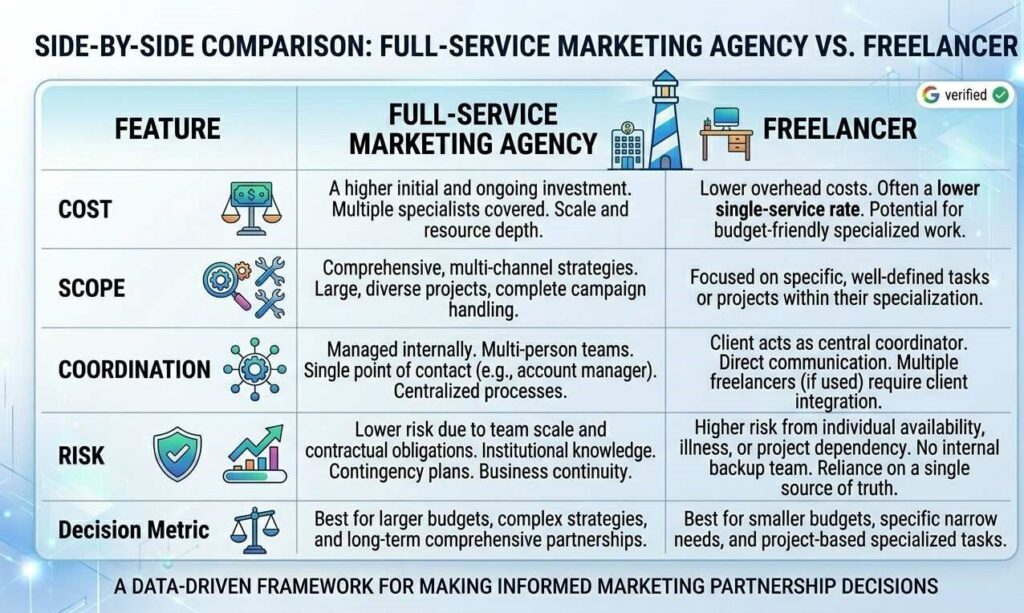
The nominal cost of a freelancer is lower than the nominal cost of an agency. That is true and worth acknowledging directly. Senior freelance copywriters charge $90 to $175 per hour in 2026. Mid-level designers run $65 to $110 per hour. A full-service agency retainer for an SMB typically starts at $3,000 to $5,000 per month, according to pricing benchmarks compiled by InfluenceFlow (2026), with mid-market retainers running $8,000 to $15,000.
The comparison breaks down when you count what is not in a freelancer’s invoice.
Management overhead. When you hire three specialized freelancers to cover SEO, social and paid media, someone has to brief them, review their work, coordinate timelines and resolve the inevitable gaps between what one produces and what another needs to work with. That coordination function costs somewhere between 5 and 15 hours per month of your own time or a team member’s time, billed at whatever your time is actually worth.
Replacement risk. Freelancers get sick, overloaded or simply leave for a better project. A VA Masters 2026 analysis found a 30% bad-hire rate on freelance platforms, with average replacement cycles consuming 20 hours of screening time and 40 hours of onboarding per hire. When a freelancer disappears mid-campaign, the replacement cost frequently exceeds the savings from choosing them over an agency in the first place.
Tool stack costs. Full-service agencies absorb the cost of SEO platforms, reporting tools, social scheduling software and analytics infrastructure into the retainer. Freelancers typically do not. If you need Ahrefs, Semrush and a social scheduling platform to properly run four channels, that tooling adds $500 to $1,200 per month before any actual work is delivered.
The total cost of engagement, not the hourly rate, is the number that matters for brand decision-making.
What a Full-Service Agency Actually Gives You
A full-service marketing agency provides a coordinated team with specialists across multiple disciplines who communicate internally, share data and build campaigns that reinforce each other across channels. The critical word is coordinated. A blog post that feeds social content that feeds a Google Ads landing page that feeds an email nurture sequence produces results that none of those channels produce in isolation.
According to HubSpot’s State of Marketing 2026, website, blog and SEO is the top ROI-generating channel for B2B brands, with 49% of marketers naming organic search as delivering the best return of any single channel. But that organic performance compounds when it connects to a paid strategy that captures the same audiences who engaged with content. That connection requires a team that sees both channels simultaneously.
The other thing a full-service agency provides is strategic accountability. When a freelancer delivers a piece of work and it does not convert, the question of why is genuinely ambiguous. Was the content wrong? Was the targeting wrong? Was the landing page wrong? Was the offer wrong? A freelancer who handled only one of those elements cannot answer for the others. An agency that owns the full funnel can.

What Freelancers Are Actually Good At
Freelancers are not the wrong answer. They are the wrong answer for specific problems.
A freelancer makes sense when you have a clearly scoped, single-discipline project with a defined deliverable and timeline: a website audit, a content brief, a one-off paid media audit, a brand identity refresh. The scope is contained. The deliverable is clear. The management overhead is low. No cross-channel coordination is required.
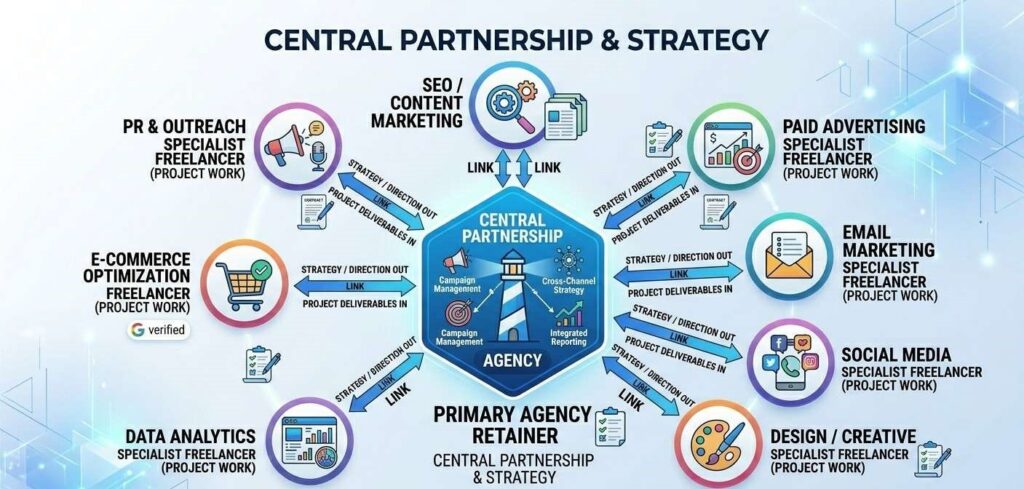
Freelancers also make sense as specialists within a larger agency relationship. The most common structure among growing mid-market brands in 2026 is a primary agency retainer handling strategy, content and core channel management, with individual freelancers engaged for specific project work that sits outside the retainer scope: motion graphics, technical development, industry-specific copywriting. According to an AdWeek 2025 survey of 600 in-house marketing leaders cited by Practiq, 68% of mid-market brands now use this hybrid structure, up from 41% in 2021.
The structure that does not work well is three or four freelancers operating in parallel, each responsible for a different channel, with no shared strategy layer connecting them. That is an in-house marketing team without the management infrastructure of an in-house marketing team.
How to Choose: A Decision Framework
The choice between an agency and a freelancer depends on four variables. Assess each one honestly before deciding.
| Variable | Hire a Freelancer | Hire a Full-Service Agency |
| Project scope | Defined, single discipline | Multi-channel or ongoing |
| Internal bandwidth | You have time to coordinate | You need execution, not management |
| Growth stage | Early-stage, one channel at a time | Active growth, multiple channels |
| Budget maturity | Under $2,000/month total | $3,000+ per month, ROI expected |
| Risk tolerance | Higher, single point of failure | Lower, team continuity built in |
The brands that get the most out of freelancers share one characteristic: they have a senior internal marketing person who can brief, review and integrate freelance work into a coherent strategy. Without that person, the freelancer’s output sits in isolation and the coordination cost falls on a founder or operations lead who has better things to do.
The brands that get the most out of full-service agencies have accepted that the first 60 to 90 days of any agency engagement is a ramp period. Strategy, messaging, channel setup and reporting infrastructure take time to build correctly. Agencies that deliver strong results in month one are usually recycling a previous client’s playbook. The ones that deliver strong results in month four built something that actually fits.
Running digital marketing through Adnnel’s full-service agency model across real estate, restaurant and service business clients, we have seen the same pattern repeat across markets: brands that switch from a patchwork of freelancers to a structured agency relationship typically see measurable improvement in channel coherence within 60 days, not because the freelancers were bad at their individual functions but because the strategy layer finally existed.
The AI Factor in 2026: How It Changes the Equation
AI tools have changed the economics of marketing production in a way that benefits agency models more than it benefits individual freelancers, though the narrative often runs in the opposite direction.
The argument that AI makes freelancers cheaper is true for low-complexity production work: a freelancer using AI tools to produce first drafts at higher volume charges less per word. The argument breaks down on strategy, targeting, analytics interpretation and cross-channel sequencing. Those functions require judgment across multiple data sources simultaneously, and that judgment is what a coordinated agency team provides.
AI also introduces a quality verification problem in the freelancer market. Multiple marketers in 2025 and 2026 reported spending significant time filtering spam applications, AI-generated proposals and inflated portfolios when sourcing through freelance platforms. The vetting cost has increased in proportion to the volume of low-quality applications that AI tools have made trivially easy to produce.
For growing brands, the practical implication is that the agency premium buys verified expertise and accountability, two things that AI tools have made harder, not easier, to confirm in the freelancer market.
What This Means for Realtors, Restaurants and Service Brands
The brands most often caught in the agency-vs-freelancer loop are the ones growing past DIY marketing but not yet at the revenue level where a full-time in-house hire makes sense. A realtor scaling from 10 to 30 transactions per year. A restaurant expanding to a second location. A service brand entering a new geographic market.
For these brands, the math typically favors a focused agency relationship over a freelancer assembly. The volume of marketing activity required to support that growth phase exceeds what one freelancer can handle, and managing three freelancers at that stage creates an operational burden that slows the growth it was supposed to support.
The post on topical authority and content cluster strategy for growing brands covers one of the specific areas where agency coordination pays off most: building a content infrastructure that compounds traffic over 12 to 18 months rather than generating isolated one-off posts. And the GEO guide for small businesses covers how AI search visibility, now a critical acquisition channel, requires the same cross-channel consistency that agencies are structured to deliver.
Want to See How a Full-Service Agency Actually Works?
The comparison above is honest: agencies cost more upfront. The brands that choose them do so because the math on total engagement cost, cross-channel performance and strategic accountability consistently favors the structured model for multi-channel growth.
Adnnel is a full-service digital marketing agency serving realtors, restaurants and growing brands across the US and Canada. See how Adnnel works and what a structured agency engagement looks like for your specific growth stage. For a direct conversation about whether your current marketing setup fits where you are trying to go, the contact page is the right starting point.
Frequently Asked Questions
Is a full-service marketing agency worth the cost for a small business?
It depends on how many channels the business runs simultaneously and whether an internal person can manage freelancer coordination. For businesses running two or more marketing channels, an agency’s built-in coordination typically makes the total engagement cost comparable to a freelancer arrangement once management overhead and tool costs are added. The agency premium buys coordination, continuity and cross-channel accountability that a freelancer model requires you to supply yourself.
What do full-service marketing agencies actually include?
A full-service agency covers strategy, content creation, SEO, paid search, paid social, email marketing, analytics and reporting under a single retainer. The specific channels included vary by retainer tier and agency specialty. The key distinction from a specialist freelancer is that a full-service agency connects those channels to each other: the content strategy informs the SEO approach, which informs the paid targeting, which feeds back into content decisions based on what converts.
Can you use both an agency and freelancers at the same time?
Yes, and 68% of mid-market brands do exactly this, according to an AdWeek 2025 survey of 600 in-house marketing leaders. The most effective structure uses an agency for the strategic core, ongoing content and primary channel management, then engages specialist freelancers for project work outside the retainer scope: motion graphics, technical audits, industry-specific content. The key is that the agency owns the strategic layer. Freelancers operate within it, not parallel to it.
What are the risks of using only freelancers for marketing?
The primary risks are single-point-of-failure reliability, lack of cross-channel coordination and hidden management costs. When a key freelancer goes unavailable mid-campaign, replacement disrupts momentum. Without a shared strategy layer, multiple freelancers covering different channels produce disconnected work that does not reinforce each other. And the coordination function, briefing, reviewing and integrating freelance output, falls on the business owner or an internal person whose time carries real cost.
How do you measure ROI from a full-service marketing agency?
Track revenue attribution by channel using UTM parameters and a CRM that connects marketing activity to closed revenue. At minimum, track cost per lead by channel, lead-to-close rate and customer acquisition cost against customer lifetime value. The comparison of SEO, GEO and AEO as separate but connected disciplines covers how organic, AI search and paid channels each contribute to the attribution picture in 2026 and how to read them together.