
Keys Takeaway: A B2B content marketing strategy that converts buyers in 2026 focuses on depth over volume, trust over lead capture and topical authority over keyword frequency. According to the Content Marketing Institute’s 2026 annual B2B survey, 46% of B2B content marketers lack a documented strategy, which correlates with 37% lower ROI. According to Searchlab’s 2026 B2B marketing statistics report, thought leadership content influences 65% of B2B purchase decisions, particularly among C-level executives. Content marketing also generates over three times as many leads as traditional outbound marketing at 62% lower cost, according to Demand Metric data cited by MSMC’s 2024 B2B content statistics. The format, tone and distribution channel you choose matter more than publishing frequency.

Most B2B content fails for the same reason: it reads like a company talking about itself. The product overview dressed as a guide. The case study that spends four paragraphs explaining the company’s founding story before mentioning the client result. The blog post that answers no real question because it was written to rank for a vanity keyword rather than help an actual buyer. A serious B2B content marketing strategy starts from the buyer’s actual problem, not the seller’s preferred talking points. This post covers the format decisions, topic approaches and tone shifts that separate content that generates pipeline from content that generates PDF downloads no one reads twice.
Why Most B2B Content Feels Like a Sales Deck and Loses Buyers Because of It
B2B content reads like a sales deck when it leads with product features, company credentials or unsupported claims about industry leadership instead of addressing a specific buyer problem with specific evidence. Buyers who encounter this pattern leave quickly because they came to learn or compare, not to read a brochure that’s been formatted to look like a guide.
According to CMI’s 2026 B2B research survey of 1,229 global respondents, 96% of B2B organizations publish thought leadership content. But only 37% say minimal employee participation, meaning fewer than 5% of staff with actual specialized knowledge are involved. The result is content teams trying to sound authoritative about topics they don’t fully understand, which produces the bloated, vague output that B2B buyers have learned to skim past.
The fix isn’t more content. It’s content built from genuine internal expertise and structured around the questions your buyers actually search. According to SeoProfy’s 2026 B2B marketing statistics, 79% of top-performing B2B content marketers attribute their success to knowing their audience. That’s not a soft principle. It’s the explanation for why some companies produce 12 posts a year that drive meaningful pipeline and others publish 200 that collect dust.
What B2B Content Formats Actually Convert in 2026?
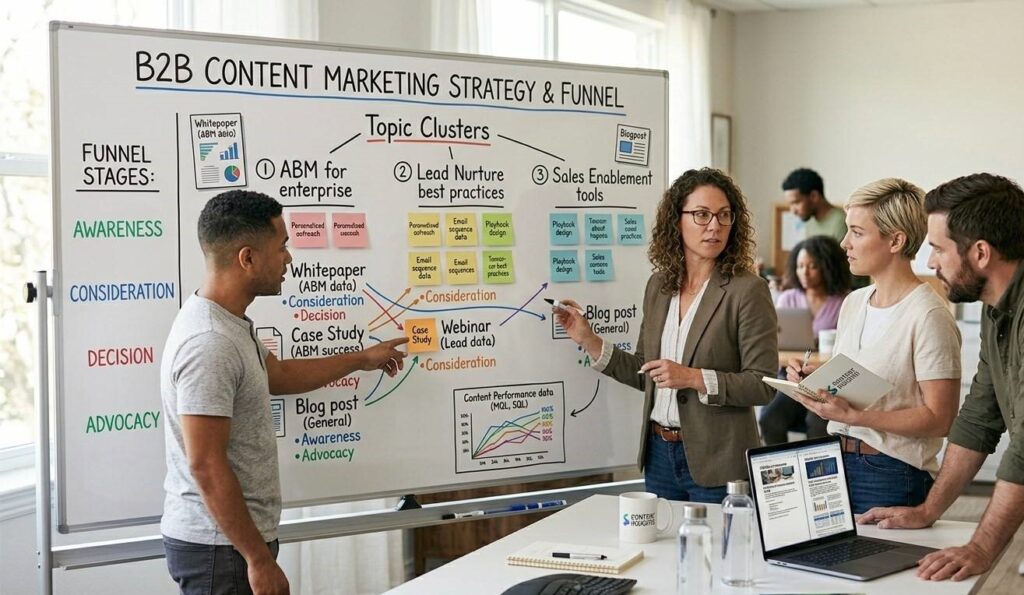
The B2B formats that convert in 2026 are: case studies with specific results, comparison guides written for buyers already evaluating options, original research reports with proprietary data and SEO-optimized long-form posts targeting decision-stage keywords. Blog posts above 2,000 words generate three times more traffic, four times more shares and 3.5 times more backlinks than shorter posts, according to Searchlab’s 2026 data citing HubSpot.
Awareness-Stage Content That Earns Organic Reach
At the top of the funnel, original research is the only content type that reliably earns organic reach in 2026. According to Scalarly’s 2026 B2B lead generation playbook, the winners have “shifted from volume to depth, from gated to ungated, and from content as lead capture to content as trust building.” Repackaged public data earns nothing. But a survey of 200 clients with anonymized proprietary findings, published as a full report without a gate, earns links and drives branded searches for months.
Short-form thought leadership on LinkedIn supplements this. Fifty-seven percent of B2B marketers say thought leadership content is among their top channels, according to SeoProfy’s 2026 research. But LinkedIn posts drive awareness for people who already follow you. Original research earns awareness from people who have never heard of your brand because it appears in search results and earns citations.
Consideration-Stage Content That Moves Buyers Toward a Decision
Buyers in the consideration stage are actively comparing options. Comparison guides, implementation playbooks and technical deep-dives serve them specifically. These formats work because they match the buyer’s actual mental state: they’ve moved past “should I solve this problem?” and into “who should I solve it with?”
A comparison guide that honestly addresses competitor strengths alongside your own is more persuasive than one that makes only favorable comparisons. Buyers who feel a guide is hiding something don’t convert. Buyers who find a guide that gives them a fair framework use it to justify their internal recommendation, which in B2B is usually the actual decision-making moment. The content brief process that structures every brief before writing begins defines the buyer stage before anything else so the format matches the intent from the first draft.

Should B2B Companies Still Gate Their eBooks and White Papers?
Gate original research with a clear value differential and ungate everything else. A gated guide that contains information available elsewhere generates resentment, not leads. A gated original research report with proprietary data and methodology the reader can’t access any other way earns email addresses from the right buyers. The distinction is value, not format.
According to Scalarly’s 2026 playbook, the paradox of B2B content in 2026 is that the less aggressively you try to capture leads, the more leads your content generates. Ungated content builds search visibility, earns backlinks and generates inbound inquiries from buyers who arrived without being forced through a form. Gated content stops that distribution entirely.
The approach that works: publish the full report or guide ungated, then offer supplementary analysis, an implementation template or a recorded walkthrough behind an optional email signup. That structure gives motivated buyers a reason to identify themselves without blocking everyone else from the core content. The generative engine optimization guide I reference for content teams follows this model: the full framework is publicly accessible because public access is what drives citations and organic reach.
How Long Should B2B Blog Posts Be and How Often Should You Publish?
B2B blog posts targeting competitive keywords should exceed 2,000 words and aim for 2,500 to 3,000 words when the topic genuinely demands depth. Publish consistently at a pace your team can maintain with high quality, which for most B2B companies is two to four posts per month. Volume without quality degrades topical authority rather than building it.
The “how often” question trips up most B2B content teams because they confuse frequency with performance. Publishing 20 mediocre posts per month produces less pipeline than four deeply researched posts that each target a specific decision-stage keyword, include original insights and earn inbound links over time. The semantic content cluster approach makes each post more effective because it contributes to a topical authority signal rather than sitting as an isolated URL with no structural connection to related pages.
The content I produce for B2B clients through my SEO content writing services treats every post as part of a cluster: pillar pages cover the main topic, supporting posts cover specific buyer questions within it and internal links carry authority between them. That structure compounds search performance rather than starting from zero with each new URL.
Does AI-Generated B2B Content Work or Kill Pipeline?
Unedited AI-generated B2B content consistently underperforms human-researched content because it produces authoritative-sounding text without the specificity, original insight or genuine domain knowledge that B2B buyers expect. It also triggers a recognizably generic tone that experienced buyers in technical or professional fields spot immediately.
AI tools work well as drafting and structuring aids when a subject matter expert reviews, adds proprietary data and rewrites the generic passages. They fail when they replace research and expertise entirely. According to CMI’s 2026 B2B research, the content programs with the highest ROI have senior leadership involvement, documented strategy and measurement systems tied to pipeline. None of those require AI restriction. But all of them require editorial judgment that AI alone doesn’t provide.
The brands winning B2B content in 2026 use AI to speed up distribution logistics and draft outlines, then invest human expertise in the sections that carry actual insight. That combination produces content that ranks, builds trust and contributes to pipeline over a 12-month window. Volume-only AI programs produce short-term impressions and long-term authority damage because buyers stop trusting the source.
Ready to Build B2B Content That Earns Trust Instead of Just Traffic?
The gap between B2B content that sounds good and B2B content that generates pipeline usually comes down to one thing: whether the strategy started from your buyer’s actual questions or your product’s talking points. If you want content built the right way, start the conversation through my contact page and share your industry, your buyer type and what your current content actually covers. We’ll figure out where the real opportunities are.
Frequently Asked Questions
Should B2B companies still gate their eBooks in 2026?
Gate original research with genuine proprietary value and ungate everything else. A guide that covers information available elsewhere generates email addresses from people who feel tricked, not qualified leads. An original research report with your own survey data, published free with an optional email signup for supplementary analysis, earns organic traffic, backlinks and self-identified leads from high-intent buyers. According to Scalarly’s 2026 B2B lead generation playbook, the shift from gated to ungated content correlates directly with stronger pipeline contribution because ungated content distributes and compounds while gated content stops at the form.
How long should a B2B blog post be to rank and convert?
Posts targeting competitive B2B keywords should run 2,000 to 3,000 words when the topic genuinely supports that depth. According to Searchlab’s 2026 data, blog posts above 2,000 words generate three times more traffic, four times more shares and 3.5 times more backlinks than shorter posts. But length is a byproduct of depth, not a target in itself. A 3,000-word post that repeats the same point across different headings performs worse than a focused 1,600-word post that directly answers every buyer question in that topic cluster.
What replaces white papers in a 2026 B2B content strategy?
Original research reports with proprietary data replace traditional white papers because they offer something a buyer cannot find anywhere else. A 40-page vendor-perspective white paper is harder to distribute and easier to ignore than a 12-page research report based on 200 client interviews with real benchmark data. The format also earns links and citations from industry publications in a way vendor white papers rarely do. If your team can commission or conduct genuine primary research, publish it with a clear methodology and make it the center of your awareness-stage content.
How often should a B2B company publish content to build authority?
Two to four posts per month at high quality consistently outperforms 15 to 20 posts per month at average quality. CMI’s 2026 research found that 46% of B2B content marketers lack a documented strategy, which correlates with 37% lower ROI. A documented, cluster-based strategy at lower publishing frequency produces more compounding search authority than high-frequency publishing with no internal linking structure or buyer-stage targeting. Set a pace your team can sustain with full editorial review, then maintain it for 12 consecutive months before evaluating whether to scale.
Does AI-generated B2B content work for lead generation?
AI-generated content without expert editorial review consistently underperforms in B2B because experienced buyers in technical fields recognize generic, authoritative-sounding text that lacks genuine domain knowledge or original insight. AI tools accelerate drafting and structuring but don’t replace the research, proprietary data and subject matter expertise that makes B2B content credible. The content programs with the highest ROI in CMI’s 2026 B2B research share three traits: senior leadership involvement, documented strategy and measurement tied to pipeline, none of which AI replaces.