
Keys Takeaway: Wedding photographer SEO gets you found when couples search for a photographer in your city before they ask anyone for a referral. According to Clicks Geek’s 2024 photographer SEO research, 78% of couples with luxury wedding budgets found their vendors through Google searches. According to a February 2025 poll of 330 photographers by Adventure Instead, SEO ranked as the number-one inquiry source for wedding and elopement photographers. The local search checklist that moves the needle covers six areas: a city-specific homepage, dedicated venue pages, a Google Business Profile with active photos and reviews, image alt text on every portfolio image, a strategic blog and image compression for mobile load speed.

Most wedding photographers fill their calendars with referrals for the first few years and then plateau. Referrals bring the clients your existing clients already know. Wedding photographer SEO brings couples who found you independently, which means they’re already sold on your style before the first inquiry arrives. The photographers who stay consistently booked aren’t always the most talented in their market. They’re the ones Google shows first when a couple types “wedding photographer [city]” with a credit card sitting next to the laptop. This checklist covers every piece of that ranking puzzle, in the order it actually matters.
Why Wedding Photographer SEO Is Different From Other Local Business SEO
Wedding photography is high-value, location-driven and venue-focused, which means it requires a more specific local strategy than most service businesses. Couples search months ahead of their date, compare multiple photographers across portfolio and pricing pages and often research the venues they’re considering at the same time. A single location page and a contact form aren’t enough.
According to Pasha Belman’s 2026 wedding photographer SEO guide, couples are actively planning, researching and comparing options long before they reach out. That extended research window is your opportunity. Photographers who publish content at every stage of that search cycle, from “best wedding venues in [city]” to “how to choose a wedding photographer,” appear more often and build more trust before the inquiry ever arrives.
The competitive stakes are also real. Every market has talented photographers. According to Sara Does SEO’s December 2025 wedding pro survey, over 60% of respondents have been in business six or more years and most wedding professionals fall in a 21 to 40% booking rate for inquiries. So the majority of inquiries don’t convert. But inquiry volume is the variable most photographers can actually control through local search visibility.
The local search frameworks I build for service businesses at wajahatamin.com treat photography the same way they treat any appointment-based local service: get found first, build trust before contact and make the booking path obvious.

The Six-Point Wedding Photographer Local SEO Checklist
1. City-Specific Homepage With the Right Primary Keyword
Your homepage H1 must include your city name and the phrase “wedding photographer.” Not “capturing love stories” or “timeless moments.” Something clear: “Wedding Photographer in [City].” Google matches pages to searches by reading what’s actually on the page. A homepage that uses poetic language without geographic context ranks for nothing specific.
Use the city name at least three times in the homepage body copy, naturally. Include your neighborhood, the surrounding towns you cover and a one-line mention of your style or specialty. That specificity helps Google connect your page to couples searching for “candid wedding photographer Austin” or “outdoor ceremony photographer Portland.”
2. Venue Pages That Target Where Couples Search
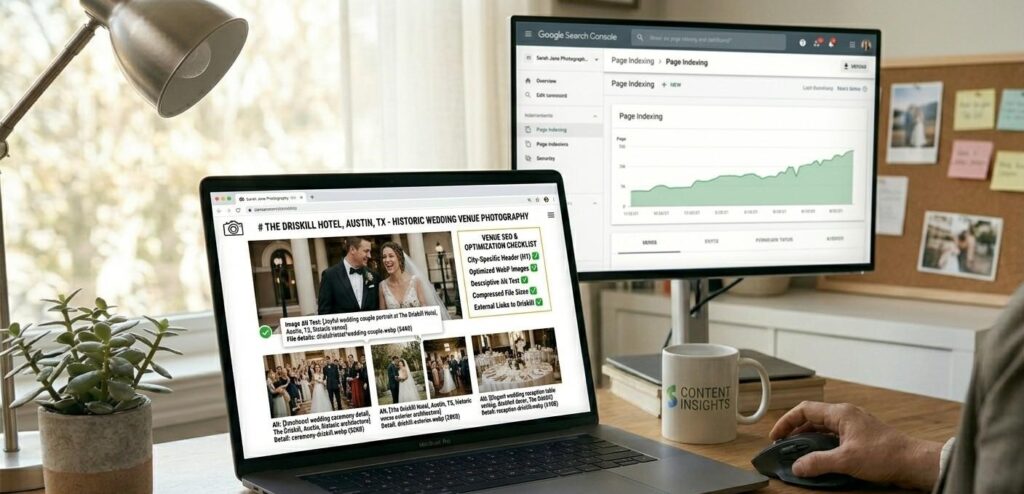
Venue pages are the most underused wedding photographer SEO asset available. When a couple books a venue, their next search is often “[venue name] wedding photographer.” A dedicated page titled “Wedding Photography at [Venue Name]” captures that search before any competitor does.
According to WolfPack’s 2025 wedding photographer SEO guide, style and location keywords attract couples who already love your approach. Venue pages combine both signals in one place. Each page needs the venue name in the H1, two or three paragraphs describing the space through a photographer’s eye and a gallery from an actual wedding there. That combination of specificity and genuine content outranks a generic location page every time.
3. Google Business Profile With Active Photos and Reviews
A complete and active GBP drives your map pack placement for “wedding photographer near me” and “wedding photographer [city]” searches. Upload new gallery images weekly, respond to every review and list your service areas and photography styles specifically in the GBP description.
Kari Bjorn’s documented case study shows what consistent SEO produces over time. She went from two to three Google clicks per day in late 2021 to 175 daily clicks by July 2024, nearly doubling her income between 2022 and 2023. Her GBP and on-site content worked together. Neither alone would have produced those numbers.
The GBP optimization guide for 2026 covers the specific fields, photo upload cadence and review response approach that compound local prominence for service businesses. The same structure applies directly to wedding photography practices.
4. Image Alt Text on Every Portfolio Image
Google cannot see your photos. It reads filenames and alt text. So a gallery full of gorgeous but unnamed images is invisible to search. Rename every image file before uploading: “outdoor-ceremony-wedding-photography-austin.webp” tells Google far more than “IMG_4872.jpg.” Write alt text that describes what the image shows and includes a keyword variant: “couple exchanging vows at Barr Mansion wedding, Austin wedding photographer.”
Compress every image before uploading using a tool like ShortPixel or TinyPNG. Convert to WebP format. Page speed is a confirmed ranking factor, and wedding portfolio pages are typically image-heavy. A gallery that loads in two seconds ranks better than one that loads in seven and makes no other SEO mistakes.
5. Strategic Blog Content That Matches Couple Research Behavior
Blogging every wedding you shoot is only worth doing if each post targets a real search. A blog post titled “Sarah and James’s Beautiful Spring Wedding” ranks for one thing: their names, which no one searches. Instead, title it “Spring Wedding at [Venue Name]: Outdoor Ceremony in [City]” and you’ve created a page that targets a venue-plus-season search with genuine local content.
Beyond venue recaps, the topics that drive consistent organic traffic for wedding photographers are venue guides, photography style comparisons and pre-wedding planning advice. The same research-first approach I use for real estate content, covered in the buyer research guide for real estate agents, applies directly to wedding photography because both industries serve buyers who research extensively before reaching out to anyone.
6. Internal Linking That Connects Venue Pages to Your Homepage and Style Pages
Every venue page should link back to your main location page. Every blog post should link to your portfolio and contact page. Your homepage should link to your top three venue pages. This internal link structure tells Google which pages are most important and passes authority from your stronger pages down to newer ones.
The hair salon local SEO checklist approach, which covers the same compounding structure for another appointment-based service, appears in detail in the salon local search guide. The logic runs parallel: service specificity plus location signals plus active review intake equals a compounding local presence that outranks directories over 12 months.
The content briefs I build for creative service businesses on my SEO content writing services page treat every new venue page and blog post as part of this link architecture from the start.
Ready to Turn Your Google Presence Into a Consistent Booking Engine?
Referrals will only get you so far. The photographers who stay fully booked in competitive markets are the ones couples find when they search, before they ask anyone for a recommendation. If you want help building the page structure, venue content and keyword strategy that supports that kind of visibility, reach out through my contact page and share your city, your style and where your current website stands. We’ll build from there.
Frequently Asked Questions
Is Instagram enough marketing for a wedding photographer in 2026?
Instagram builds audience among people who already follow you. SEO builds visibility for couples who have never heard of you and are actively searching. According to the February 2025 poll of 330 photographers by Adventure Instead, SEO ranked as the top inquiry source for wedding and elopement photographers, ahead of Instagram and referrals. Instagram stops producing the moment you stop posting. A well-optimized website page ranks for months or years without additional effort. Use both, but treat SEO as the foundation and Instagram as a traffic amplifier, not your primary booking strategy.
How do I rank for “wedding photographer in [city]” on Google?
Put the exact phrase “wedding photographer in [city]” in your H1, page title and within the first 100 words of your homepage body copy. Use your city name naturally throughout the page at least three more times. Add your city to your Google Business Profile’s description and service areas. Collect genuine Google reviews that mention your city or a local venue. Internal links from venue pages and blog posts that also mention your city and photography reinforce the same geographic signal across multiple URLs.
Should I blog every single wedding I shoot?
Only blog weddings if each post targets a real keyword someone searches for. “Sarah and James’s Barn Wedding” ranks for nothing useful. “Summer Wedding at [Barn Venue Name] in [City]” targets couples researching that venue and that season. Blog posts that pair a venue name with a style (“moody outdoor ceremony photography at [venue]”) also capture style-driven searches. Aim for one to two strategic venue recap posts per month rather than documenting every wedding with a title that only the couple themselves would search.
Does photographing at popular venues help your wedding photography SEO?
Yes, significantly. Once you shoot at a well-known venue, you can build a dedicated page targeting “[venue name] wedding photographer” searches. Couples book venues before photographers, so they frequently search for photographers with experience at their specific venue. A dedicated page with real images from that venue, a first-person description of the shooting challenges and a gallery from the actual day outranks any generic portfolio page competing for the same search. Photographing five to ten of your area’s top venues and building a page for each is one of the fastest SEO wins available to wedding photographers.
How many portfolio pages should a wedding photography website have?
Your website should have at least one city or location page, one page per major style or specialty you offer such as elopements or destination weddings and one venue page for each significant venue where you’ve shot. Five to fifteen venue pages is a realistic target for an established local photographer. Each page needs real content, real images and a distinct keyword focus. Duplicate pages with different city names but identical content don’t rank. Genuine, location-specific pages with unique context do.