
Keys Takeaway: How long SEO takes depends on industry competition, domain age and how consistently you execute. According to a poll of 3,680 practitioners by Ahrefs, the majority report seeing results within three to six months. Google’s former Developer Programs Tech Lead Maile Ohye, cited in Semrush’s SEO timeline guide, stated that in most cases SEOs need four months to a year for a business to first implement improvements and then see potential benefit. Local businesses in low-competition niches can see initial ranking movement in 60 to 90 days. High-competition national industries like insurance, finance and legal routinely take 12 to 24 months before meaningful organic traffic arrives. New websites take longer than established ones because Google’s trust in a domain builds incrementally, not overnight.

If you’ve started SEO work and seen nothing move yet, the most likely explanation isn’t that it failed. It’s that results don’t follow a straight line and the timeline varies more than most guides admit. How long SEO takes is genuinely one of the most context-dependent questions in digital marketing, and any answer that ignores your industry, your domain history and your competition level is too vague to be useful. This breakdown separates the timeline by business type and explains what drives the difference between a site that ranks in four months and one that’s still waiting at month ten.
Why Does SEO Take So Long to Show Results?
SEO takes time because Google builds trust in a domain incrementally, not from a single action. Each signal, whether it’s a published page, a backlink or a technical fix, carries weight only after Google has crawled it, evaluated it and compared it against competing pages across hundreds of ranking factors. No single update pushes a site to page one overnight, but consistent execution compounds over months in a way that paid traffic simply doesn’t.
The clearest data on this comes from Ahrefs’ study on ranking page age: the average page currently sitting in the top 10 results is over two years old, and pages ranking at position one average nearly three years. Only 22% of pages in the top 10 were created within the last year. That data doesn’t mean you have to wait three years. It means Google weights time-tested pages heavily, which is why new sites and new content need months to accumulate the signals that let them compete.
Three other factors slow the timeline beyond just age. First, technical crawl issues prevent Google from seeing your pages cleanly. Second, a weak internal link structure limits how well authority flows from your strongest pages to newer ones. Third, publishing without a keyword strategy means pages land on queries where you have no realistic chance of ranking in the near term. The SEO content audit process addresses all three by showing which existing pages need to be strengthened before new content compounds their authority.

What the SEO Timeline Looks Like Month by Month
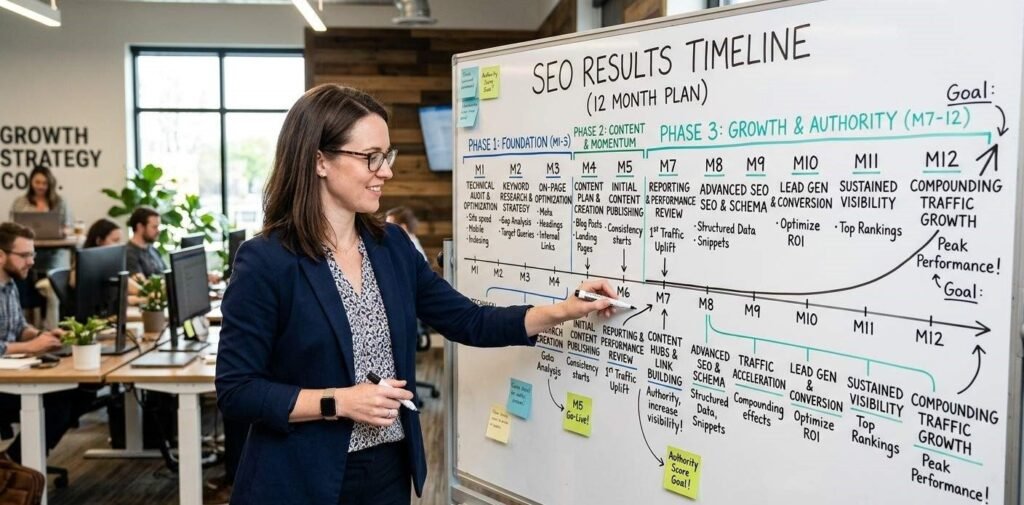
The SEO timeline follows a consistent pattern across most business types: foundation work in months one and two, early ranking signals in months three and four and measurable traffic growth from month five onward. According to Shopify’s SEO timeline guide, Arthur Camberlein, Shopify’s senior SEO specialist, puts the expected window for measurable results at three to six months for most sites, with the first two months focused on groundwork rather than rankings.
Here’s what each phase realistically produces:
| Phase | Months | What You Actually See |
| Foundation | 1 to 2 | Technical fixes, content briefs, keyword mapping complete |
| Early signals | 3 to 4 | Impressions growing in Search Console, first position moves |
| Initial traction | 5 to 6 | Rankings stabilizing, organic sessions beginning to climb |
| Steady growth | 7 to 12 | Consistent traffic, compounding content authority |
| Full compounding | 12 months+ | ROI positive, authority widening to secondary keywords |
The “early signal” phase in months three and four is where most business owners panic. Rankings often bounce. A post that climbs to position 18 may drop back to 30 before it settles. That bounce is normal. Google tests new content at various positions before committing. According to SeoProfy’s 2025 industry timeline report, the majority of medium-competition niches produce significant results between six and twelve months, not before.
How Does the SEO Timeline Change by Industry?
The SEO timeline changes significantly by industry because competition level, content quality expectations and domain trust requirements vary by niche. A local plumber in a mid-size market can see map pack results in 60 to 90 days. A new insurance comparison site competing with established aggregators should plan for 18 to 24 months before meaningful organic revenue arrives.
Industries Where SEO Works Faster
Local service businesses, specialty therapists, boutique e-commerce stores in niche categories and B2B companies targeting long-tail industry keywords typically see results within three to six months. These niches face lower domain authority competition and the search queries are specific enough that a well-structured page with clear local signals can rank without needing hundreds of backlinks.
For local SEO specifically, Google Business Profile signals contribute to map pack rankings faster than organic rankings move. A local business that completes its GBP, builds consistent NAP citations and collects five genuine reviews per month often sees map pack movement within 60 days. That early win doesn’t replace organic strategy, but it delivers leads while the longer-term content compounds.
Industries Where the SEO Timeline Extends to 12 to 24 Months
Finance, insurance, legal services, health and wellness, national e-commerce and high-volume SaaS tools all take longer. According to SeoProfy’s 2025 data, highly competitive niches like online finance, gambling and crypto can require 16 to 24 months for significant organic results. These industries require stronger domain authority, more backlinks and higher content quality before Google trusts a newer competitor enough to move it past established incumbents.
The semantic SEO topic cluster approach accelerates competitive-niche timelines because building topical authority across a cluster signals expertise to Google faster than individual one-off posts targeting disconnected keywords.
What Is the Fastest SEO Win You Can Get for a New Site?
The fastest SEO wins for any site come from three actions in the first 60 days: fixing crawl errors that prevent Google from indexing pages, optimizing existing pages for keywords where you already rank between positions 11 and 30 and building out your Google Business Profile if you serve local clients. These three moves work with your current domain authority instead of requiring new authority to be built from scratch.
Pages ranking between 11 and 30 are the fastest content investment in SEO because they already have some signal from Google. Improving their title tags, strengthening their answer capsule in the first paragraph and adding internal links from stronger pages can push a position-18 page into the top 10 in weeks rather than months. That’s meaningfully faster than publishing a new post and waiting for it to be indexed and evaluated from scratch.
Technical issues also delay results more than most new SEO programs account for. A page with a canonical tag pointing to the wrong URL, a noindex directive left over from development or a duplicate content issue with a pagination parameter can all prevent ranking movement regardless of content quality. Fixing these before publishing new content gives every subsequent action a cleaner base to build from.
The ROI measurement approach shows how to track whether those early wins are translating into real business value, rather than just watching position changes that may or may not connect to revenue.
Why Did My SEO Traffic Suddenly Drop?
Sudden SEO traffic drops happen for three main reasons: a Google core algorithm update that re-evaluated your content quality, a technical issue such as a server error or accidental noindex directive, or a competitor who significantly improved their content on the same keywords. Core algorithm updates in 2024 and 2025 focused heavily on content quality, E-E-A-T signals and helpful content, which caused meaningful traffic drops for sites with thin pages or excessive AI-generated content without editorial review.
The first step after any traffic drop is checking Google Search Console for any spike in crawl errors, coverage issues or manual action notices. The second step is comparing the date of the drop to Google’s publicly announced update schedule. If the drop aligns with a core update, it’s a quality signal problem. If it predates any update, it’s almost always technical.
The content I build at wajahatamin.com always includes a performance review checkpoint at six months so clients can confirm whether early ranking movement is converting to sessions and whether any drops are technical or competitive before they compound into a longer setback.
Want an SEO Strategy That Sets Realistic Timelines and Hits Them?
Most SEO programs fail because the expectations are wrong from month one. If you want a content strategy built around your actual competition level, your domain history and where the fastest wins sit for your specific business, reach out through my contact page and we’ll look at what a realistic six-month and twelve-month trajectory looks like for your site. No false promises, just a clear starting point.
Frequently Asked Questions
Why does SEO take so long compared to paid ads?
Paid ads produce traffic immediately because you’re buying placement. SEO earns placement by convincing Google your page is the most relevant and trustworthy result for a query, which takes consistent signals over time. According to Ahrefs’ ranking age study, the average top-10 page is over two years old. Google doesn’t hand authority to new content immediately because it can’t verify trust without repeated positive signals. The tradeoff is that organic rankings don’t stop the moment you pause spending, while paid ads stop the instant your budget runs out.
Is SEO faster for businesses in small or niche markets?
Yes, noticeably. A specialty therapist in a mid-size city or a local plumber serving a specific suburb faces far less competition than a national insurance brand. According to SeoProfy’s 2025 industry data, local businesses in low-competition niches can see initial results within three to four months. The lower domain authority requirements and the hyper-specific long-tail keywords in niche markets mean a well-structured page can rank much faster than the same effort in a nationally competitive category.
What is the fastest SEO win for a brand-new website in 2026?
Fix crawl issues first, then target keywords where you rank between positions 11 and 30 on existing pages and optimize your Google Business Profile for local visibility. These three actions build on existing signals rather than requiring new authority. New content on a brand-new domain typically needs four to six months to rank for anything competitive, but technical fixes and GBP optimization can produce visible results within 60 days. Publishing tightly briefed content targeting low-difficulty keywords also reduces the typical new-site timeline.
Why did my SEO rankings drop suddenly after months of growth?
The three most common causes are a Google core algorithm update, an accidental technical error such as a noindex tag or broken canonical and a competitor who substantially improved their content on the same keywords. Check Google Search Console for crawl errors and coverage issues first. Then compare your drop date to Google’s public update calendar. According to SeoProfy’s 2025 analysis, technical issues and algorithm sensitivity affect most sites at least once in a 12-month SEO program, so a single drop doesn’t mean the strategy failed.
Can I speed up SEO results by spending more money?
Budget helps but doesn’t override the fundamentals. More budget means faster technical fixes, more content production and professional link building outreach, all of which can compress the timeline from 12 months to 8 or 9. But no amount of spending bypasses Google’s trust-building process for new domains or speeds up how quickly a newly published page gets evaluated. According to Shopify’s SEO specialist Arthur Camberlein, patience and ongoing optimization are what determine outcomes, not budget alone. Spending more on weak strategy just produces weak results faster.