Keys Takeaway: Zero click search happens when a user’s query gets answered directly inside Google’s search results without any visit to an external website. According to Semrush’s 2025 zero-click study, 58.5% of US Google searches now end this way. Queries that trigger AI Overviews reach an 83% zero-click rate, and only 1% of users click citation links inside those overviews (Pew Research, July 2025). Ahrefs found in December 2025 that AI Overviews reduce CTR for position one content by 58%. Brands cited inside AI Overviews earn 35% higher organic CTR compared to those excluded, according to Seer Interactive’s November 2025 data. This shift demands a new visibility metric stack beyond clicks and session counts.
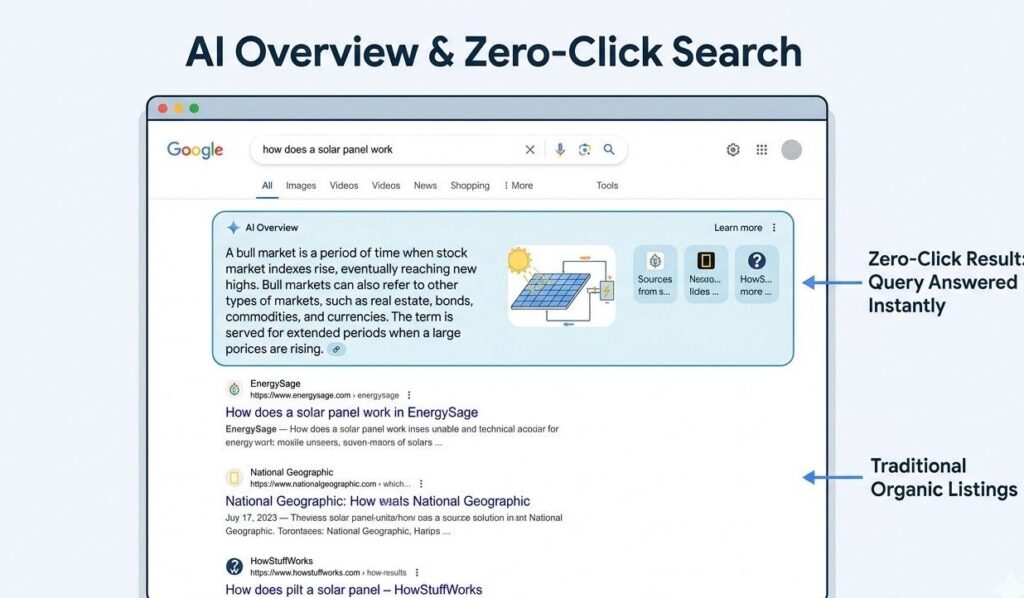
If your traffic is flat despite holding steady rankings, zero click search is the most likely explanation. You can rank first and still lose clicks to an AI Overview that answers the question before anyone scrolls to your result. The problem isn’t your content quality or your technical SEO. Search results pages are now destinations in themselves, not doorways to your website. For most businesses, traffic numbers no longer tell the full story of search visibility. This post breaks down what zero click search costs you, which businesses feel it hardest and what a realistic response looks like in 2026.
Why Zero Click Search Is Now the Default Search Experience
Zero click search is the majority experience for US searchers because Google now resolves most informational queries directly on the results page. Semrush’s 2025 zero-click analysis found 58.5% of US searches and 59.7% of EU searches end without a click. For queries that trigger AI Overviews specifically, Similarweb’s 2025 aggregated data puts the zero-click rate at 83%.
This trend predates AI Overviews. Featured snippets, knowledge panels and People Also Ask boxes have absorbed clicks for nearly a decade. But AI Overviews accelerated the change dramatically when Google rolled them out at scale in 2024. According to BrightEdge’s February 2026 data, AI Overviews now appear on 48% of all Google searches, up 58% year over year.
Ahrefs ran the same CTR study twice. In April 2025, AI Overviews reduced CTR for position one by 34.5%. By December 2025, that worsened to 58%. The impact compounds as users learn to expect complete answers inside the SERP. Gartner predicts organic search traffic will fall 50% or more by 2028, a forecast that looks increasingly credible given current trajectory.
The practical reading is this: impressions are growing for most sites while clicks stay flat or fall. Your brand appears in search results more than ever before. But fewer people are clicking through. Both facts are true and each demands a different strategic response.
The content work I do for clients at wajahatamin.com now accounts for this split in every brief. Traffic forecasts have to factor in whether target keywords trigger AI Overviews, because a post ranking first for an AIO-heavy query will convert impressions to clicks at a fraction of the historical rate.
Which Industries and Query Types Lose the Most to Zero Click Search
Informational and health-related content takes the heaviest losses, while transactional and local searches are significantly more resilient. Ahrefs’ November 2025 study found 99.9% of informational keywords now trigger an AI Overview, science topics carry a 43.6% AI Overview share and health content sits at 43%. By contrast, only 3.2% of shopping queries and 7.9% of local searches trigger one.
Informational and Educational Content: Hardest Hit
“How to” posts, explainer guides and definition-style content trigger AI Overviews at near-universal rates. When someone types “how to remove a stripped screw” or “what causes high blood pressure,” Google answers inside the SERP and the user closes the tab without clicking anything. Educational verticals reach an 83% zero-click rate in some categories.
One documented case makes the stakes concrete. Yelp appeared constantly as a cited source in AI Overviews for review queries. Despite that citation volume, the platform’s monthly visits fell from 867 million at their peak to 122 million by December 2025. Citation does not automatically convert to traffic, even at scale.
Transactional and Local Searches: More Resilient
Transactional and local queries hold up significantly better because users still need to visit a website to complete the action. Only 3.2% of shopping queries trigger an AI Overview, and local searches sit at just 7.9%, according to Ahrefs’ November 2025 data. Users booking a table, requesting a quote or calling a plumber cannot complete those tasks inside a search result.
Commercial comparison searches, product category queries and “near me” searches are the parts of any keyword portfolio most worth protecting. If your content strategy leans on transactional intent, zero click search is a smaller threat than it appears on an aggregate level.
Being Cited in AI Overviews Changes the Zero Click Equation
Brands cited inside AI Overviews earn 35% higher organic CTR than brands excluded from the summary, according to Seer Interactive’s November 2025 data. Citation doesn’t deliver direct traffic at scale, but it lifts brand recognition and downstream branded search volume, which converts at significantly higher rates than cold organic clicks.
Being inside the AI Overview is no longer optional for content-driven businesses. It’s a defensive position. The brands Google cites as sources lend authority to its answer. Users read the summary, register the cited names and often search those brands directly afterward. That follow-up search is a navigational query with high conversion intent and almost no AI Overview interference.
According to Goodfirms’ 2026 survey, only 14% of marketers currently track AI Overview impression share. That means the majority of businesses are measuring only the traffic that reaches their site while missing the visibility layer that shapes what converts downstream.
The structural decisions that lift citation probability include front-loaded direct answers, specific statistics with named sources and comparison tables. I cover the full GEO citation approach in the generative engine optimization guide for content teams, which goes through the specific content patterns AI engines consistently pull from.

What to Track Instead of Clicks in a Zero Click Search Environment
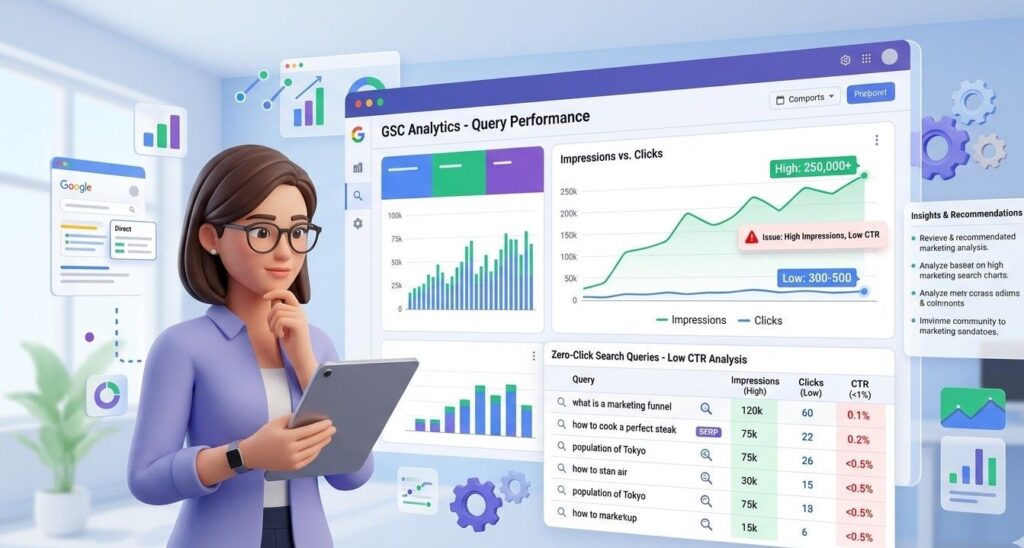
Track five signals alongside clicks: impression share in Google Search Console, branded search volume growth, AI Overview appearance rate for target keywords, direct traffic trends and organic conversion rate from the clicks that do arrive. These five metrics show whether your SEO is building real business value even when raw traffic looks stagnant.
The distinction between the old measurement model and the new one matters for how you report SEO internally or to clients. Here’s a straightforward view of which metrics to reconsider:
| Old Metric | Problem in 2026 | Better Signal |
| Organic sessions | Misses zero-click impressions | Impression share + branded search volume |
| Position one ranking | Means less without AI Overview CTR context | AI Overview citation rate |
| Click-through rate | Falls even when content is winning | Revenue per organic visitor |
| Bounce rate | Distorted by AI referral behavior | Organic conversion rate |
| Page views | Inflated by thin topical coverage | Assisted conversion paths in GA4 |
The SEO vs AEO vs GEO breakdown explains how these three optimization tracks work alongside each other in a 2026 search strategy, because zero click search affects each one differently. For the GA4 setup that ties organic visibility to actual business outcomes, the post on measuring SEO ROI when clicks are falling covers the attribution path steps in detail.
The content briefs I build for clients through my SEO content writing services now include AI Overview citation structure as a standard element, because ranking without being cited increasingly means ranking without a measurable return. According to Digital Applied’s 2026 zero-click data report, the clicks that survive AI Overviews convert 23% better than pre-AI organic traffic. So although there are fewer clicks, the ones that arrive are higher-intent visitors.
Ready to Build Visibility That Survives When Clicks Don’t Come?
Zero click search isn’t reversing, so the question is how to build a strategy that accounts for it honestly. If you want content that earns AI citations, ranks for the searches where clicks still happen and gives you a measurement model that actually reflects business impact, start the conversation through my contact page and we’ll take a clear look at where your current content stands. No guesswork.
Frequently Asked Questions
Is zero click search killing SEO?
No, but it’s reshaping what SEO success looks like. Clicks are no longer the primary evidence that SEO is working. According to Semrush’s 2025 study, 58.5% of US searches end without a click, yet brands cited inside AI Overviews earn 35% higher organic CTR on the clicks that do happen. The content and technical foundations of good SEO still feed AI citation. So zero click search is changing the measurement model, not eliminating the channel’s value.
How can I track business impact from zero click results?
Start in Google Search Console by monitoring impression volume separately from click volume. Rising impressions on branded and topical queries signal your content is surfacing in AI Overviews and influencing searches your site never receives directly. Also track direct traffic growth and branded search volume month over month. In GA4, check assisted conversion paths to see whether organic-influenced visits convert downstream as direct or email sessions. Together these signals show zero click exposure that click data alone won’t capture.
Do zero click impressions still build real brand awareness?
Yes, and the effect is measurable. Being cited inside an AI Overview exposes your brand name to every user who sees that answer, even without a click. Users form impressions of which brands are authoritative before visiting any website. Seer Interactive’s November 2025 data found that brands cited in AI Overviews earn not just 35% higher organic CTR but also 91% higher paid CTR compared to non-cited brands. That second figure shows the downstream impact on brand recognition reaching paid search behavior as well.
Which industries are hit hardest by zero click search in 2026?
Health, science, education and B2B technology content face the steepest losses. Ahrefs’ November 2025 data found informational keywords trigger AI Overviews at a 99.9% rate, with science content carrying a 43.6% AI Overview share and health at 43%. E-commerce, real estate and local service businesses hold up better because users need to visit a website to complete a transaction. Only 3.2% of shopping queries and 7.9% of local searches trigger an AI Overview, so transactional businesses retain far more click value than informational publishers.
Can I stop Google from using my content in AI Overviews?
You have limited but real options. Adding nosnippet to the robots meta tag on a page tells Google not to display that page’s content in featured snippets, and this also reduces its use in AI Overviews. The max-snippet:0 value works similarly. However, Google hasn’t confirmed these directives fully exclude content from AI Overview generation in every case. The tradeoff is significant: opting out reduces AI Overview inclusion but also removes you from featured snippets, which still drive traffic on queries without AI Overviews. For most businesses, optimizing for citation is a stronger return than opting out entirely.