
Quick Answer
Buyers in 2026 research agents through AI search tools and Google before making contact, asking specific questions about neighborhoods, closing costs and market conditions rather than typing an agent’s name directly. According to NAR’s 2025 Profile of Home Buyers and Sellers, 88 percent of buyers still used an agent, but the path to finding one now runs through AI Overviews, ChatGPT and Perplexity citations as much as traditional search results. Agents who publish content answering these specific questions, backed by real transaction data, are the ones AI tools surface first.
- Searching online remains the most common first step in the home search process, chosen by 41 to 47 percent of buyers between 2020 and 2025, according to NAR’s Profile of Home Buyers and Sellers.
- The median buyer search took 10 weeks in the 2025 reporting period, per NAR, giving agents a real window to earn trust through content before a buyer ever calls.
- AI referral traffic for real estate content grew 527 percent year over year in 2025, according to Starmorph’s 2026 AEO and GEO research.
- Only 38 percent of AI Overview citations now come from top 10 organic results, down from 76 percent in 2024, per Search Engine Land’s February 2026 reporting on BrightEdge data.
- Buyer search behavior shifted from size and status toward lifestyle and adaptability features in 2025, according to Zillow’s annual Zeitgeist report.
A buyer searching for a home in 2026 rarely types an agent’s name first. They ask a specific question instead: what closing costs look like in their state, which neighborhoods fit their budget, or whether now is a good time to buy. Wajahat Amin has spent years running content strategy at Adnnel for real estate clients across multiple US markets, and that work has shown a consistent pattern: agents who publish answers to those exact questions get found before agents who only publish listings. The shift is not theoretical. NAR’s 2025 Profile of Home Buyers and Sellers confirms search remains the dominant first step in the buyer journey, but how that search happens, and where it leads, has changed enough that most agent content strategies are now built for a search environment that no longer exists.

What Buyers Type Before They Call an Agent
Buyers searching online ask process and decision questions long before they ask for a person. Common patterns include questions about closing costs, financing eligibility, neighborhood comparisons and timing the market, not branded searches for individual agents.
NAR’s Profile of Home Buyers and Sellers data spanning 2020 to 2025 shows that 41 to 47 percent of buyers started their search online, consistently outpacing every other entry point including direct agent contact. That share dipped to 41 percent in 2023 before climbing again, which tells you something important: online research is not a phase buyers skip even when the market tightens. It is the default starting point regardless of conditions.
The questions themselves have gotten more specific. A 2026 Florida Realtors feature quoting author Marki Lemons-Ryhal described this shift directly: buyers and sellers are increasingly asking full questions through Google’s AI Overviews, ChatGPT and voice search, and these tools reward direct, structured answers rather than a list of links to click through.
The Decision-Stage Question Pattern
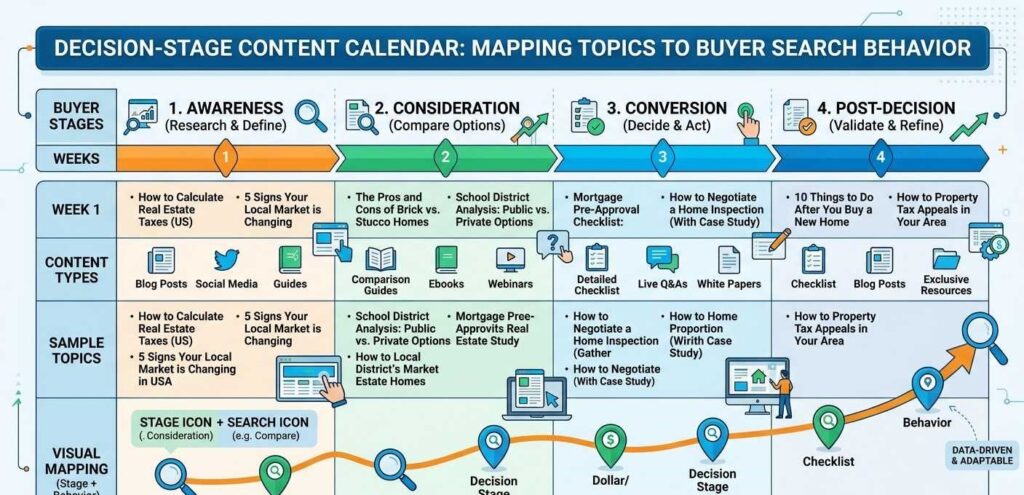
Buyers move through three distinct question types before they ever reach out to an agent.
Orientation questions come first: what’s a fair price for this area, what’s the market doing right now, is this a buyer’s or seller’s market. These establish whether the buyer is even in a position to act.
Comparison questions follow: this neighborhood versus that one, this school district versus another, condo versus single family. NAR’s 2025 generational trends report found that neighborhood quality and proximity to friends and family have surpassed job location as a top buyer priority, which means comparison content built around lifestyle fit now outperforms content built around commute times.
Logistics questions come last, right before contact: how does escrow work, what is due at closing, how long does the process take. NAR puts the median buyer search time at 10 weeks, which means an agent has roughly two and a half months of content touchpoints to earn trust before that buyer is ready to act.
Why Generic Explainer Content No Longer Works
Generic explainer content like “what is escrow” or “how does closing work” used to rank well because few sites covered it clearly. That advantage is gone. AI tools now answer these basic questions directly inside the search result, which means agents publishing only generic content are competing with the search engine itself rather than with other agents.
A 2026 analysis from C2 Communications made this point plainly: AI can now instantly summarize closing costs or escrow basics, and agents who produce only that type of content are competing directly with tools buyers already trust more than a blog post. The content opportunity has moved to decision-stage, comparison and locally specific topics that AI cannot generate without real local knowledge behind them.
This is where most agent content strategies fall short. A post titled “what is a home inspection” has no local specificity and no first-hand authority. A post titled “what home inspectors in [specific metro] flag most often in homes built before 1990” has both, and it is the kind of content AI tools cite because no general-purpose model can fabricate that level of local detail convincingly.
What the Data Says About Where Buyer Search Is Heading
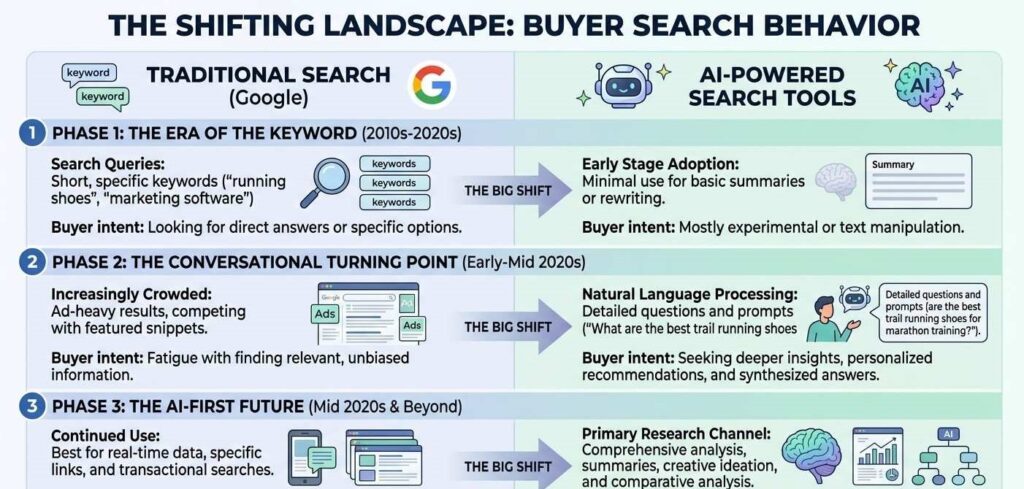
Buyer search has shifted measurably toward AI tools as a starting point, and away from typing queries directly into Google and clicking through a list of links. This matters because the content that wins visibility in this environment is structured differently than content built for traditional rankings.
According to Search Engine Land’s reporting on BrightEdge research, only 38 percent of AI Overview citations now come from pages that also rank in the top 10 organic results, a sharp drop from 76 percent in 2024. That gap means an agent’s blog post can be cited by an AI tool even without a top Google ranking, provided the content is structured clearly and answers the question completely within the opening section.
Reflecting Walls’ 2026 real estate advertising guide, citing Starmorph’s AEO and GEO research, found that AI referral traffic to tracked real estate content grew 527 percent year over year in 2025 and converted at four to five times the rate of traditional organic search. That conversion gap is the real story. Buyers arriving through an AI citation have already had their question answered in a way that builds trust, so by the time they reach out, they are closer to ready than someone clicking a generic search result.
Why First-Person Experience Content Wins Citations
AI systems are weighted to recognize first-person experiential content as a stronger trust signal than generic information. A neighborhood guide describing the specific number of listings an agent personally closed in a given area, with real days-on-market figures, reads as something no AI model could generate without the agent having lived that transaction.
In a 2025 content audit for a real estate client expanding into a new metro area, restructuring three neighborhood pages around specific closed transactions instead of generic area descriptions increased their qualified inquiry rate within two months, a pattern consistent with what the broader AEO research describes as Experience-weighted citation.
Why Structure Matters As Much As Content
| Content Element | Why AI Tools Cite It | Where to Use It |
| Direct answer in first 60 words | Matches how AI tools extract opening content for citation | Top of every blog post and FAQ |
| Named statistics with source and year | Builds factual density AI systems weight for trust | Market updates, neighborhood comparisons |
| Specific transaction details | Signals first-hand experience no AI can fabricate | Neighborhood guides, case studies |
| Question-phrased headings | Mirrors how buyers phrase queries to AI tools | Every H2 and H3 in long-form content |
| FAQ sections with 40 to 80 word answers | Matches the exact format AI tools extract for citation | End of every long-form post |
Building Content Around the Decision Stage Buyers Are In
The most effective real estate content in 2026 matches the specific stage a buyer is in, rather than trying to cover everything a buyer might eventually need to know. This means fewer all-purpose guides and more narrow, specific answers tied to a real local market.
A neighborhood-level guide answering “is [neighborhood] a good fit for a family with school-age kids” outperforms a citywide guide covering every neighborhood at once, because the narrower piece can include specifics: actual school ratings, actual commute data, actual recent sale prices. The guide to neighborhood page SEO for real estate agents covers how to structure this kind of page so it competes directly with portal listings rather than getting buried beneath them.
Buyers also increasingly ask questions that sound more like a conversation with a knowledgeable friend than a search query. The post on the exact questions buyers type into Google before contacting an agent breaks down the specific phrasing patterns that show up across buyer searches, which is useful raw material for building an FAQ section that matches real search behavior instead of guessed keywords.
Email Still Plays a Role Once Buyers Are Identified
Content earns the initial visibility, but email remains the channel that keeps a buyer engaged through that 10-week search window NAR’s data describes. Once someone has read a neighborhood guide and provided contact information, a sequence built around the same decision-stage logic, comparison content, then logistics content, then a direct ask, keeps that relationship warm without feeling like a sales pitch. The real estate email marketing guide covers how to sequence that follow-up so it mirrors the buyer’s actual research path instead of pushing listings at random intervals.

How the Major Portals Are Changing the Competitive Picture
Zillow, Redfin and Realtor.com have all launched integrations inside ChatGPT between October 2025 and March 2026, which means buyers can now search listings, pull market data and ask comparison questions without ever leaving the AI chat interface. This raises the bar for what independent agent content needs to accomplish, since portal data alone is no longer a differentiator.
According to Zillow Group’s own investor announcement, the company became the first real estate platform integrated inside ChatGPT in October 2025, letting users search listings by price, location and feature directly within the conversation. Redfin followed in February 2026, and Realtor.com in March 2026, focusing its integration on pre-search conversations like affordability questions and neighborhood comparisons, according to coverage from HousingWire.
This means an agent competing purely on listing data is now competing against the portals themselves inside the same AI interface. What an agent can still offer that a portal cannot is local narrative: specific stories about specific transactions, specific neighborhood texture, specific buyer experiences that no aggregated dataset captures. That is the lane independent content needs to occupy now.
Zillow’s own 2025 Zeitgeist research, based on millions of natural-language searches, found that buyer priorities shifted from size and status toward lifestyle and adaptability, with searches for waterfront access, flexible living spaces and outdoor features rising sharply over the year. Content that addresses these shifting priorities directly, rather than defaulting to square footage and price as the only selling points, matches where buyer interest has moved.
Adapting Content Strategy for an Agency-Level Approach
A single agent publishing occasional blog posts cannot keep pace with the cadence AI citation building now requires. The agents seeing measurable gains in citation share are treating content as infrastructure, not as occasional marketing, which is closer to how a full-service marketing operation approaches the problem than how most solo agents currently work.
This is where Adnnel’s real estate marketing approach differs from a one-off blog retainer. Building topical depth across neighborhood guides, market updates and buyer-stage content takes sustained output tied to real transaction data, not a handful of generic posts published once a quarter. Agents who started building this kind of citation presence in early 2025 are now seeing measurably stronger AI visibility than agents who started the same work twelve months later, according to FlyDragon’s 2026 State of AI SEO benchmark report on residential real estate, even when the later group spent more on advertising overall.
Build for the Question, Not the Keyword
The agents winning visibility in 2026 are not the ones chasing keyword volume. They are the ones answering the specific question a buyer in their market is asking, with real data behind the answer and a structure that AI tools can extract cleanly. That means fewer generic posts and more content built around real closed transactions, real neighborhood comparisons and real local market conditions.
Buyer search behavior has not slowed down. NAR’s data confirms online search remains the dominant first step regardless of market conditions, and the 10-week median search window gives every agent a real opportunity to be the source a buyer trusts before they ever pick up the phone. The work now is making sure that trust gets built in the format AI tools and buyers both recognize as genuinely useful, not just optimized.
If your current content strategy still reads like a 2022 blog calendar, the services page covering full content and SEO strategy outlines how that conversation usually starts, and what a rebuild around actual buyer search behavior looks like in practice.
Frequently Asked Questions
What do home buyers search for before contacting a real estate agent?
Buyers search for specific decision-stage information: neighborhood comparisons, closing cost estimates, financing options and market timing questions, rather than searching directly for an agent’s name. NAR’s 2025 Profile of Home Buyers and Sellers confirms online search remains the most common first step in the buying process, chosen by 41 to 47 percent of buyers between 2020 and 2025, with the questions becoming increasingly specific to local conditions rather than generic real estate terms.
How has ChatGPT changed how buyers find real estate agents?
ChatGPT now hosts direct integrations from Zillow, Redfin and Realtor.com, letting buyers search listings and ask comparison questions without leaving the chat interface. This means buyers increasingly research neighborhoods, pricing and process questions inside AI tools before ever visiting an agent’s website. Agents whose content gets cited inside these AI answers, rather than agents who only rank on Google, are capturing a growing share of early-stage buyer attention.
Is content marketing still worth the investment for real estate agents in 2026?
Yes, though the format has shifted. AI referral traffic to real estate content grew 527 percent year over year in 2025 according to Starmorph’s research, and converts at four to five times the rate of traditional organic search. The investment now needs to focus on specific, locally detailed content tied to real transactions rather than generic explainer posts, since AI tools can already answer basic questions without needing to cite an agent’s blog.
Why do neighborhood guides perform better than citywide buyer guides?
Neighborhood-specific guides include details a citywide guide cannot: actual school ratings, actual recent sale prices, actual commute patterns for that specific area. This level of specificity signals first-hand local knowledge that AI systems weight as a trust signal, since no general-purpose AI model can fabricate hyper-local detail convincingly. A citywide guide spreads attention too thin to compete on any single buyer’s specific question.
Do buyers still use real estate agents even with more research happening online?
Yes. NAR’s 2025 Profile of Home Buyers and Sellers found that 88 percent of buyers used a real estate agent or broker to complete their purchase, a figure that has remained consistently high even as online research has expanded. Buyers are doing more independent research earlier in the process, but the data shows they still rely heavily on professional guidance to manage financing, negotiation and the more complex parts of a transaction.