
Quick Answer
An internal linking strategy builds topical authority by connecting a broad pillar page to focused cluster pages through descriptive, two way links, keeping every priority page within three clicks of the homepage. Google uses these links to understand which pages belong together and which page deserves to rank for a given topic. According to a 2026 LinkStorm study of 2.5 million internal links, most sites maintain a flat structure with shallow link depth, which means the sites that build deliberate pillar to cluster connections stand out by default.
- Ahrefs’ own internal linking guide recommends 3 to 5 contextual links per article, and its Beginner’s Guide to SEO pillar page reportedly earns roughly 2,900 organic visits per month with backlinks from 649 unique domains as proof the model works.
- An independent analysis of 23 million internal links by SEO researcher Cyrus Shepard found pages with at least one exact match anchor saw roughly five times more traffic than pages without one, though the research flags this as correlation rather than proof of causation.
- Search Engine Journal’s February 2026 coverage of topical authority confirms that internal linking and anchor alignment directly influence how Google interprets a site’s subject matter expertise.
- Search Engine Land’s complete guide to topic clusters confirms that scattered, near duplicate pages create keyword cannibalization, while a properly linked pillar and cluster structure resolves it.
- Google’s own developer documentation states that anchor text helps both users and Google understand the linked content, reinforcing that descriptive anchors are not optional polish.
Most sites do not have a content problem. They have a connection problem. Wajahat Amin has audited more than 40 client sites at Adnnel, and the same pattern shows up again and again: strong individual posts that rank for a week, then slide, because nothing on the site tells Google those posts belong to a coherent body of work. Internal linking is the mechanism that builds that coherence, and it remains one of the most underused levers in SEO precisely because it looks simple. It is not simple. Done correctly, it is the difference between a site Google treats as scattered content and one Google treats as an authority.
What Internal Linking Signals to Google
Internal links tell Google three things at once: which pages exist, how those pages relate to each other, and which pages the site itself considers important. A page with no internal links pointing to it is functionally invisible to Google’s crawler, regardless of how well written the content is.
Google’s own developer documentation on link best practices states plainly that anchor text should be descriptive and concise, helping both users and Google understand the linked content. This is not a stylistic suggestion. Anchor text is one of the clearest signals a site can send about what a page covers, and Google treats it as such when deciding which page to rank for a given query.
The practical effect shows up at scale. Ahrefs’ own guide to internal links recommends 3 to 5 contextual internal links per article as a starting point, and points to its own Beginner’s Guide to SEO pillar page as proof of the model working in practice. That single pillar page reportedly earns an estimated 2,900 organic visits per month and has attracted backlinks from 649 unique domains, according to Ahrefs’ own data. The lesson is not the specific numbers. It is that a single well built pillar page, properly linked to its cluster, can become a site’s strongest single asset.
The Pillar and Cluster Model, And Why It Still Works in 2026
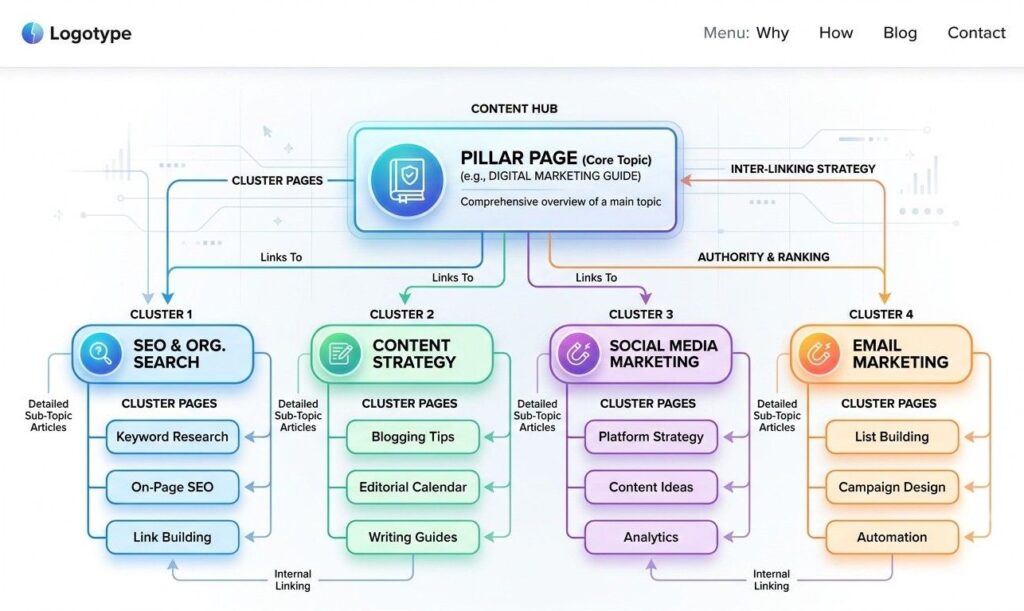
A pillar and cluster structure means one broad page covers a topic in full depth, while narrower cluster pages each handle a specific subtopic and link back to the pillar. This bidirectional linking pattern concentrates authority on the pillar while signaling to Google that the cluster represents a coherent, well developed subject area rather than a handful of unrelated posts.
This is not a new idea, but it remains the dominant content architecture for a reason: it matches how Google evaluates topical depth. A site with twelve scattered posts about content marketing competes weakly against a site with one pillar page and eight cluster posts that all link to and from each other with purpose. The second structure tells Google exactly where the center of expertise sits.
Building the Pillar Page Correctly
The pillar page should cover the topic at a level of completeness that makes it the obvious hub for everything beneath it. This means linking down to every relevant cluster post, using anchor text that describes each cluster’s specific angle rather than a generic phrase repeated across every link.
A well built pillar page on internal linking, for example, should link out to cluster posts on anchor text variations, orphan page audits and crawl depth management, each with anchor text specific to that subtopic. If every link on the pillar page reads “learn more,” Google has no way to distinguish what each linked page covers.
Building the Cluster Pages Correctly
Each cluster page should link back up to the pillar early in the content, ideally within the first few paragraphs where context gets established. This is where most sites get lazy, burying the pillar link at the bottom of the post as an afterthought rather than treating it as the page’s primary topical anchor.
Cluster pages should also link laterally to two or three closely related sibling pages within the same cluster, not just up to the pillar. This lateral linking is what separates a true cluster from a simple hub and spoke model. A 2026 analysis from Digital Applied frames this clearly: clustered content reportedly outperforms isolated posts on organic traffic, and cluster rankings tend to persist longer through algorithm shifts because the structure gives Google more entry points and more context to work with.
Anchor Text Strategy That Helps Instead of Hurts
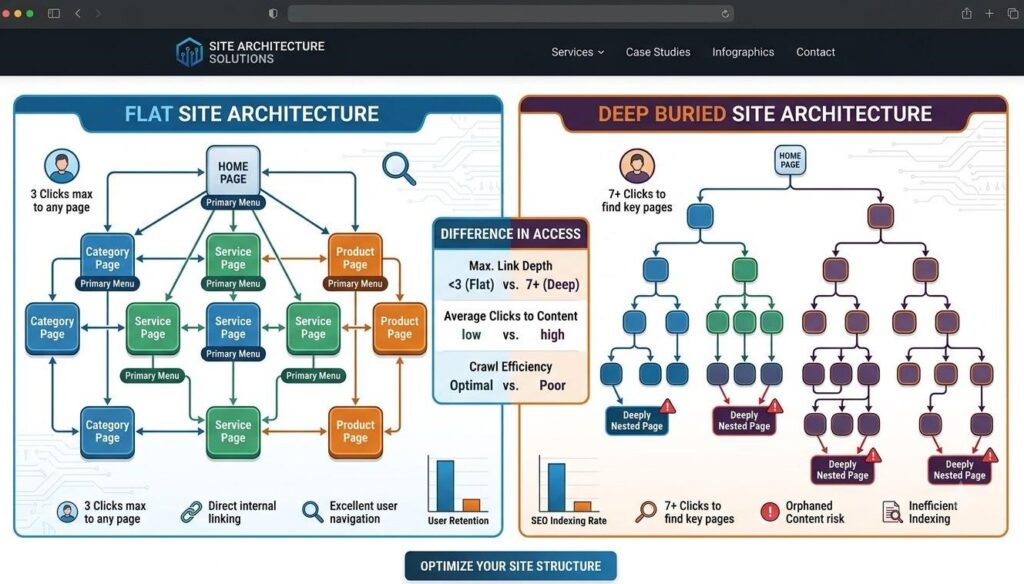
Anchor text should describe the destination page’s topic specifically enough that removing the link would still leave a sentence that makes sense, but specific enough that Google can distinguish it from every other link on the site. Generic anchors like “click here” or “read more” waste the single clearest topical signal available in an internal link.
An independent analysis of 23 million internal links by SEO researcher Cyrus Shepard found that pages with at least one exact match anchor saw roughly five times more traffic than pages without one. The research is careful to flag this as correlation rather than proof that exact match anchors cause the traffic increase, and that caution is worth repeating here. Pages that earn exact match anchors are often already topically focused and well structured in other ways too. The anchor is one piece of a larger pattern, not a standalone trick.
What this means practically: vary anchor text across links pointing to the same page, mixing exact match, partial match and natural phrasing, since no two links to the same page should share identical anchor text within one post. This is not just a defensive move against looking manipulative. It mirrors how a person would reference a page across different contexts without repeating the same phrase every time.
Common Internal Linking Mistakes That Quietly Cap Rankings
The most common internal linking failure is not broken links. It is link neglect, where the majority of pages on a site carry only one inbound internal link or none at all. Semrush’s site audit tool flags this as one of the most frequently occurring issues across the sites it scans, which suggests the problem is structural rather than occasional.
| Mistake | Why It Hurts Topical Authority | Fix |
| Pages with zero or one internal link | Google struggles to discover or contextualize the page | Add 2 to 5 contextual links from related pages on publish |
| Identical anchor text across every link | Removes the topical distinction anchors are meant to provide | Vary anchor phrasing to match each destination’s specific angle |
| Pillar link buried at the bottom of cluster posts | Loses its role as the page’s primary topical signal | Place the pillar link within the first few paragraphs |
| Linking to unrelated pages for the sake of link count | Confuses Google about the page’s actual subject matter | Only link where it serves the reader’s next likely question |
| No lateral links between cluster siblings | Creates a hub and spoke model instead of a true cluster | Add 2 to 3 links between closely related cluster pages |
Search Engine Land’s complete guide to topic clusters and pillar pages illustrates the cost of getting this wrong from the other direction. Before topic clusters became standard practice, sites commonly built dozens of separate pages each chasing slightly different versions of the same keyword, a pattern that produced keyword cannibalization and diluted authority across too many near duplicate pages. The fix the industry settled on, consolidating that scattered content into a single pillar with a properly linked cluster, is the same fix that applies at the page level whenever internal links get added without a clear topical purpose.
Cannibalization Is the Risk Nobody Talks About Until It Happens
Building a tight cluster around one topic creates a separate risk: if a cluster page covers ground too close to the pillar’s own subject matter, Google can struggle to decide which page deserves to rank for a given query, sometimes causing both to underperform. Search Engine Journal has flagged this as an inherent risk inside cluster architectures, not a rare edge case.
The fix is deliberate scope separation before writing begins. The pillar should own the broad, high volume version of the topic. Each cluster post should own a genuinely distinct angle, a specific subtopic, a specific use case or a specific question the pillar only mentions in passing. Search Engine Journal’s analysis of internal linking and topical authority confirms this risk is structural, not occasional, and recommends auditing scope overlap before adding new cluster content rather than after. If two pages on the site could reasonably target the same search intent, one of them needs to be rewritten or merged.
Why This Matters More for AI Search Than It Used To
Internal link structure now shapes more than crawl behavior, since large language models and AI crawlers increasingly use link topology as a contextual signal when summarizing or citing content. A site with a clear pillar and cluster structure gives these systems an easier path to understanding which page represents the authoritative answer on a given subtopic.
This connects directly to a pattern covered in the guide to building topical authority in 2026, where depth within a single content cluster consistently outperforms breadth across many shallow topics, both for traditional rankings and for AI citation eligibility. Internal linking is the structural mechanism that makes that depth visible to anything crawling the site, human or machine.
This also ties closely to how content gets phrased for citation purposes. The guide to semantic SEO versus keyword density explains why matching meaning rather than exact phrasing matters for ranking, and the same principle applies to anchor text: an anchor that captures the destination page’s actual meaning will outperform one that simply repeats a target keyword.
For posts built specifically to answer a direct question, the answer engine optimization guide covers how to structure content so it gets extracted cleanly by AI tools. Internal linking supports that goal by making sure the cluster around a given answer is dense enough that an AI crawler encounters multiple reinforcing signals rather than one isolated page.
Auditing What You Already Have Before Adding More Links
Before building new pillar and cluster structures, audit the site for orphan pages, since adding links to a poorly organized site without first identifying what already exists wastes effort and risks reinforcing the wrong hierarchy. Tools like Screaming Frog or a Search Console coverage report will surface pages with zero inbound internal links, which is the first thing to fix regardless of what new content gets built afterward.
A useful four tier priority order: fix orphan pages with real traffic potential first, then fix pages buried more than three clicks deep, then improve anchor text on existing links before adding new ones, and only then build genuinely new pillar to cluster connections. Skipping straight to new link building without this audit step means new links get added on top of a foundation that is still broken.
This is the kind of structural work that separates surface level SEO advice from an actual content architecture rebuild, and it is exactly where Adnnel’s SEO services focus when a client’s content has scaled past the point where ad hoc linking can keep up. A site with 300 posts and no deliberate link architecture needs an audit and a rebuild plan, not another blog post.
Build the Structure, Then Build the Content
Internal linking is not a checklist item to handle after a post gets published. It is the architecture that determines whether everything else, the research, the writing, the external link building, compounds into something Google and AI tools recognize as expertise. A site with brilliant individual posts and no deliberate linking strategy will keep losing to a site with merely good posts that are connected with intent.
Start with one pillar topic where the site already has the most content. Map every related post that exists, fix the anchor text, add the missing lateral links between cluster siblings, and only then turn to new content. The compounding effect of a properly linked cluster takes a few months to show up fully, but the first signs, more consistent rankings and faster indexing of new posts, tend to appear within weeks.
If your site has reached the size where this audit feels overwhelming to do manually, the contact page is where that conversation usually starts, and where a full structural audit gets scoped before any new content gets written.
Frequently Asked Questions
How many internal links should a blog post have?
Most practitioner guidance recommends 2 to 5 contextual internal links per 1,000 words of content, with longer pillar pages supporting a higher density than short cluster posts. The number matters less than the relevance of each link. A post with three genuinely useful links will outperform a post with ten links added purely to hit a quota, since Google and readers both notice when links feel forced.
What is the difference between a pillar page and a cluster page?
A pillar page covers a broad topic in full depth and links down to every related cluster page beneath it. A cluster page focuses narrowly on one subtopic within that broader subject and links back up to the pillar, along with two or three closely related sibling cluster pages. This bidirectional structure is what signals topical depth to Google, rather than either page type existing in isolation.
Do internal links help with AI search visibility, not just Google rankings?
Yes. Large language models and AI crawlers increasingly use a site’s link structure as a contextual signal when deciding which page best represents the authoritative answer on a topic. A well linked cluster gives these systems multiple reinforcing signals pointing to the same conclusion, which makes citation more likely than relying on a single isolated page to carry the entire topic.
Can too many internal links hurt a page’s rankings?
Excessive internal links dilute the value passed to any single linked page and can make a page feel like a directory rather than genuine content. Most guidance suggests keeping total links per page under roughly 150 and prioritizing relevance over volume. A page where every sentence links somewhere reads as manipulative to both readers and search engines.
What is keyword cannibalization and how does internal linking cause it?
Keyword cannibalization happens when two or more pages on the same site target the same search intent closely enough that Google cannot confidently decide which one should rank, sometimes causing both to underperform. Building tight content clusters increases this risk if cluster pages overlap too closely with the pillar’s own scope. The fix is deliberate scope separation: each page in a cluster should own a genuinely distinct angle on the topic, not a slight rewording of the same query.