
Quick Answer-Generative Engine Optimization (GEO) is the practice of structuring content so AI platforms like ChatGPT, Perplexity and Google AI Overviews cite it when answering user questions. For small businesses, it means your brand shows up in AI answers, not just Google rankings. The core tactics are answer-first writing, named statistics, cited sources and FAQ-structured content. Research from Princeton University and Georgia Tech published at ACM SIGKDD 2024 showed GEO techniques boost AI citation visibility by up to 40%.
- Gartner forecast traditional search engine volume to drop 25% by 2026 as AI chatbots replace conventional query behavior, with the decline concentrated on informational queries (Gartner, February 2024).
- AI-referred website sessions grew 527% year-over-year in the first five months of 2025, while still accounting for under 2% of total traffic for most sites (Previsible AI Traffic Report, 2025).
- Adding named statistics to content improves AI citation visibility by 41%, the single highest-impact GEO tactic in the Princeton/Georgia Tech study (ACM SIGKDD, 2024).
- Zero-click searches on Google grew from 56% to 69% in the year following AI Overviews rollout, meaning most searchers never reach a website at all (Similarweb, July 2025).
- Only 23% of marketers currently invest in GEO measurement, and most small-to-medium businesses have not started a GEO strategy yet as of early 2026 (Incremys, 2025; Digital Agency Network, 2026).
Most small businesses are still optimizing for a version of search that is changing faster than their agencies are telling them. A plumber in Phoenix, a family dentist in Dallas, a real estate agent in Toronto. They are all competing for Google rankings while a growing share of their potential customers are asking ChatGPT or Perplexity for recommendations instead. Running content and SEO strategy at Adnnel across service businesses in the US and Canada has shown us that the earliest concern is rarely “what is GEO”. It is “I didn’t know my competitor was already showing up in AI answers.” Wajahat Amin covers SEO strategy and AI search optimization for service businesses with a focus on practical, operator-level implementation. That gap is what this post closes.
What Is Generative Engine Optimization?
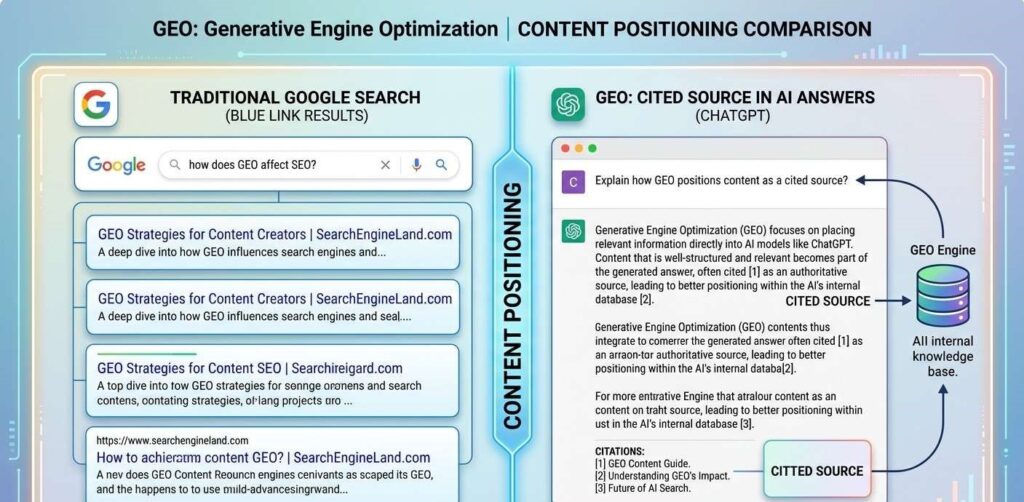
Generative Engine Optimization is the practice of structuring and writing content so that AI platforms cite it as a source inside their generated answers. The difference from traditional SEO is the goal: SEO gets you ranked in a list of links. GEO gets you quoted inside the answer itself, reaching users who never click through to any website.
The term was formalized by researchers at Princeton University, Georgia Tech and the Allen Institute for AI in a study presented at the ACM SIGKDD conference in 2024. The research tested nine optimization tactics across 10,000 queries and found that specific content changes could boost a site’s visibility inside AI-generated responses by up to 40%. The study named “Statistics Addition” and “Cite Sources” as the two highest-impact tactics, both of which are things any small business content team can do starting today.
The platforms where GEO matters right now are ChatGPT in web search mode, Perplexity AI, Google AI Overviews, Google AI Mode, Microsoft Copilot and Gemini Advanced. Each pulls from indexed content, but each has slightly different citation preferences. Google AI Overviews pull from pages that rank well in organic search around 85% of the time, so strong traditional SEO remains the foundation. Perplexity places higher weight on directness and source diversity. ChatGPT activates web search on roughly 34% of queries and generates the rest from training data, which means brand authority and entity recognition matter for the queries where no crawl happens.
Why Small Businesses Cannot Afford to Ignore GEO in 2026
The numbers here are not speculative. Traditional search engine volume will drop 25% by 2026, according to Gartner’s February 2024 forecast, with AI chatbots and virtual agents replacing queries that previously ran on Google. That forecast aligned with what actually happened: zero-click searches on Google grew from 56% to 69% in a single year following the rollout of AI Overviews, a figure documented by Similarweb in July 2025. Search Engine Land reported on this trajectory as early as 2024, noting the search volume decline was concentrated on the informational queries that small business blogs and FAQ pages depend on most.
For small businesses, the math is blunt. If you run a local service business, a specialty clinic or a boutique agency, your top-of-funnel blog content and FAQ pages were already the lowest-converting channel you had. AI Overviews absorb that traffic first. When a potential patient searches “how much does a crown cost,” the AI answers it. The dental practice’s FAQ page no longer gets the click.
What GEO does is put your business back in that answer. Instead of hoping the user clicks through, your name appears as the cited source. That citation is not just awareness. It is trust transfer. The user who sees your practice named in a Perplexity answer and then searches your name directly converts at a far higher rate than a cold organic visitor. Research from Seer Interactive in 2025 found that AI-referred visitors convert at 14 to 16%, compared to Google organic’s average of 1.76%.
The SMB Gap Is an Opportunity Right Now
Most enterprise marketing teams had a GEO initiative in place by early 2026. Most small and medium business teams had not started, according to research from Digital Agency Network (2026). That gap is the opportunity. Citation share in AI platforms is still open for most local and niche categories. A dentist who publishes two well-structured GEO-optimized posts per month right now faces far less competition for AI citations than a SaaS company competing in a saturated category.
What GEO Looks Like for a Service Business
A property management company in Austin starts getting cited in Perplexity answers about Texas landlord-tenant law by publishing one 800-word FAQ page with direct answers, named statistics and schema markup. A physical therapist in Chicago starts showing up in Google AI Overviews for “how long does PT take for a rotator cuff” by restructuring their blog posts to answer questions in the first 50 words. These are not large content investments. They are structural changes to content the business should already be publishing.

How GEO Differs from SEO (And Why You Still Need Both)
GEO does not replace SEO. The two disciplines work in parallel, and weakening your organic foundation to chase AI citations is a mistake. Google AI Overviews pull from pages with strong organic rankings the majority of the time, which means a site that ranks on page three is less likely to be cited regardless of how well its content is structured for GEO.
The table below captures the core differences:
| Dimension | Traditional SEO | GEO |
| Goal | Rank in a link list | Get cited inside an AI answer |
| Success metric | Click-through rate, organic traffic | Citation frequency, brand mentions in AI |
| What gets rewarded | Backlinks, keyword relevance, technical health | Fact density, direct answers, named sources |
| Time to results | 3 to 6 months typically | 8 to 12 weeks for initial traction |
| Who benefits most | High-volume informational queries | Any query where AI gives a synthesized answer |
The key conceptual shift is this: SEO asks “can Google find and rank my page?” GEO asks “can an AI extract a useful, citable answer from my page?” A page can rank well but fail the GEO test if its answers are buried inside long paragraphs, unsupported by data or written in a promotional tone.
Research from the Princeton GEO study found that promotional tone had a -26% correlation with AI citation rates. A service page that reads like an ad is actively less likely to get cited than a neutral, fact-based FAQ page on the same topic.
The Core GEO Tactics Small Businesses Should Use
These five tactics come directly from the Princeton/Georgia Tech study and have been validated by real-world citation data throughout 2025 and 2026.
Answer First, Every Time
Every piece of content should open with a direct 40 to 60 word answer to the question the page targets. AI platforms extract the first substantive answer block far more often than they extract context buried mid-article. Research from SparkToro published in January 2026 found that 44.2% of all LLM citations come from the first 30% of a piece of content. Front-loading the answer is the single fastest structural change a small business can make.
At Adnnel, we run this as a content audit step across all client blog posts before any other GEO work begins. In a 2025 audit for a home services client in the Southeast, moving the direct answer to the top of eight existing blog posts produced measurable citation gains on Perplexity within ten weeks, without any new content being published.
Add Named Statistics to Every Post
Adding named statistics, numbers attributed to a specific source and year, improved AI citation visibility by 41% in the Princeton study. “Most dental practices” does not get cited. “74% of patients choose a dentist based on online reviews, according to a 2024 PatientPop survey” does. The source and year do the heavy lifting. This is why the comparison covered in the broader guide on what every business owner needs to know about SEO, AEO and GEO keeps returning to citation structure as the foundation of all three disciplines.
Build FAQ Sections With Schema
FAQ schema markup makes individual question-answer pairs machine-readable. Both Google AI Overviews and Perplexity show disproportionately high citation rates for FAQ-schema pages in their respective analyses. Each FAQ answer should be 40 to 80 words, self-contained and answerable without surrounding context. A reader who lands only on that answer block should come away with the complete information. If the answer requires the previous paragraph to make sense, it will not get cited.
Keep Paragraphs Short and Structure Clean
AI engines parse short paragraphs far more reliably than dense blocks of text. Two to three sentences per paragraph is the practical ceiling for GEO-structured content. Subheadings should describe what is in the section, not tease it. “Why Small Businesses Need GEO” is a useful heading. “The Surprising Truth About Search” is not. AI systems cannot reliably extract an answer from a section they cannot classify.
Build Third-Party Brand Mentions
Brand mentions from external sources correlate 3x more strongly with AI citation rates than backlinks, according to research compiled by Omnibound in 2026 drawing on Similarweb and Muck Rack data. Getting quoted in industry publications, local news and niche directories builds the entity authority that AI models use when deciding which brands to cite. For a small business, this means local press coverage, guest posts on industry sites and active profiles on structured data sources like Google Business Profile, Bing Places and industry-specific directories.

How to Measure GEO Results
Tracking GEO is newer than tracking SEO, but the signals are clear once you know where to look.
Track branded search spikes in Google Search Console. A jump in branded queries after no marketing campaign often signals AI citation activity: someone saw your business named in an AI answer and searched for you directly. Track referral traffic from AI platforms in Google Analytics 4. Sessions from chatgpt.com, perplexity.ai and similar sources appear as referral traffic with a distinctive pattern. Track your own citation presence by asking ChatGPT, Perplexity and Google AI Mode the exact questions your customers ask, then recording whether your business appears and in what context.
For the broader picture of how GEO measurement integrates with content strategy, the full GEO guide for content teams walks through both the tracking framework and the content architecture in detail.
Ready to Get Your Business Cited by AI?
The businesses capturing AI citations now are building brand authority in channels where most of their competitors have not shown up yet. If your content is not structured for GEO, the gap between your business and your AI-visible competitors grows wider each month.
Adnnel’s SEO, GEO and AEO optimization service builds both your Google rankings and your AI citation presence across the platforms your customers use. For a direct conversation about where your business stands and what the first 90 days of GEO work looks like, reach out through the contact page.
Frequently Asked Questions
Is GEO the same as SEO?
No. SEO gets your page ranked in a list of links on Google. GEO gets your content cited inside an AI-generated answer on platforms like ChatGPT, Perplexity and Google AI Overviews. The tactics overlap partly. Both need well-structured, trustworthy content, but GEO adds direct answer formatting, named statistics and FAQ schema that traditional SEO does not require. Most businesses need both running at the same time.
Can a small business compete with big brands for AI citations?
Research from the Princeton GEO study found that lower-ranked websites gained a 115% visibility boost from GEO tactics, while already-high-ranked pages saw smaller relative gains. GEO is one of the few digital marketing channels where smaller, focused businesses can outperform larger competitors with weaker content structure. A specific, well-cited answer from a niche expert gets cited more often than a vague generalist page from a large brand.
How long does GEO take to produce results?
Most sites see initial citation traction within 8 to 12 weeks of consistent GEO-structured publishing, with more consistent citation patterns after 4 to 6 months. That timeline depends on your existing domain authority, how competitive your topic area is and whether you already have indexed content that can be restructured. Existing sites with organic presence move faster than entirely new domains.
What AI platforms should a small business prioritize for GEO?
Start with Google AI Overviews, because they appear on 25% of all Google searches and draw mostly from pages that already rank organically. Second priority is Perplexity AI, which values source diversity and direct answers. Third is ChatGPT in web search mode, which uses Bing’s index. Submitting your sitemap to Bing Webmaster Tools is a practical first step for ChatGPT visibility that many small businesses skip entirely.
Does GEO require new content or can existing content be optimized?
Both work. Existing posts can be restructured for GEO with relatively low effort: move the direct answer to the top, add named statistics with source citations, add FAQ sections and apply FAQ schema markup. New content should be built with GEO structure from the first draft. For the implementation side, the post on getting cited by AI through generative engine optimization covers the full tactical framework.