
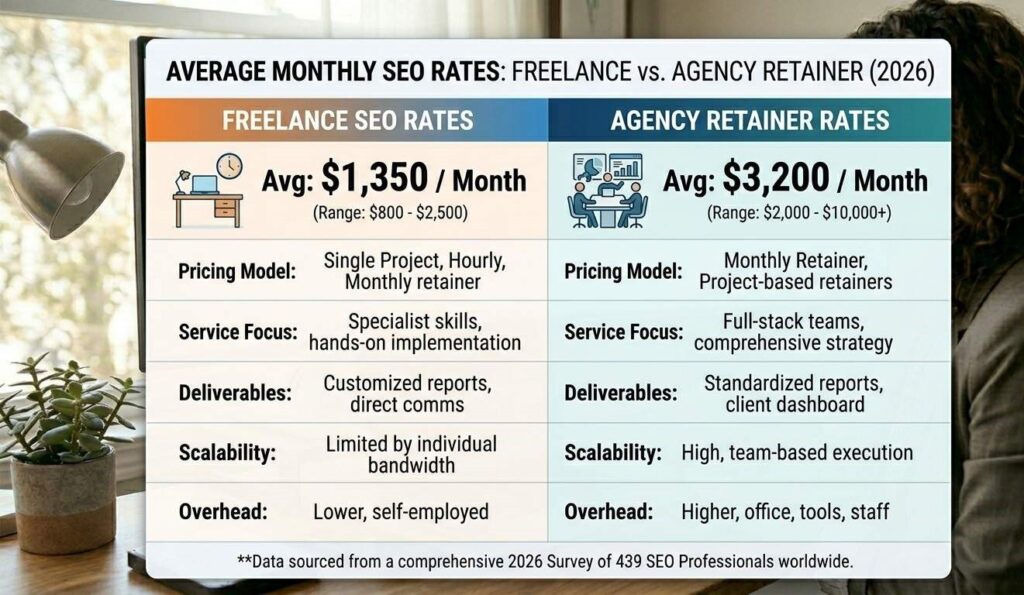
Keys Takeawa: Freelance SEO vs agency is primarily a budget and scope decision. According to a survey of 439 SEO professionals cited by Consultus Digital’s 2025 budget guide, the average monthly fee sits at $3,209 for agency-led programs and $1,348 for freelancers. According to the 2026 Ahrefs pricing survey via OuterBox, freelancers average $71.59 per hour while agencies average $98.90. According to Keystar Agency’s 2024 SEO cost statistics, agencies and consultants charge 29 to 63% more than freelancers. Freelancers suit small and mid-size businesses with a defined scope and a $500 to $3,000 monthly budget. Agencies suit businesses with multiple disciplines running simultaneously or content volume above 15 pieces per month.

Most small business owners approach the freelance SEO vs agency decision by price alone and end up with the wrong answer in both directions. Some hire an agency they can’t fully use because their site doesn’t need six service tracks running at once. Others hire a budget freelancer who doesn’t have the technical depth the project actually requires. The right comparison isn’t about which model costs less. It’s about which model delivers what your specific site needs in 2026, when both organic rankings and AI citation rates depend on more than just keyword placement. This post runs both options through the same framework so you can make a clear decision before the contract goes out.
What the Real Cost Difference Is Between Freelance SEO and Agency SEO
A freelance SEO consultant typically costs $500 to $3,000 per month on retainer. An SEO agency retainer starts at around $3,000 to $10,000 for boutique firms and can exceed $20,000 per month at the enterprise level. The gap between those ranges is where most businesses make their decision. But the more important question is what you get inside each range, not just the number.
At the $1,348 average for freelancers, you’re getting one experienced practitioner who handles strategy, keyword research and either content production or technical recommendations directly. At the $3,209 agency average, you’re paying for account management, team coordination, tooling and profit margin on top of the actual SEO work. The writer or specialist doing the hands-on work often costs less than their agency hourly rate implies.
According to Flying V Group’s 2025 SEO price list breakdown, boutique agencies start at $3,000 to $10,000 monthly while freelancers typically charge $500 to $3,000. That overlap range, roughly $1,500 to $3,000, is where the two models produce the most similar output for different price reasons. At those levels, a senior freelancer often delivers comparable strategic work to a boutique agency without the overhead layer.
The broader picture on what businesses actually pay comes from Savo Group’s 2026 SEO cost analysis: the median cost of SEO, not the average pulled up by enterprise agencies, is closer to $1,500 to $2,000 per month. Most businesses sit in that range. Knowing that means you’re already in freelancer territory if your site needs focused, ongoing SEO work with a clear scope.

What Freelance SEO Handles Well and Where It Falls Short
A freelance SEO practitioner handles strategy, content, on-page optimization, keyword research, Google Search Console monitoring and Google Business Profile work well within a standard retainer. These cover the majority of what small and mid-size businesses need to move rankings over a 12-month period. What a single freelancer can’t provide is simultaneous coverage across paid media, development, design and SEO all running in parallel.
Where Freelance SEO Genuinely Performs
Freelancers work best when the scope is defined and the output is primarily content and strategy. A solo practitioner managing a 4 to 10 post-per-month content program, conducting quarterly keyword audits and monitoring technical health through Semrush or Ahrefs can sustain and grow organic traffic for most local businesses, B2B companies and service providers without any agency overhead.
The continuity benefit is also real. A freelancer on a six to twelve-month retainer builds genuine knowledge of your brand, your audience and your historical content. That context compounds into faster, sharper work over time. By contrast, agency client teams rotate, and a new account contact means re-briefing someone on context you assumed was established.
What Freelancers Can’t Reasonably Scale To
Technical SEO at scale, such as a full migration audit on a 10,000-page e-commerce site, or a site rebuild involving development, design and SEO coordination, requires more than one discipline running simultaneously. A freelancer can advise on technical issues but can’t implement development fixes, redesign landing pages and produce content all within the same retainer without something dropping. At that point, either an agency with specialist staff or a curated group of specialist contractors becomes the more practical structure.
I cover the exact contractor coordination model and where it makes sense in the senior freelancer vs agency ROI comparison, which also explains what each model realistically produces over a 12-month window for the same budget.
What Size Business Is the Right Fit for a Freelance SEO Approach?
A freelance SEO is the right fit for businesses with a monthly SEO budget of $500 to $3,000, a clearly defined content and ranking scope and no simultaneous need for paid media, technical development or design across the same engagement. That covers most local businesses, solo practices, specialty B2B companies and growing e-commerce stores in the early to mid stages of their organic program.
Here’s a straightforward decision framework:
| Business Type | Monthly Budget | Right Fit |
| Local service business (plumber, therapist, salon) | $500 to $1,500 | Freelancer |
| Specialty B2B or SaaS (early stage) | $1,000 to $3,000 | Freelancer |
| Growing e-commerce (under 1,000 SKUs) | $1,500 to $3,000 | Freelancer or boutique agency |
| E-commerce at scale or multi-location business | $3,000 to $10,000 | Boutique agency |
| Enterprise or nationally competitive niche | $10,000+ | Mid-size or enterprise agency |
According to the Search Engine Journal’s 2024 State of SEO Agency Report, cited in Foxxr’s 2026 pricing guide, most businesses have budgets between $500 and $10,000 per month and businesses with under $5,000 per month tend to allocate the highest share to SEO specifically. That concentration in the lower budget range is exactly the market where a senior freelancer delivers the most direct return.
The pricing context behind this framework also appears in the 2026 SEO content writer cost breakdown, which explains how retainer and per-word pricing compare across different experience levels. The broader service comparison at wajahatamin.com shows where content strategy, technical review and local SEO work fit into a single-practitioner retainer scope.
When You Should Switch from a Freelancer to an Agency
Switch to an agency when your content volume exceeds 15 pieces per month, your site requires simultaneous paid media, technical development and content management or you’re entering a nationally competitive category where a team of specialists consistently outperforms a solo practitioner. These are the three conditions where agency overhead becomes justified rather than just expensive.
The switching signal most businesses miss is scope creep. A freelancer who adds paid media management, then technical auditing, then CRO consulting to their original content retainer is now operating at partial depth across four disciplines. At that point the work suffers. It’s better to transition clearly to an agency or to build a specialist contractor network around the freelancer’s strategic core.
Before any transition, ask whether your current SEO problems are actually scope problems or execution problems. A poorly run agency doesn’t outperform a strong freelancer just by having more staff. If the issue is execution quality rather than bandwidth, the warning signs to check before hiring any SEO provider apply equally to agencies and freelancers and the vetting process is the same.
The content and SEO services I outline on my SEO content writing services page cover the freelancer retainer structure that fits most small and mid-size businesses, including what’s included in strategy, content and performance review at each tier.
Ready to Know Which SEO Model Is Right for Your Site Specifically?
Most businesses don’t need an agency. They need one senior person who owns the keyword strategy, produces the content and tracks what it produces over time without three layers of approval between the brief and the published page. If that’s closer to what you’re looking for, reach out through my contact page and share your current site, your niche and what your SEO goals look like for the next 12 months. We’ll figure out quickly whether a freelancer retainer is the right model for where you are.
Frequently Asked Questions
Is a freelance SEO cheaper than an agency in the long run?
Yes, typically by a significant margin for comparable output. According to a survey of 439 SEO professionals, the average freelancer monthly fee is $1,348 compared to $3,209 for agencies. Keystar Agency’s 2024 data found agencies charge 29 to 63% more than freelancers. The long-run difference compounds because agencies carry overhead costs that don’t reduce even when your account’s actual work volume stays steady. For small and mid-size businesses with defined scope, a senior freelancer at $1,500 to $2,500 per month typically delivers more direct hours of strategic output per dollar than an agency at the same figure.
Can a freelance SEO handle technical SEO or is that only for agencies?
A senior SEO freelancer can conduct technical audits, diagnose crawl issues, identify Core Web Vitals problems and provide structured recommendations for a developer to implement. What a freelancer typically can’t do is implement the fixes themselves while also managing content and strategy simultaneously. For most small business sites with under a few hundred pages, the scope of technical work is fully manageable within a standard freelancer retainer. Larger sites needing simultaneous technical implementation, content production and paid media should consider either a boutique agency or a freelancer supported by specialist contractors.
What size business is the right fit for a freelance SEO approach?
Freelance SEO fits businesses spending $500 to $3,000 per month on SEO with a defined scope covering content, keyword strategy and on-page optimization. That includes most local service businesses, solo medical or legal practices, B2B companies in early-stage organic growth and specialty e-commerce stores. Once your budget crosses $3,000 and your needs include simultaneous paid media, development and content management, a boutique agency or coordinated contractor model starts to make more operational sense than a single-person retainer.
When should I switch from a freelance SEO to an agency?
Switch when your content volume exceeds 15 pieces per month consistently, when you need paid media and technical development running alongside organic SEO at the same time or when you’re entering a nationally competitive category. The most reliable switching signal is scope creep: when your freelancer is already managing four disciplines at partial depth, you’ve outgrown the single-person model. Before switching, confirm the issue is scope rather than execution quality because a poorly organized agency underperforms a strong freelancer at every budget level.
Can I start with a freelance SEO and bring in an agency later when I’m ready to scale?
Yes, and this is actually the most cost-effective growth path for most small businesses. A senior freelancer builds your organic foundation, establishes your topical authority and generates early ranking momentum during the first 12 to 18 months. Once you have proven organic traffic and a clear picture of which channels you want to scale into simultaneously, the agency transition is easier because you’re bringing a performing asset into a more resourced environment rather than handing over a site that’s never ranked for anything.