
Keys Takeaway: A senior marketing freelancer typically costs $1,500 to $3,000 per month for content strategy and writing, compared to $2,500 to $10,000 or more per month for a content marketing agency, according to HawkSEM’s 2026 content cost guide. The cost gap is real, but the hidden ROI difference runs deeper: senior freelancers bring direct execution, no account management overhead and faster revision cycles. Businesses switching from agency retainers to fractional freelance models report 40 to 60% cost savings, according to AMAKA’s 2025 agency research. For most small and mid-size businesses, the question isn’t which option is cheaper. It’s which one delivers strategic thinking without billing you for the junior staff underneath it.

If your agency relationship feels like a game of telephone, you’re not alone. The brief goes to the account manager, who passes it to the strategist, who briefs the writer, who produces a draft you never quite asked for. Most businesses compare a senior marketing freelancer vs agency reactively, usually after a disappointing quarterly report. But the choice has real financial and quality consequences that compound over months. This post breaks down where the ROI difference actually sits and what the cost data says about which model works for which type of business.
What Does a Senior Marketing Freelancer Cost Compared to an Agency?
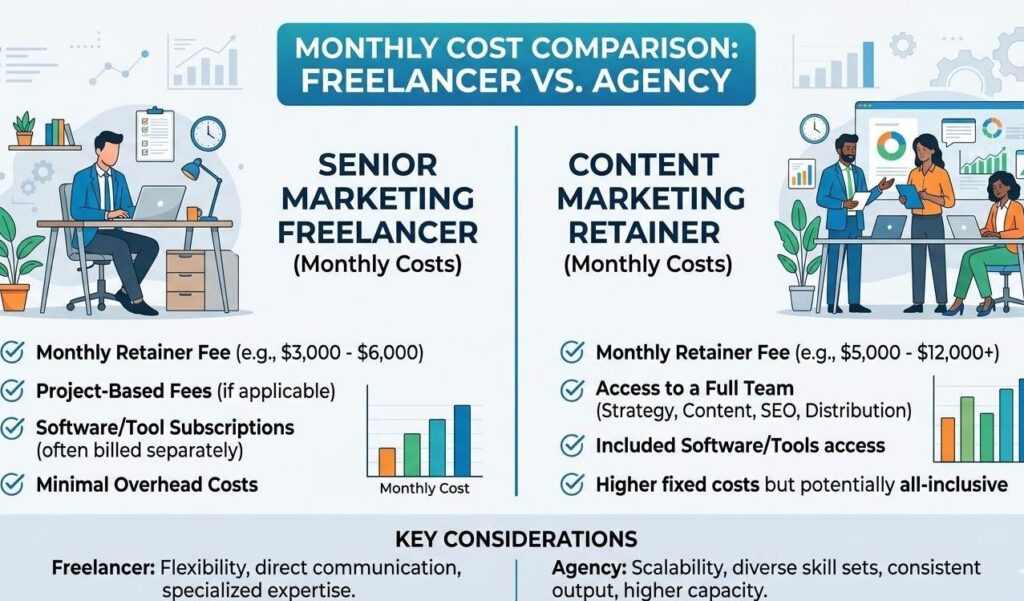
A senior freelance content strategist or SEO writer typically costs $1,500 to $3,000 per month on retainer. A content marketing agency retainer starts at $2,500 and commonly runs $5,000 to $10,000 for mid-size clients. The direct cost difference favors the freelancer by 40 to 60%, but the real value comparison depends on what each model actually produces for that budget.
The hidden cost in agency relationships is overhead. When you pay a $5,000 monthly retainer, a portion covers account management, team coordination, project management tools and profit margin. The person actually writing your content often earns $25 to $35 per hour on the back end. By contrast, a senior freelancer charging $2,000 per month is the person doing the work, not someone briefing a writer who does it.
According to Amra and Elma’s 2025 freelance marketing rate study, the average hourly rate for marketing consultants globally sits at around $101. SEO consultants specifically charge $65 to $250 per hour depending on experience and scope. At those rates, even a senior freelancer billing 20 hours per month delivers strategy and execution for roughly $1,300 to $2,000, well below most agency retainers for comparable output.
The per-word and retainer pricing breakdown for SEO content writers in 2026 makes it easier to translate hourly comparisons into real project cost, so the two models can sit side by side on the same spreadsheet.
The Hidden ROI Factors That Cost Comparisons Miss
The real ROI difference between a senior freelancer and an agency shows up in three places that invoice comparisons rarely capture: strategic continuity, revision cycles and time to publish. Senior freelancers who own the full brief-to-publish workflow typically cut turnaround from three to four weeks at an agency to five to ten days on a monthly retainer. Fewer handoffs mean fewer errors and faster iteration.
Strategic Continuity and Brand Voice
Agencies rotate staff. A writer who knows your brand voice in March may leave by July and your new contact starts from scratch. A senior freelancer on a six or twelve-month retainer builds genuine product and audience knowledge over time. That compounding context rarely appears on an invoice but has real output value.
For businesses in regulated or technical niches, this continuity matters even more. A therapy-facing brand needs a writer who understands scope-of-practice language, referral ethics and therapeutic framing. A rotating agency team rarely builds that depth. It’s the kind of brand-specific expertise I develop across long retainers with clients in specialist industries, which you can see reflected across the work on wajahatamin.com.
Revision Cycles and Speed to Publish
Agency contracts often cap revisions at two rounds per piece. A senior freelancer on retainer typically works iteratively because there’s no account team billing for extra revision hours. That flexibility produces better output, but only if the freelancer has enough experience to self-edit before the first draft arrives.
According to AMAKA’s 2025 research on marketing agency costs, businesses switching to fractional or freelance models report 40 to 60% cost savings alongside faster turnaround and more direct attention. Speed and strategic depth at a lower cost is the combination most small businesses can’t find inside an agency structure.
When an Agency Genuinely Outperforms a Senior Freelancer
An agency makes more sense when you need more than writing: design, paid media, technical SEO audits and development all under one contract. A single senior freelancer handles content well but cannot simultaneously manage a PPC account, redesign landing pages and produce monthly video scripts. If you need five distinct disciplines running in parallel, an agency with specialist staff is the right fit.
Agencies also provide redundancy. If your freelancer gets sick or takes leave, delivery stops. An agency has backup resources, escalation paths and project management infrastructure that keeps campaigns moving without gaps. For high-volume clients publishing 20 or more pieces per month, that operational backup offers a genuine advantage one person can’t match.
The solution for most growing businesses isn’t choosing one model permanently. A senior freelancer handles content strategy and execution while specialist contractors cover design or ads. According to RecurPost’s 2026 freelance marketing rates guide, a senior freelance marketing consultant charges approximately $82 per hour, so a 20-hour month runs around $1,640. That’s lower than most agency retainers for comparable strategic output.
The freelance SEO expert vs agency comparison breaks this decision down specifically for SEO work, including what each model realistically produces over a 12-month period.
How to Vet a Senior Freelancer Before You Pay Senior Rates
Vetting a senior freelancer requires three checks: ranked content samples with confirmed organic results, references who describe strategic thinking rather than just writing volume and a clear process for keyword research, content briefs and performance tracking. Anyone who cannot show actual ranking evidence and explain the SEO reasoning behind their approach isn’t operating at a senior level.
Ask for three live published URLs and check each one in Ahrefs or Google Search Console. A senior SEO writer can tell you the target keyword, current rank and what on-page decisions drove the result. If the answer is “the client handles tracking,” the writer is a craftsperson but not a strategist. You may be paying strategic rates for execution-only work.
Also ask how they handle brief development. A senior freelancer should walk through their process unprompted: how they choose keywords, how they structure briefs and how they decide when a post needs a refresh. The seven warning signs worth checking before hiring any SEO content writer apply equally to individual freelancers and the writers inside agency teams.
The content strategy process I use with clients, which I outline on my SEO content writing services page, includes keyword mapping, brief templates and a reporting cadence so clients see what the content produces over time, not just at publication.

Want Strategy-Level Content Without the Agency Markup?
Most businesses don’t need an agency. They need one senior person who owns the brief, writes the content, tracks the results and iterates without three layers of approval in between. If that’s closer to what you’re looking for, reach out through my contact page and we’ll talk through your content volume, goals and what a senior freelance retainer would look like for your specific situation. No pitch, just a real conversation about what you need.
Frequently Asked Questions
Is a freelancer always cheaper than a marketing agency?
Usually yes at comparable experience levels, but not always at the senior end. A senior freelance content strategist charges $1,500 to $3,000 per month, while agency retainers start at $2,500 and commonly reach $5,000 to $10,000. A junior freelancer from a marketplace at $400 per month often produces output worth less than that in strategic value. The comparison that matters is senior freelancer versus agency at equivalent experience, not any freelancer versus any agency. At that level, the freelancer almost always costs less for comparable output.
Can one senior freelancer replace a full marketing team?
Not entirely, but a senior freelancer can replace the strategist and primary content producer on a small or mid-size team, and coordinate specialist contractors for design, video or paid ads. According to AMAKA’s 2025 research, businesses switching to fractional models report 40 to 60% cost savings over full agency retainers. One experienced freelancer with a small collaborator network often produces the same output as a five-person agency team at significantly lower cost, especially for businesses publishing four to eight pieces per month.
What happens if my freelancer gets sick or goes on vacation?
This is a real risk and worth addressing in the contract upfront. Ask any freelancer how they handle illness, leave and unexpected delays before signing. Senior freelancers on retainer typically build buffer time into their schedules and communicate availability changes early. For businesses publishing more than 15 pieces per month, the single-person dependency is a genuine operational risk. A smaller content schedule of four to eight pieces per month is far less exposed to delivery gaps than a 20-piece-per-month program running through one person.
How do I know if I’m actually getting a senior freelancer and not a junior writer?
Ask for three live published URLs and verify ranking performance in Ahrefs or Google Search Console. A senior practitioner can tell you the target keyword, current rank and what content decisions drove the result. Ask them to walk through their brief process and how they track performance after publishing. If either answer is vague, you’re looking at a writer rather than a strategist. Ranking evidence, a documented process and the ability to explain SEO reasoning are the clearest signals of genuine senior-level experience.
When should I move from a freelancer to an agency?
Move to an agency when you need more than two or three distinct disciplines running at the same time and cannot coordinate specialist freelancers yourself. If you’re managing paid media, technical SEO, content production and email marketing simultaneously as a solo founder, agency coordination starts to justify the overhead. Also consider an agency if content volume grows above 20 pieces per month and the single-point-of-failure risk becomes an operational reality rather than a theoretical one. According to Siege Media’s 2026 content marketing cost guide, agency investment at that scale often delivers measurable ROI when the content program is large enough to benefit from team infrastructure.