
TL;DR: SEO content writers in 2026 charge between $0.05 and $1.00+ per word depending on experience. Beginners sit at $0.05 to $0.10, mid-level writers at $0.15 to $0.30 and experienced writers at $0.30 to $1.00 or higher. Monthly retainers for small and midsize businesses typically run $1,500 to $5,000. According to ZipRecruiter’s April 2026 data, the average annual pay for a US-based SEO content writer is $84,151 or about $40.46 an hour. Healthcare, finance and legal topics add 30 to 50 percent to base rates. Writers who can show ranking results charge more than writers who only show samples.

Most service providers bury their pricing behind a contact form. That feels safe until you realize the person researching your rates just went to a competitor who published theirs.
If you are researching what an SEO content writer costs, you deserve a direct answer. This post covers real rate ranges by experience level, explains what drives the price up or should make you suspicious when it’s too low and walks through how I price my own work. What I can tell you from eight years of client work: publishing your pricing honestly is one of the cleanest ways to attract the right clients and filter out the wrong ones.
What Drives the Price of SEO Content Writing?
The cost of SEO content writing comes down to five things: the writer’s experience level, the niche’s complexity, whether keyword research is included in the scope, turnaround time and total word count. A 500-word product description and a 2,500-word pillar guide do not carry the same weight, and the rate reflects that. Most pricing confusion comes from clients comparing writers without controlling for these variables.
Experience is the biggest driver. A writer two years in and a writer with eight years of documented ranking results are not interchangeable at the same price, any more than a junior developer and a senior architect are.
Niche complexity comes second. General business content requires solid research. Healthcare content, legal analysis or B2B SaaS writing requires specialist knowledge, a higher accuracy standard and sometimes a compliance pass before publication. That adds time and cost.
Turnaround matters too. According to ClearVoice, rush jobs with 48-hour deadlines typically carry a premium of 25 percent or more above a writer’s standard rate. If you need speed, budget for it upfront rather than negotiating after the brief is sent.
Finally, scope creep is real. A 1,000-word draft that becomes 2,500 words because the brief changed mid-project should cost more. Set scope in writing before work starts.
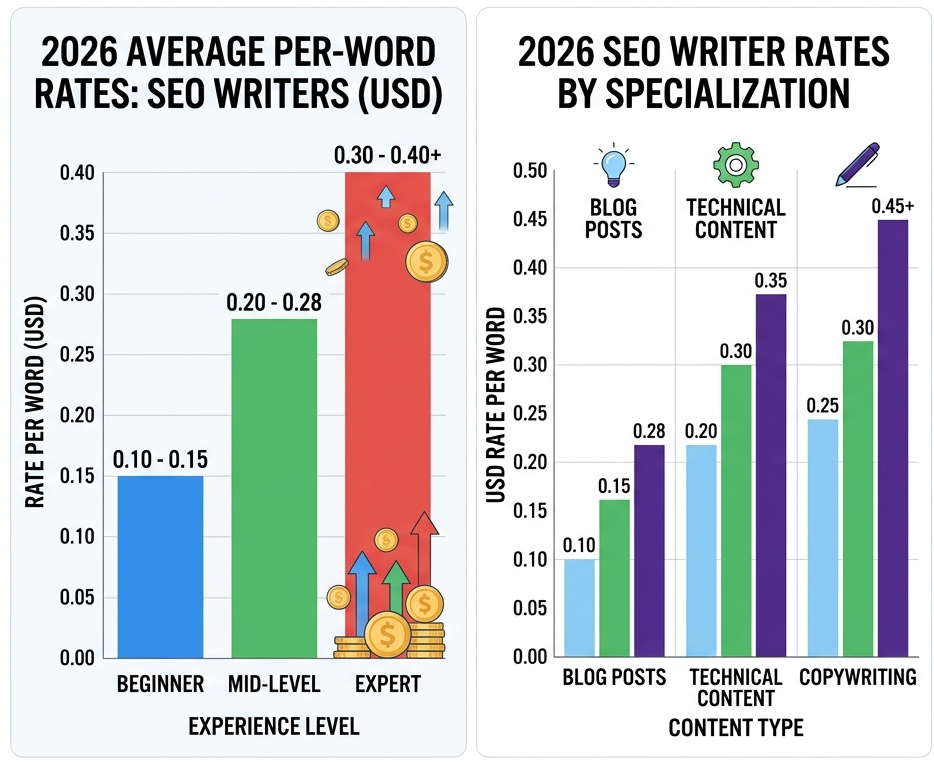
Per-Word Rates Explained: Beginner, Mid-Level, Experienced and Expert
Freelance SEO content writers charge between $0.05 and $1.00+ per word based on experience. Beginners (0 to 2 years) typically sit at $0.05 to $0.10, mid-level writers (3 to 6 years) at $0.15 to $0.30 and experienced writers (7 or more years) at $0.30 to $1.00 or higher. ClearVoice’s survey of 500-plus freelance writers found only 0.8 percent of expert writers charged $0.10 per word or less.
Here’s what those tiers look like in practice:
| Experience Level | Years Active | Per-Word Rate | What to Expect |
| Beginner | 0–2 years | $0.05–$0.10 | High revision rate, no ranking proof |
| Mid-level | 3–6 years | $0.15–$0.30 | Solid structure, improving SEO instincts |
| Experienced | 7–9 years | $0.30–$0.75 | Proven results, lower editorial overhead |
| Expert | 10+ years | $0.75–$1.00+ | Documented rankings, niche authority |
ClearVoice ran a direct quality test using three tech writers at three price points. The expert at $0.75 per word scored 6.1 out of 10 for editorial quality. The mid-level writer at $0.25 per word scored 5.8. The beginner at $0.10 scored 4.9. That gap sounds small in numbers but translates into real editorial time spent correcting, restructuring and re-researching work your internal team then has to review.
The same pattern holds across niches. ClearVoice ran the same study for travel writers and found the expert at $1.00 per word scored 7.4 out of 10. The beginner at $0.10 scored 4.4. Quality and price are correlated. Not perfectly, but consistently enough to use as a baseline.
Per-Project and Per-Blog-Post Rates
Per-project pricing bundles the per-word rate into a flat fee for a defined deliverable. A 1,000-word SEO blog post from a mid-level writer typically costs $150 to $300. A 2,000-word pillar page from an experienced writer runs $600 to $1,500. The flat rate usually covers research, drafting and one revision round, though what is and is not included varies by writer.
Project pricing is easier to budget than open-ended per-word billing. You know the total cost before the work starts.
What typically comes at an extra cost: additional revision rounds beyond the first, topic cluster research, metadata writing, internal link mapping and updating older posts to reflect new information.
If the writer you are considering cannot tell you clearly what is included in their project rate, ask for it in writing before signing off. Scope should not be ambiguous. A writer without a clear scope document is a writer without a clear process.
Monthly Retainer Pricing for SEO Content
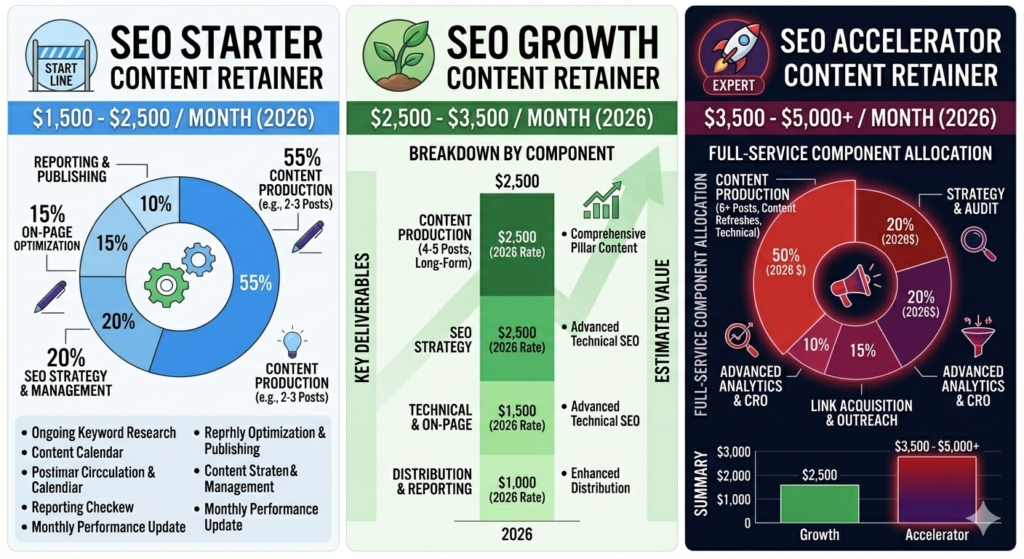
Monthly retainers for SEO content writing typically range from $1,500 to $5,000 for small and midsize businesses. That range usually covers four to eight blog posts per month, keyword research per piece and basic on-page guidance. Retainers above $5,000 generally indicate higher output volume, a more senior writer or strategy work included alongside production.
Here is how the tiers break down in practice:
$1,500 to $2,500 per month: Four posts per month, standard keyword research, general business or lifestyle topics. Right for a newer site building out foundational content and topical authority from scratch.
$2,500 to $4,000 per month: Six to eight posts, keyword clustering, competitive gap briefs, more structured internal linking. Better for established sites pushing into harder, more competitive keyword territories.
$4,000 to $5,000-plus per month: Higher volume with strategy included, specialist niche knowledge required. Common for healthcare, legal and finance brands where content accuracy carries real-world stakes.
Retainers make sense when you need consistent output over time. A single post rarely moves organic traffic. A calendar of 48 well-built posts over six months starts to build the topical depth that compounds. If you want to hire a freelance SEO content writer on an ongoing basis, a retainer structure almost always delivers a better per-post rate than one-offs.
Why Cheap Writers Cost More in the Long Run
A $0.05-per-word writer on a 2,000-word post costs $100. If that post never ranks, requires a full rewrite six months later and consumes three hours of internal review time, the real cost is closer to $400 or more. Thin content wastes crawl budget, publishing cycles and the months you could have spent building authority.
ClearVoice’s research is direct on this: writers who charge more produce measurably better work. In their tech writer study, higher-paid writers required significantly less correction and produced content the editorial team described as more naturally knowledgeable about the subject.
There is also an AI layer now. Many cheap writers are submitting lightly edited AI output. Google’s spam guidance, updated with the March 2024 Helpful Content rollout, treats thin and unoriginal content as a liability. A page that gets filtered does not just fail to rank. It can depress the authority signals of every page around it.
Writers who charge $0.30 to $0.75 per word and can show you the rankings to justify it have usually spent years developing source networks, research habits and editorial instincts that a $0.08-per-word writer has not had time to build. For a deeper look at this pattern, the post on 7 red flags to watch for when hiring an SEO content writer covers the specific signs that separate a quality writer from a risky hire.
What Should Be Included in Every SEO Content Package
A complete SEO content package should include primary and secondary keyword research, a structured brief or outline, the full written draft, at least one revision round, a meta title and meta description and basic on-page recommendations such as suggested internal links. If any of these are missing from what a writer proposes, ask about it explicitly before you agree to anything.
Some writers break keyword research into a separate add-on. That is fine as long as it is transparent upfront. What is not fine: receiving a post with no keyword strategy attached and being told “the SEO is in the writing.”
At minimum, your package should deliver:
- Primary keyword used correctly in the H1, first 100 words, at least one H2 and the meta title
- Secondary keywords woven naturally through the body, not repeated in every third sentence
- Meta title and meta description within character limits and written for click-through
- One revision round included before final delivery
- Two to four internal link suggestions that connect the new post to existing content
A writer who never asks about your existing content library cannot suggest internal links. That absence of curiosity is usually a sign of a transactional process rather than a strategic one. You can review what an affordable SEO content writer should still include at every budget tier in this related resource.

Red Flags When a Price Sounds Too Good
Three things stand out as reliable red flags: a per-word rate below $0.08 with no explanation of the writer’s process, no questions about your audience or existing content before the quote arrives and no samples linked to posts that have actually ranked. Price alone is not the problem. A low price paired with no process and no results is.
No Discovery Questions
A writer who quotes you without asking about your target audience, your competitors or your content history is treating writing as a commodity transaction. SEO content is not a commodity. The brief, the context and the existing site architecture all shape what a post should do and how it should be written.
AI Output Passed as Original Work
If the first draft reads like it could have been written for any client in any industry, it probably was generated and passed through a grammar checker. Ask about the writer’s research process. A good writer can tell you where their information came from and why they structured the post the way they did.
Vague Revision Policy
“Unlimited revisions” sounds generous until you are on the seventh round of a post that was never right from the brief stage. Ask what is included and how many rounds before additional fees apply. A writer with a clear process should have no trouble answering that.
How I Price My Own Work
I charge $0.20 to $0.45 per word for standard SEO blog posts, depending on niche complexity, required research depth and turnaround time. Monthly retainers start at $2,000. Specialized topics including healthcare, mental health, B2B SaaS and legal-adjacent content carry a premium because the research standard is higher and the margin for error is smaller.
What Eight Years of Client Work Taught Me About Rates
I built these rates over eight years writing for clients including Mayfair Therapy, Juggernet Communications and Alpha Ahead across niches ranging from mental health and therapy to communications and business services.
The rates are not based on what sounds competitive. They’re based on what the work actually takes: the research time, the keyword strategy, the structural thinking that goes into every brief before a word is written.
For one-off blog posts, I price on three factors: topic complexity, whether the client provides a brief or I build one from scratch and the level of keyword research the piece requires. For retainer clients, each post includes keyword research, a structured brief, the full draft, one revision round and a meta title and description. The retainer rate is lower per post than a one-off because predictable volume allows for a better workflow on both sides.
If you want to understand what that looks like for your specific niche and publishing goals, the fastest path is a conversation. You can start with a discovery call to talk through scope, budget and what results actually matter to your business.
Ready to Stop Publishing Posts That Disappear?
If you are done guessing at rates and want to work with a writer who can show you what well-built SEO content actually looks like in practice, I am happy to talk. Whether you need one test post or a consistent monthly output, the process starts the same way: a short conversation about your goals, your niche and what results matter. You can hire a freelance SEO content writer with a track record across competitive niches or start with a discovery call to figure out the right fit first. Either way, you get a straight answer, not a pitch.
FAQs
Why do SEO writers charge per word instead of per hour?
Per-word pricing makes scope easier to agree on before work starts. A 1,500-word post has a defined deliverable, so both the client and the writer know exactly what they’re agreeing to. Per-hour billing makes scope harder to predict and gives clients no clean way to compare quotes across writers. Most experienced SEO writers fold research, drafting, editing and basic on-page optimization into a single per-word rate rather than itemizing every task.
Is a $0.05-per-word writer worth it for SEO?
Usually not for SEO purposes. At that rate the writer is either very new, working at unsustainable speed or submitting lightly edited AI output without proper fact-checking. The hidden cost is not just rewrites. It’s the months your posts spend not ranking, the crawl budget spent on thin content and the publishing cycles you cannot recover. ClearVoice’s quality study found that even moving from $0.10 to $0.25 per word produced a measurable improvement in editorial quality for tech writing.
Do experienced SEO writers charge more for niche topics?
Yes. Healthcare, finance and legal content typically adds 30 to 50 percent to a writer’s base rate. These topics require compliance awareness, specialist research and a higher degree of factual accuracy because the stakes for the reader are real. Writers who work in these niches have usually developed source networks and fact-checking habits that general writers have not had reason to build.
Should I pay for keyword research separately?
Ask before you agree to anything. Some writers include a primary keyword and a cluster of secondaries in their base rate. Others charge separately for a full keyword map or topic cluster. Neither approach is wrong. What matters is knowing before work begins so the keyword strategy is connected to the post from the start rather than tacked on after.
How many blog posts per month should I budget for before I see SEO results?
Google’s guidance on helpful content and consistent agency data both point to regular, quality publishing as a prerequisite for compounding traffic. Most SEO professionals recommend at least four to eight well-built posts per month for six to nine months before organic traffic starts to grow meaningfully. One post per month is generally not enough to build topical authority in a competitive niche.
What is the difference between a content writer and an SEO content writer?
A content writer writes clearly and engages readers. An SEO content writer does that and also understands keyword intent, content structure for search, internal linking, metadata optimization and how to write answer sections that get cited in AI Overviews. The SEO layer is not about inserting keywords. It is about writing in a way that satisfies both a reader and a search engine’s understanding of what the page is for and who it serves.
Can I hire an SEO writer for one post before committing to a retainer?
Yes, and most experienced writers offer this. A test post lets you evaluate voice, research quality and how well the writer follows a brief before you commit to a monthly arrangement. Expect to pay the standard per-post rate rather than a discounted trial rate. A writer who discounts their test post heavily is usually more interested in landing the retainer than in demonstrating their actual value.