
Quick Answer
E-E-A-T stands for Experience, Expertise, Authoritativeness and Trust. It is not a ranking factor, it is a framework Google’s human quality raters use to judge page quality, and their judgments train the ranking algorithm over time. Google states directly on its own documentation that trust is the most important piece, with the other three building toward it. In practice this means showing who wrote your content, proving they know the topic firsthand and backing claims with real sources, especially after a core update.
- Google’s own help page states outright that “trust is most important” among the four E-E-A-T pillars, according to Google Search Central.
- The current Search Quality Rater Guidelines run 182 pages and were last updated September 11, 2025, per Google’s official guidelines document.
- The March 2026 core update was the most volatile on record, with 79.5% of top three positions changing hands, according to SE Ranking data reported by Search Engine Land.
- E-E-A-T is not a direct ranking factor. Raters do not adjust rankings themselves, their scores feed into how Google trains its algorithm over months, not individual pages.
- Citing sources and references is one of the confirmed quality signals Google’s own guidelines point raters toward, according to Backlinko’s ranking factors breakdown.
Running SEO strategy at Adnnel for clients across healthcare, real estate and restaurants has made one thing obvious: most site owners think E-E-A-T is a checklist item, something you bolt on with an author bio and call it done. It is not a checklist. It is the lens Google’s human raters use to decide whether a page deserves to rank at all, and after the volatility of the March 2026 core update, sites without real trust signals took the hardest hits. This breakdown of what separates high-trust pages from the rest draws on the same SEO strategy and GEO work Wajahat covers across the site, applied specifically to what raters and AI citation engines check first.

What E-E-A-T Stands For
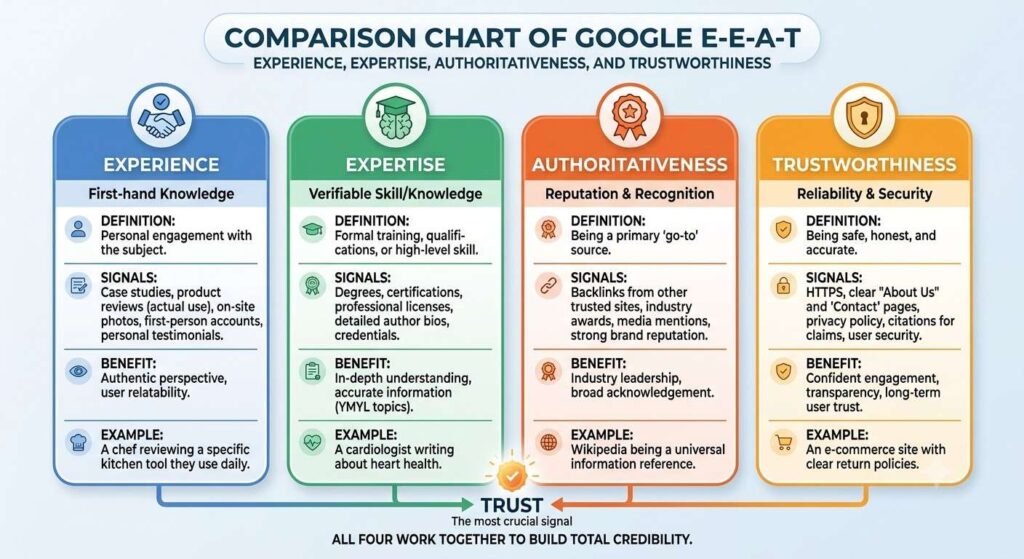
E-E-A-T is short for Experience, Expertise, Authoritativeness and Trust, a framework Google’s Search Quality Rater Guidelines use to describe what separates a genuinely helpful page from one that only looks helpful. Google added the second E for Experience in December 2022, expanding the older E-A-T model to reward content written by people who have lived through what they are describing, not only researched it.
The four pillars are not weighted equally. Trust sits at the center, and the other three exist to build toward it. A page can rank well by demonstrating strong experience even without deep formal credentials, or by demonstrating expertise even without decades of brand history, but every path runs through trust eventually. Google’s own language makes this explicit rather than leaving it open to interpretation.
Why E-E-A-T Is Not a Ranking Factor
E-E-A-T does not sit inside Google’s algorithm as a direct scoring input the way page speed or mobile-friendliness does. It is a set of criteria that around 16,000 contracted quality raters around the world use to manually evaluate search results, and their evaluations become training data that shapes future algorithm updates. No single page gets an E-E-A-T score that pushes it up or down in real time.
That distinction matters because it changes how a site owner should respond to a ranking drop. Chasing an imaginary “E-E-A-T score” wastes time. Building the underlying signals, clear authorship, cited sources, demonstrated firsthand knowledge, is what shifts how raters judge a page, and rater judgments compound into algorithm behavior across future updates.
Experience
Experience asks whether the person behind the content did the thing they are writing about firsthand. A product review carries more weight from someone who used the product than from someone who summarized ten other reviews. Original photos, specific details only a firsthand user would know and disclosed personal outcomes all signal this to a rater.
Expertise
Expertise covers demonstrated knowledge and skill, which does not always require a formal credential. A hobbyist woodworker with fifteen years of documented projects can show expertise as clearly as a licensed professional, depending on the topic. For YMYL topics like health or finance, Google’s raters hold this bar much higher.
Authoritativeness
Authoritativeness is about reputation beyond your own site. It shows up as citations from other reputable sources, mentions in industry publications and a track record other people in the space reference regularly. This is the pillar that is hardest to fake since it depends on how others treat you, not how you describe yourself, and it overlaps heavily with the kind of topical authority building that strengthens an entire site rather than a single page. Adnnel’s own client work on E-E-A-T and author authority engineering treats this pillar as a site-wide project, not a one-page fix, since a single well-cited article rarely moves the needle on its own.
What Changed After the March 2026 Core Update
The March 2026 core update rewarded trust signals more visibly than any update in recent memory, and the volatility data backs that up directly. Nearly 80% of top three positions shifted during the rollout, and roughly one in four pages that had ranked in the top 10 fell completely out of the top 100, according to SE Ranking’s analysis reported by Search Engine Land.
The pattern in that data points toward one conclusion: pages built on original data, named authors and cited sources held their ground, while templated or aggregated content without clear ownership lost visibility. This lines up with what the current Quality Rater Guidelines instruct raters to look for, since the September 2025 revision added explicit guidance for evaluating whether content shows genuine originality or repackages what already exists elsewhere.
How to Build Real E-E-A-T Signals
Fixing E-E-A-T starts with the parts of a page a rater can see and verify directly, not internal claims about how trustworthy a brand is. These same signals carry over directly into getting cited by AI engines in 2026, since ChatGPT and Perplexity lean on the same markers of firsthand experience and sourcing. The table below breaks down the signal, what it looks like in practice and which pillar it strengthens most.
| Signal | What It Looks Like | Pillar It Builds |
| Named author with a real bio | Full name, credentials, link to a professional profile | Expertise, Trust |
| Firsthand detail in the content | Specific results, dates, original photos or data | Experience |
| Cited external sources | Links to primary sources with named publications | Trust, Authoritativeness |
| Third-party mentions | Coverage or citations on other reputable sites | Authoritativeness |
| Updated publish dates | Content reviewed and refreshed on a real schedule | Trust |
| Clear contact and about pages | Verifiable business details, not a stock template | Trust |
Citing references and sources is a signal Google’s own guidelines explicitly call out for topics where expertise matters, which is exactly what shows up in Backlinko’s breakdown of confirmed and inferred ranking factors. In a 2026 content audit for a healthcare client at Adnnel, adding named physician reviewers and dated citations to a set of previously anonymous articles preceded a recovery in rankings that had dropped during an earlier core update, though Google never confirmed which specific change drove the recovery.
Get Your Site’s E-E-A-T Signals Reviewed
A site can look polished and still fail every E-E-A-T signal a rater checks first: no named author, no cited sources, no evidence anyone on the team has done the thing they are writing about. Adnnel’s SEO, GEO and AEO services include a dedicated E-E-A-T and author authority layer built specifically around what raters and AI citation engines both look for now. If you want a straight read on where your site’s trust signals stand, reach out through the contact page and get a plain answer, not a sales pitch.
Frequently Asked Questions
Is E-E-A-T a confirmed Google ranking factor?
No. Google has stated directly that E-E-A-T is not a specific ranking factor. It is a framework used by human quality raters to evaluate search results, and their evaluations help train Google’s algorithms over time rather than adjusting any single page’s ranking directly.
How do I add E-E-A-T to a website that has generic AI-generated content?
Start by adding named, verifiable authors and firsthand details AI cannot fabricate, such as specific dated results or original data. Google has confirmed that AI-assisted content is acceptable if it demonstrates real editorial oversight and adds genuine value, but content that is purely automated with no added expertise gets the lowest quality ratings.
Does my small business site need E-E-A-T if it is not a YMYL topic?
Yes, though the bar is lower than for health or finance sites. Every site benefits from named authorship, cited sources and evidence of real experience, since these same signals also influence how ChatGPT and other AI engines choose which sources to cite in their answers.
Why did my rankings drop after a core update even though nothing changed on my site?
Core updates reassess how Google weighs quality signals across the entire index, so a page can lose position because competing pages improved their trust signals, not because anything on the original page got worse. Google’s own guidance says a ranking drop does not necessarily mean something is broken.
What is the fastest E-E-A-T fix for an established website?
Adding real author bios with verifiable credentials to existing content, along with dated citations to primary sources, tends to be the highest-impact and lowest-effort fix. It does not require new content, only stronger authorship and sourcing signals on pages that already rank.