
Quick Answer
Most ecommerce product pages in 2026 lose visibility from four repeatable mistakes: manufacturer descriptions copied word for word, missing or incomplete Product structured data, thin copy that never answers a real buyer question, and images with no useful alt text or file naming. Fixing these does not require a redesign. It requires rewriting copy at the SKU level, adding complete schema fields and treating every product page as something both a shopper and an AI shopping agent need to read. Google’s AI Overviews already appear on 14% of shopping queries, up from 2.1% a few months earlier.
- Google AI Overviews now appear on 14% of shopping queries, a 5.6x jump from 2.1% only months earlier, according to a Visibility Labs analysis reported by Search Engine Land.
- Only 38% of pages cited inside AI Overviews still rank in Google’s traditional top 10, down sharply from 76% a year earlier, according to Ahrefs’ updated citation study.
- Google’s own case study data shows Nestlé measured an 82% higher click-through rate on pages using structured data compared to pages without it, per Google Search Central.
- Product structured data is not optional guesswork. Google documents the exact required and recommended fields directly in its Product structured data reference.
- Copying manufacturer descriptions does not trigger a direct penalty, but when several stores use identical text, Google shows only one version and the rest lose visibility in practice.
Auditing ecommerce catalogs at Adnnel across apparel, home goods and specialty retail clients has turned up the same handful of mistakes on nearly every account, regardless of platform or catalog size. Stores keep treating the product page as a container for a manufacturer feed instead of a page that has to earn its own ranking. That gap matters more now than it did even a year ago, since AI Overviews and Google Shopping are both reading the same page for distinct signals. This post breaks down the specific on-page elements still getting missed, building on the same SEO and GEO strategy work Wajahat covers across the site, and what fixes them.

Why Most Product Pages Still Underperform in 2026
Product page SEO in 2026 has to satisfy three separate systems at once: the classic organic result, Google Shopping’s merchant listings and AI Overviews that now summarize product comparisons before a shopper ever clicks through. A page built for only one of these tends to underperform on the other two, a pattern covered in more depth in our broader ecommerce SEO guide for product pages.
The AI layer is moving the fastest. Google’s AI Overviews appeared on roughly 14% of shopping queries as of early 2026, a jump of more than five times from a few months earlier, based on an analysis of nearly 21 million shopping search results. That growth means a product page missing clean structured data or original copy is not only losing traditional rankings anymore. It is also losing the chance to get pulled into the AI summary a shopper reads before deciding where to click, a competitive pressure that mirrors what we cover in ranking product pages against larger competitors.
The On-Page Elements Stores Keep Getting Wrong
Four on-page problems account for most of the lost visibility Adnnel finds during product page audits, and each one has a specific, testable fix rather than a vague best practice.
Duplicate Manufacturer Descriptions
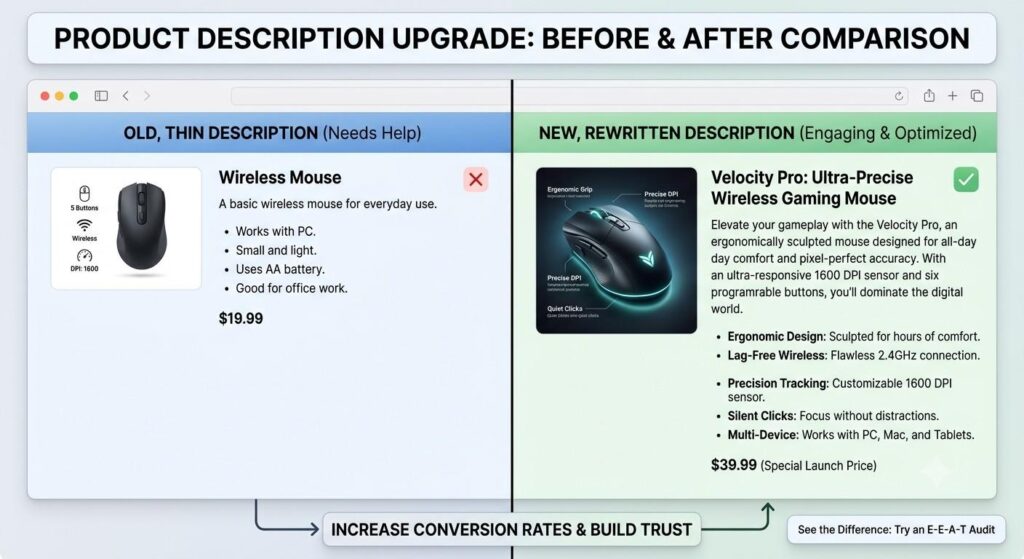
Copying a manufacturer’s product description word for word is still the most common mistake on ecommerce catalogs. Google has confirmed there is no direct duplicate content penalty for reused manufacturer copy, but when dozens of retailers carry the same description, Google indexes one version and treats the rest as redundant in practice. The fix is not a full rewrite of every SKU. Adding a short paragraph of original context, sizing notes, compatibility details or a comparison point the manufacturer copy omits is often enough to make a page meaningfully different.
Missing or Incomplete Product Structured Data
A product page without Product schema is invisible to the systems that decide whether to show price, availability and review data directly in search results. Google’s documentation lists required and recommended fields for both product snippets and merchant listings, and stores frequently implement only a fraction of them, usually name and price while skipping availability, brand, SKU and review data entirely. Since AI Overviews and Google’s Shopping Graph both read this same markup to decide whether a product deserves a citation, incomplete schema now costs visibility on two fronts instead of one.
Thin or Generic Product Copy
A product description under 100 words rarely answers the specific questions a buyer has before checkout: fit, material, compatibility, care instructions or how it compares to a similar item. Thin copy also gives AI systems less to work with when deciding which page best answers a shopping-related query, a distinction covered further in our comparison of semantic SEO versus keyword density. Pages that spell out these details in plain sentences, not only a bullet list of specs, tend to hold up better across both traditional rankings and AI citation. Adnnel’s product catalog rewrite process prioritizes this fix first for retail clients, since it is one of the cheapest changes with the widest payoff across every product page it touches.
Unoptimized Product Images
Product images still get uploaded with generic filenames and blank or keyword-stuffed alt text on a large share of catalogs Adnnel reviews. Descriptive filenames and alt text that describes what is shown accurately, paired with modern compressed formats, improve both crawlability and the page’s Largest Contentful Paint score, since the hero image is almost always the LCP element on a product page.
What Moves the Needle Across Both Search and AI
The table below breaks down each element, what stores typically get wrong and the specific fix that addresses both traditional search and AI shopping visibility at once.
| Element | Common Mistake | Fix That Works for Both Surfaces |
| Product description | Copied verbatim from manufacturer feed | Add original buyer-focused context: fit, use case, comparison |
| Structured data | Only name and price fields populated | Complete Product schema including brand, availability, SKU, reviews |
| Image alt text | Blank, generic, or keyword-stuffed | Descriptive alt text plus filename matching the actual product |
| Reviews | No review or rating schema on the page | AggregateRating and Review schema that matches visible review data |
| Page copy length | Under 100 words, spec list only | Full sentences answering fit, material and comparison questions |
Get Your Product Catalog Audited Before the Next Core Update
A single template fix can repair thousands of product pages at once if the underlying schema and copy structure are wrong across the whole catalog, which is exactly why a catalog-wide audit finds more than a page-by-page review ever will. Adnnel’s full-service marketing team runs exactly this kind of audit for ecommerce clients before recommending a single change, so the fixes target what is broken instead of guessing. If your catalog has not had a structured data and copy audit in the last core update cycle, reach out through the contact page and get a straight read on where the pages are leaking visibility.
Frequently Asked Questions
Does copying a manufacturer’s product description hurt my Google rankings?
Not through a direct penalty, but it hurts indirectly. Google generally picks one page to show when several stores use identical text, and the rest lose visibility even though no penalty was applied. Original context around fit, use case or comparison is what protects a page from being filtered out this way.
What structured data fields does a product page need in 2026?
At minimum a product page needs name, image, description, brand, SKU, offers with price and availability and aggregate rating if reviews exist. Google documents the full required and recommended field list directly in its Product structured data reference, and incomplete schema limits eligibility for both rich results and AI citation.
Why does my product page rank well but never show up in an AI Overview?
Ranking well no longer guarantees an AI citation the way it did a year ago. Recent data shows only 38% of AI Overview citations still come from pages ranking in the traditional top 10, down from 76% previously, which means structured data completeness and answer-focused copy now matter as much as ranking position.
How long should a product description be for good SEO?
There is no fixed word count, but descriptions under 100 words rarely answer the questions that drive both conversions and AI citation. A description that covers fit, material, use case and one comparison point tends to outperform a short spec list, regardless of exact length.
Do product images affect SEO rankings?
Yes, in two ways. Descriptive alt text and filenames help both traditional image search and AI systems understand what the product is, and the hero image is almost always the page’s Largest Contentful Paint element, so an unoptimized image slows down a core ranking signal directly.