
Quick Answer
Getting cited in ChatGPT, Perplexity and Google AI Overviews requires structuring content with a direct answer in the first 40 to 60 words, named statistics with sources and clear question phrased headings that AI systems can extract cleanly. Each platform weights different signals. Perplexity favors recent content and Reddit mentions, ChatGPT favors brand recognition and Wikipedia style authority, and Google AI Overviews still correlates with organic rankings more than the others. A 2024 Princeton and Georgia Tech study found that adding statistics and named source citations lifts AI visibility by 30 to 40 percent.
- The peer reviewed GEO study from Princeton, Georgia Tech, IIT Delhi and the Allen Institute for AI found that adding statistics improved AI citation visibility by 41 percent and citing external sources improved it by up to 115 percent for lower ranked pages, published at KDD 2024.
- Only 38 percent of Google AI Overview citations now come from pages ranking in the top 10 organically, down from 76 percent in 2024, according to Search Engine Land’s reporting on Ahrefs and BrightEdge data.
- An analysis of 680 million citations across ChatGPT, Google AI Overviews and Perplexity found only 11 percent of domains get cited by both ChatGPT and Perplexity, confirming each platform runs on different selection logic.
- Data cited by Sapt.ai shows AI referred visitors convert at roughly 14.2 percent compared to 2.8 percent for Google organic traffic, a meaningful gap in lead quality even with lower overall volume.
- Reddit accounts for 46.5 percent of Perplexity’s citations according to Frase’s 2026 research, while ChatGPT favors recognized brands and encyclopedic authority over conversational sources.
Most brands check Google rankings every week and have never once checked whether ChatGPT or Perplexity mentions them at all. That blind spot costs real pipeline. Wajahat Amin runs GEO audits for clients at Adnnel across several industries, and the same pattern shows up every time: a business ranking on page one of Google can be completely invisible inside an AI answer, because Google rankings and AI citations now run on overlapping but distinct logic. This guide covers what moves the needle on each major platform, backed by the research instead of guesswork, so the next AI answer in your category includes your name.
What AI Citation Means and Why It Differs From Ranking
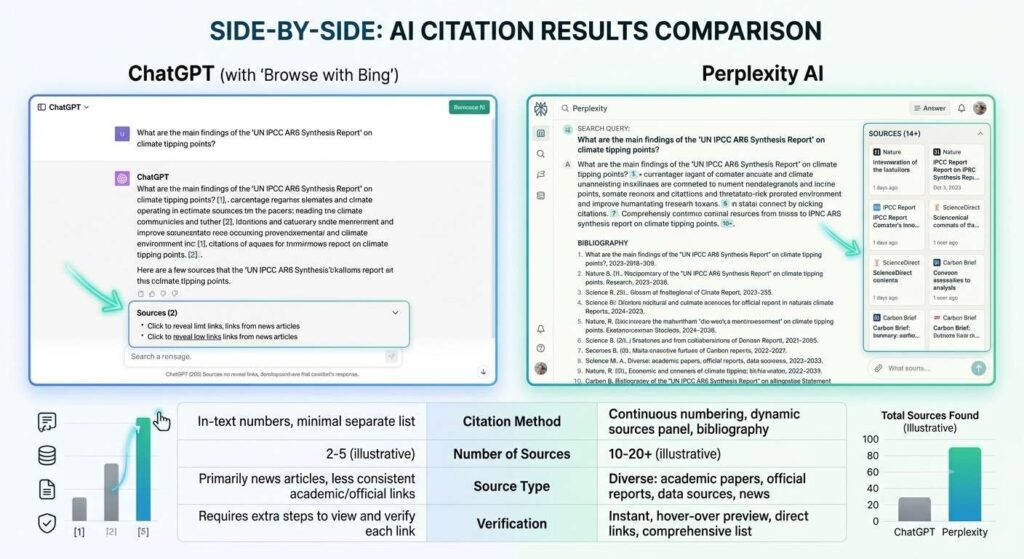
An AI citation happens when ChatGPT, Perplexity, Google AI Overviews or Claude name your brand or link to your content as the source behind a generated answer, which is a different mechanism than earning a ranked position in a search results list. A page can rank first on Google and never get cited, because AI systems extract specific passages rather than rewarding an overall page score.
This distinction matters because the two disciplines are converging less than most marketers assume. An analysis of 680 million citations across ChatGPT, Google AI Overviews and Perplexity found that only 11 percent of domains get cited by both ChatGPT and Perplexity, which means strength on one platform offers little guarantee on another. Google AI Overviews and Google AI Mode cite the same URL only 13.7 percent of the time despite frequently reaching similar conclusions.
The practical takeaway is that a single GEO strategy aimed at “AI search” in general will underperform a strategy that treats each platform’s citation logic as genuinely different, because the platforms are different.
The Research Behind GEO and What It Proved
The foundational research on AI citation behavior comes from a peer reviewed study by Princeton University, Georgia Tech, IIT Delhi and the Allen Institute for AI, published at the 2024 ACM SIGKDD Conference on Knowledge Discovery and Data Mining. The researchers tested nine content modification strategies across 10,000 queries and found that adding statistics improved AI visibility by 41 percent, while citing external sources lifted visibility by up to 115 percent for pages that started in lower ranked positions.
This research matters because it replaced guesswork with a controlled experiment. Before this study, GEO advice was mostly speculation extrapolated from traditional SEO. The same principle applies regardless of business size, a point covered in more depth in the generative engine optimization guide for small business, where the GEO-bench framework gets translated into a practical roadmap that does not require a research lab. The Princeton team built a benchmark called GEO-bench specifically to measure how generative engines select and weight content, then validated the strongest tactics against Perplexity as a real world deployment check.
What the Study Found Works
Five tactics produced measurable lifts in the study: citing sources, adding direct quotations, adding statistics, improving overall content fluency, and writing in a more authoritative voice. The top three tactics each produced gains in the 30 to 40 percent range individually, and combining fluency improvements with statistics outperformed either tactic alone by an additional 5.5 percent.
Where the Lift Is Biggest
The study found that pages starting around position five in traditional rankings benefited the most from GEO optimization, seeing visibility improvements as high as 115 percent. Pages already sitting in position one saw comparatively little change. This is useful context for prioritization: GEO work delivers the strongest return on content that is good but currently underperforming, not on content that already dominates its category.
Platform by Platform: How Each Engine Selects Citations
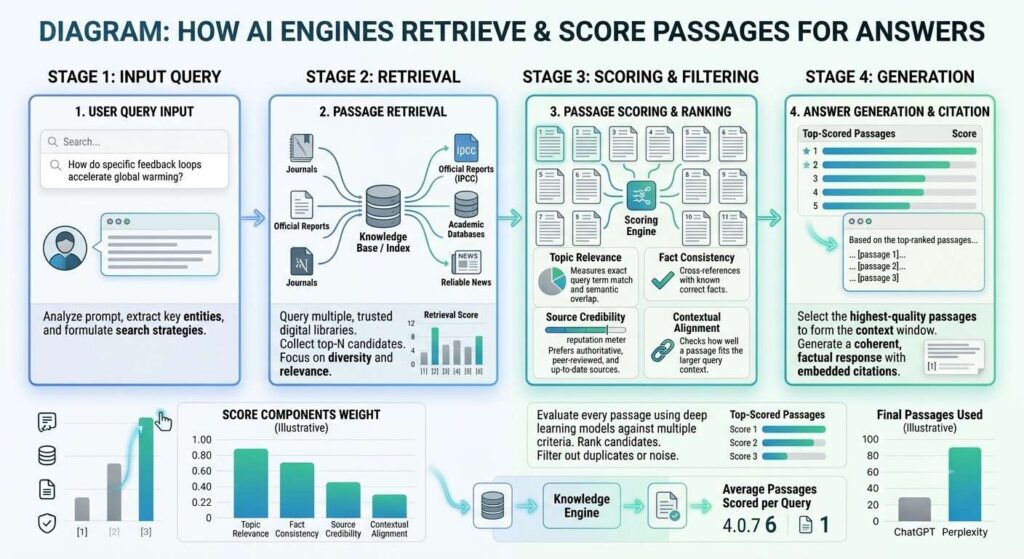
Each AI platform runs on different retrieval logic, so content built to win in ChatGPT will not automatically perform the same way in Perplexity or Google AI Overviews. Treating these as one undifferentiated channel is the most common mistake in GEO work right now.
| Platform | Primary Source Preference | Citation Behavior |
| ChatGPT | Recognized brands, encyclopedic authority, Wikipedia | Cites brands in roughly 0.59 percent of responses, but drives the largest share of AI referral traffic |
| Perplexity | Recent content, Reddit, conversational community sources | Cites sources in roughly 13.05 percent of responses, the highest rate among major platforms |
| Google AI Overviews | Organic top 10 rankings, though the correlation is weakening | Only 38 percent of citations now come from top 10 organic results, down from 76 percent in 2024 |
| Grok | Broad source pool with high citation frequency | Cites brands in roughly 27 percent of responses according to 2026 platform comparison data |
Optimizing for ChatGPT
ChatGPT relies heavily on its training data for general knowledge, which favors high authority encyclopedic sources, but its live retrieval layer for current information uses different signals built around content structure and semantic relevance. This split matters because it means ChatGPT citation strategy needs to work on two timelines: building durable brand recognition for the training data layer, and structuring individual pages for clean extraction in the live retrieval layer.
Brand mention volume across the web correlates strongly with ChatGPT citation likelihood, since the platform treats consistent name recognition as a trust signal independent of any single page’s quality. This means a brand’s presence on third party sites, press coverage, podcasts and review platforms feeds AI visibility just as much as the brand’s own website does.
Optimizing for Perplexity
Perplexity performs a live web search for every query rather than relying primarily on stored training data, which means freshly published content can appear in its citations within hours of being indexed. This makes Perplexity the fastest platform to test new content against, since results show up almost immediately compared to the weeks-long lag typical of Google AI Overviews.
Recency and community validated content carry significant weight in Perplexity’s selection logic, with Reddit alone accounting for a substantial share of its citations according to Frase’s 2026 research. A page published or meaningfully updated within the past twelve months has a real advantage here, which means a content refresh calendar is not optional housekeeping. It is an active GEO lever.
Optimizing for Google AI Overviews
Google AI Overviews still draws more heavily from existing organic rankings than the other platforms, but that correlation has weakened considerably. Search Engine Land’s reporting on Ahrefs and BrightEdge data found that only 38 percent of AI Overview citations now come from pages in the top 10 organic results, down sharply from 76 percent in 2024.
That gap means a page does not need a top ranking to earn an AI Overview citation, provided the content answers the query clearly within its opening section and carries strong semantic completeness. Traditional SEO fundamentals still help here more than on Perplexity or ChatGPT, but they no longer guarantee the outcome the way they once did.
Building a Page Structure AI Engines Can Extract
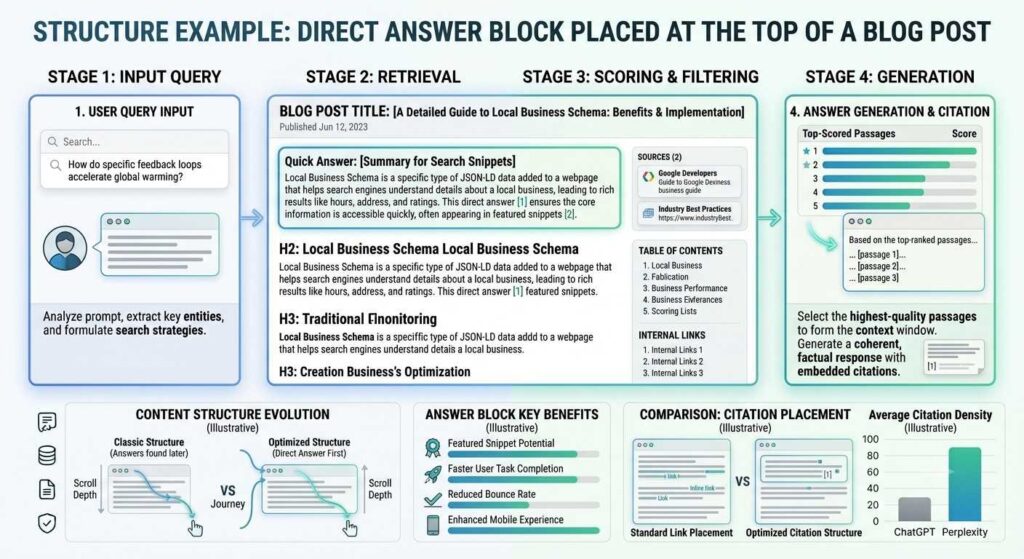
A page structured for AI citation opens every major section with a self contained answer in the first 40 to 60 words, uses headings phrased as the questions readers ask, and supports every significant claim with a named source. This structure exists because AI engines retrieve and score passages individually rather than evaluating a page as one undifferentiated block of text.
The opening section of any page carries disproportionate weight. Growth Memo’s research, cited widely across GEO guides in 2026, found that 44.2 percent of all LLM citations come from the first 30 percent of an article’s text. This is the strongest single argument for putting the direct answer immediately after the heading rather than building up to it through several paragraphs of context.
Headings That Match How People Ask AI Engines Questions
Phrase H2 and H3 headings as direct questions rather than descriptive labels, since this format mirrors the exact phrasing a person would type into ChatGPT or Perplexity and makes the matching section easier for the engine to retrieve and quote. A heading like “How long does it take to get cited by ChatGPT” outperforms a generic label like “Citation Timeline” because it matches conversational query patterns directly.
Naming Entities and Sources Explicitly
Name the specific publication, researcher or organization behind every statistic rather than writing vague attributions like “studies show” or “research indicates.” AI engines build more confidence in a claim when the source is verifiable and named, which is also the foundation of the trust signal Google’s E-E-A-T framework rewards. A claim attributed to “the Princeton GEO study published at KDD 2024” carries more retrieval weight than the same claim attributed to nothing at all.
Why Brand Mentions Outside Your Own Site Matter More Than Most Teams Realize
Brand mentions across third party sites correlate more strongly with AI citation likelihood than domain authority or backlink volume alone, because AI systems treat independent verification as a trust signal that a single domain cannot manufacture on its own. Ahrefs’ study of 75,000 brands across ChatGPT, Google AI Mode and AI Overviews found that YouTube mentions correlated with AI visibility at roughly 0.737, compared to 0.266 for Domain Rating, with branded web mentions landing between 0.66 and 0.71.
This research reframes what counts as GEO work. Optimizing a single page is necessary but not sufficient. A brand’s presence across Reddit discussions, YouTube tutorials, industry publications and review platforms feeds the same citation engine that a well structured blog post does, often with more weight. If a brand exists only on its own website with no independent third party validation, AI systems treat its claims with more skepticism and tend to recommend competitors with broader external presence instead.
This connects directly to the deeper mechanics covered in the guide on how ChatGPT chooses sources, which breaks down the consensus signal AI platforms look for before confidently citing a brand. It also reinforces why the answer engine optimization guide treats structure and brand presence as two separate, equally necessary tracks rather than one combined effort.
Measuring Whether Any of This Is Working
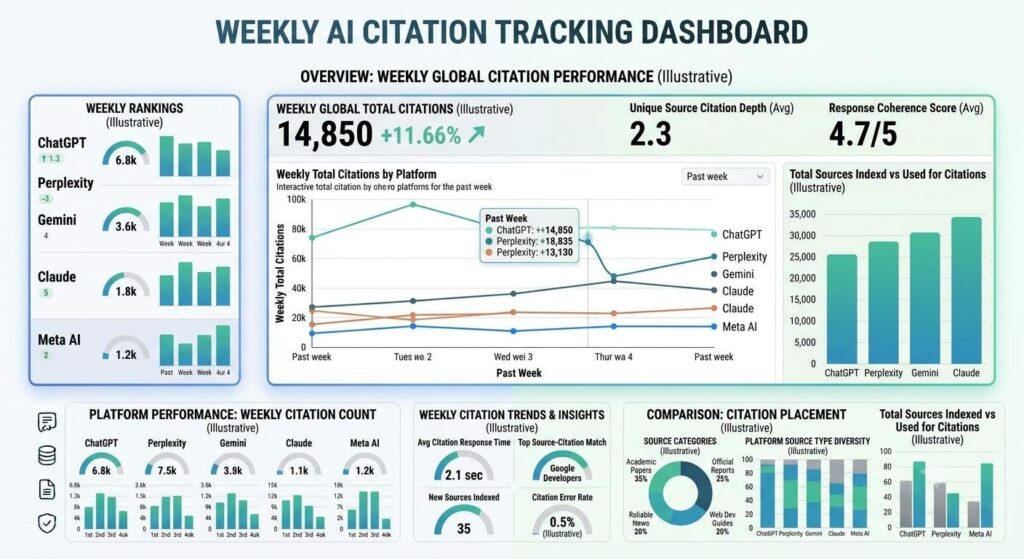
Most GEO measurement still happens manually, since the analytics tooling for AI citation tracking remains less mature than traditional SEO reporting. The most reliable approach combines a manual citation log with whatever automated tracking is available through existing tools.
A practical weekly process: pick ten target queries that represent the questions buyers ask, test each one on Perplexity, ChatGPT with web search enabled, and Google AI Mode, then log whether the brand was cited, where it appeared in the citation list, and what specific text got quoted. This takes roughly twenty minutes a week and requires no specialized software. Google’s own Search Console documentation confirms that AI Overviews now appear as a filterable search type inside the Performance report, which gives every site a built in starting point before reaching for a third party tool.
Google Search Console now includes an AI Overviews filter inside the Performance report, letting a site see which pages and queries trigger an AI Overview impression even without a click. This is a useful complement to manual testing since it surfaces visibility data Search Console previously had no way to report.
Build Your AI Citation Strategy Around This
Adnnel’s GEO and AEO services build this exact process for clients who need a structured content and brand presence strategy rather than a one-off audit. The work involves restructuring cornerstone pages for clean extraction, building out the FAQ and direct answer formats that earn citations, and developing the third party brand mention presence that AI platforms weight so heavily. If your current content strategy has never once been tested against a real AI query, the contact page is where that conversation starts.
Frequently Asked Questions
How long does it take for new content to get cited by ChatGPT or Perplexity?
Perplexity can cite new content within hours of it being indexed by Google or Bing, since it performs a live web search for every query. ChatGPT and Google AI Overviews typically take longer, often one to eight weeks, because they depend more heavily on existing search index timelines and training data updates. Perplexity is the fastest platform to test new content against for this reason.
Does ranking number one on Google guarantee a citation in AI Overviews?
No. Only 38 percent of AI Overview citations now come from pages ranking in the top 10 organically, a sharp drop from 76 percent in 2024. Semantic completeness, structured data and clear answer formatting now influence citation selection independently of traditional ranking position, which means a page outside the top 10 can still earn a citation if it answers the query more directly than higher ranked competitors.
What is the single highest impact content change for earning AI citations?
Adding named statistics with verifiable sources produces the most consistently measured lift across the research. The Princeton and Georgia Tech GEO study found this single tactic improved AI visibility by 41 percent, and citing external authoritative sources improved it by up to 115 percent for content that started in lower ranked positions. Combining this with a direct answer in the first 40 to 60 words of each section compounds the effect further.
Why does my brand show up in Perplexity but not in ChatGPT?
The two platforms use fundamentally different selection logic. Perplexity performs live retrieval for every query and weights recency and community sources like Reddit heavily, while ChatGPT leans on training data favoring established brand recognition and encyclopedic authority for many queries. An analysis of 680 million citations found only 11 percent of domains get cited by both platforms, so strong Perplexity visibility does not transfer automatically to ChatGPT.
Do brand mentions on sites I do not control help with AI search visibility?
Yes, and the effect appears stronger than domain authority alone. Research analyzing 75,000 brands found YouTube mentions correlated with AI visibility nearly three times more strongly than Domain Rating, with general branded web mentions also showing a strong correlation. AI systems treat third party validation as a trust signal a single domain cannot manufacture on its own, which is why a presence on Reddit, YouTube, industry publications and review sites matters as much as on-page optimization.