
Keys Takeaway: Real estate email marketing returns $36 to $42 for every $1 spent, according to Luxury Presence’s 2026 email guide citing Litmus and Avenue HQ data. The average open rate across real estate campaigns sits at 20 to 40%, according to Benchmark Email data cited by Luxury Presence. According to Digital Agency Network’s 2026 real estate marketing report, real estate email converts 40% better than social media while open rates average 25% across the industry. The agents who see those returns send segmented campaigns to distinct buyer and seller audiences, use a value-first welcome sequence and measure click-through rate and conversions rather than open rate alone, since Apple Mail Privacy Protection inflates open counts for a large share of inboxes.
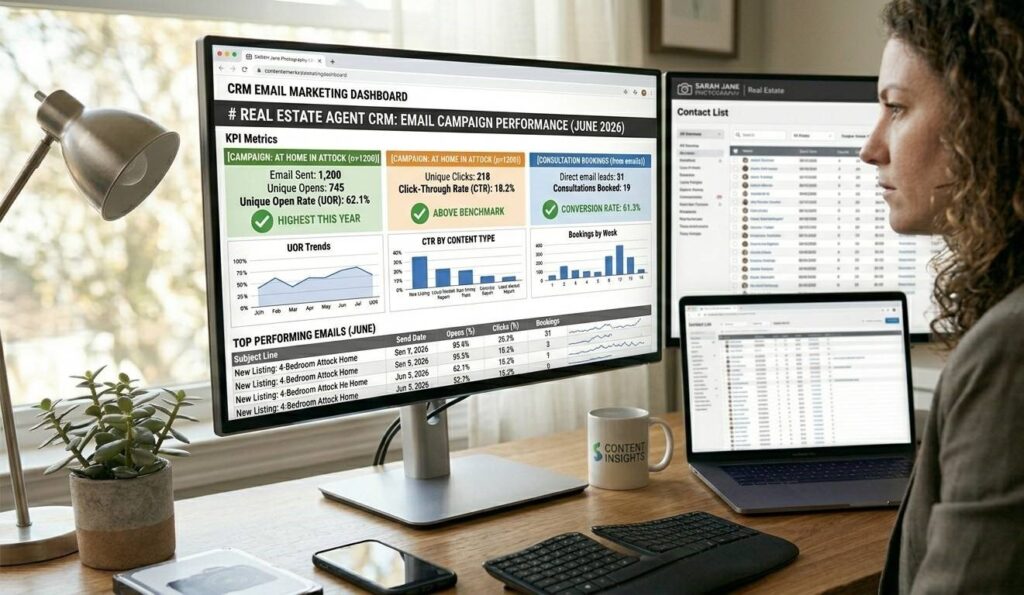
There are roughly 1.5 million NAR members competing for the same buyers and sellers in the US market, according to Taylor Scher SEO’s 2026 real estate marketing statistics. Most of them are posting the same market update graphic on Instagram and running the same Facebook lead ad. Real estate email marketing is the channel that builds the relationship underneath every eventual transaction. A prospect who found you six months before they were ready to buy still remembers you if you’ve been showing up in their inbox with something worth reading. This post covers what goes in the emails that actually convert and how to structure the sequences that keep your name at the top of the list when a lead turns into a client.
Why Real Estate Email Outperforms Every Other Marketing Channel on ROI
Real estate email delivers $36 to $42 for every $1 spent, and unlike paid ads, it continues working without ongoing ad spend. Your email list belongs to you regardless of algorithm changes, platform policy updates or rising cost-per-click rates. Once someone is on your list, each email costs only your platform fee and your time, which makes the return compound rather than reset with every campaign.
The key difference between email and social media in real estate is intent. Someone who signed up for your email list is inviting you into a channel they check daily and take seriously. They opted in. Social media reaches a passive audience scrolling between other content. According to Digital Agency Network’s 2026 report, email converts at 40% above social media for real estate, which is why agents who build their list consistently outbook agents who invest the same effort into social content.
The content I help real estate clients build at wajahatamin.com always includes an email distribution layer because the blog content and local guides that drive organic traffic also make the best email content. The two channels compound each other when the strategy connects them.
How to Segment Buyer and Seller Leads for Higher Engagement
Buyer and seller leads need different email sequences because their questions, timelines and decision triggers are completely different. A first-time buyer wants information about pre-approval timelines and neighborhood comparisons. A homeowner considering listing wants pricing data, staging tips and sold comps. Sending both the same email means neither audience gets what they need and engagement drops across the whole list.
Segment your list by lead source and stated intent from the first interaction. If someone downloaded a first-time buyer guide, they go into your buyer sequence. If someone requested a home valuation, they go into your seller sequence. Most real estate CRMs, including kvCORE, Follow Up Boss and HubSpot, support tag-based segmentation that automates this routing once you set it up.
According to Luxury Presence’s 2026 real estate newsletter guide, segmentation is the single biggest lever for email engagement. Sending the right content to the right segment can double your click-through rates compared to a single broadcast to your full list. That’s not a marginal improvement. It’s the difference between an email channel that drives consultations and one that drives unsubscribes.
The buyer research topics that drive traffic before a call are also the topics that perform best in buyer email sequences. If a buyer is Googling “how much down payment do I need,” they’ll also open an email with that subject line.
What a Real Estate Welcome Sequence Should Include
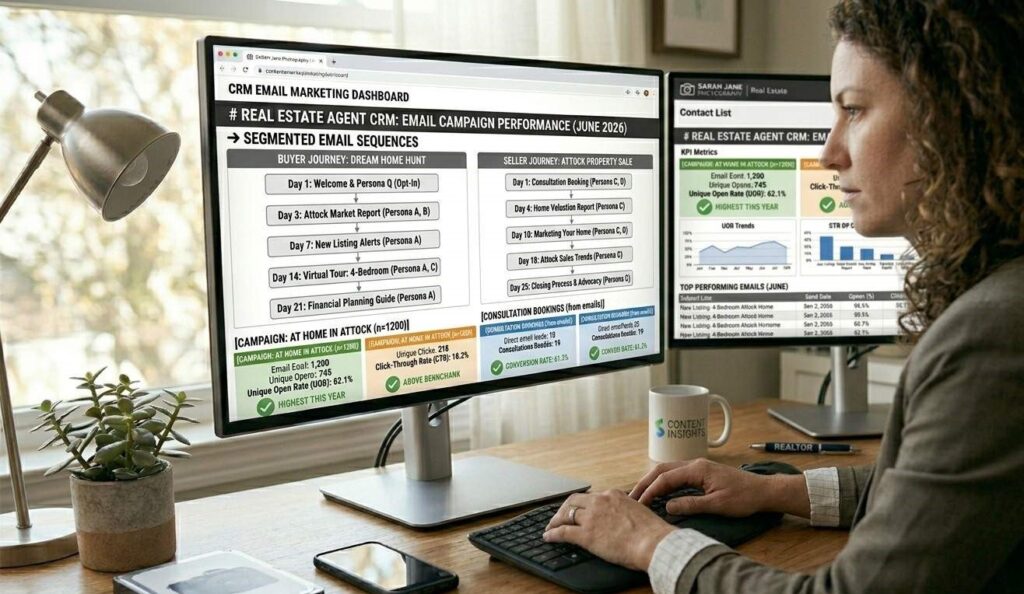
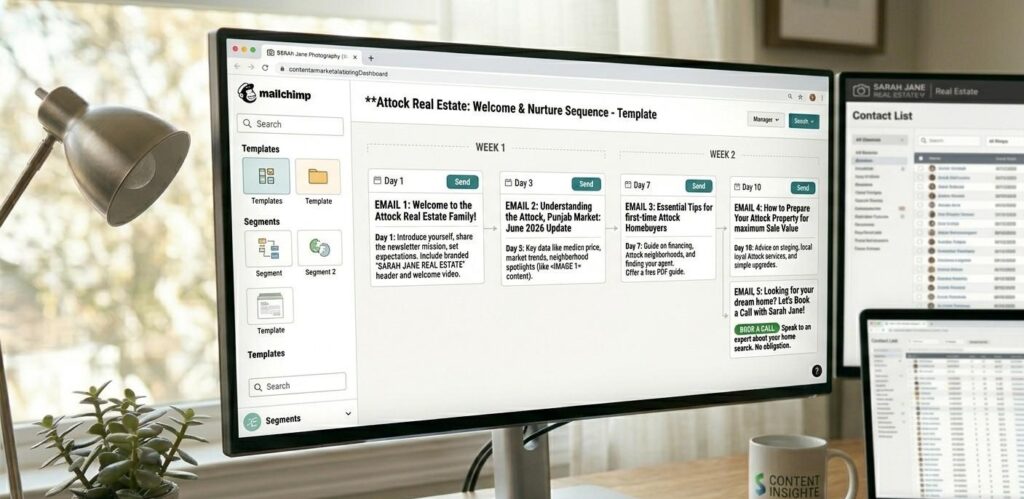
A real estate welcome sequence runs three to five emails delivered over the first two weeks after someone joins your list. It establishes your credibility, delivers clear value and tells the subscriber what to expect from future emails. Each message should have one primary call to action and address one specific question or concern the subscriber is likely to have at that stage.
Here’s the structure that works consistently:
| Timing | Purpose | CTA | |
| Email 1 | Immediately | Welcome, deliver the lead magnet if applicable | Follow me on Instagram or reply with a question |
| Email 2 | Day 3 | Your local market expertise or a market snapshot | Read my neighborhood guide |
| Email 3 | Day 7 | Answer one common buyer or seller question in depth | Check your home’s value or pre-qualify today |
| Email 4 | Day 10 | A local venue, neighborhood or community resource | View recent sold properties |
| Email 5 | Day 14 | Soft offer to connect for a no-pressure consultation | Book a 15-minute call |
According to a Luxury Presence 2025 case study on automated lead nurture, a well-built three-email drip campaign can boost buyer engagement by 43% and maintain a 0% unsubscribe rate when each message delivers clear value. Extending that to five emails with the same quality discipline produces similar results across a slightly longer relationship-building window.
For seller leads, swap the neighborhood guide in email two for a local pricing report and replace the pre-qualification CTA with a home valuation offer. The structure stays the same. The content shifts to match the seller’s question set.
What to Track in 2026 Now That Open Rate Is Unreliable
Track click-through rate, click-to-open rate and meaningful conversions rather than open rate as your primary metric. Apple Mail Privacy Protection, introduced with iOS 15, preloads tracking pixels and inflates open counts for any subscriber using Apple Mail on iPhone, iPad or Mac. By 2026, a large share of your list likely uses Apple devices, which means your open rate number overstates actual engagement.
Click-through rate, typically a target of 2 to 5% for real estate emails, tells you whether the content was relevant enough to prompt an action. According to Propphy’s 2025 real estate email benchmarks, well-segmented, hyperlocal newsletters exceed 50 to 60% open rates on tightly maintained lists. But the more reliable signal is CTR, which Propphy benchmarks at 3 to 4% for focused, single-CTA emails.
Define conversion for each email before you send it. In real estate, a conversion is a valuation request, a consult booking, an open house RSVP or a saved search creation. Tracking by email type over 90 days tells you which sequences are contributing to pipeline and which ones are filling time.
The same measurement discipline applies to blog content and lead magnets. The content brief approach that maps buyer intent before writing also applies directly to email subject line planning: you need to know what question the subscriber is asking before you know what subject line they’ll open.
Should Real Estate Emails Include Listings or Value Content?
Include both, but not in equal proportion and not in the same email. A broadcast email focused entirely on listings performs well only for active buyers who are close to making an offer. For everyone else on your list, listing-only emails train subscribers to ignore your messages because there’s nothing in them that helps until they’re ready to buy.
Value content, including market updates, neighborhood profiles, local event roundups and practical buyer or seller guides, keeps the relationship warm for the 95% of your list that isn’t ready to transact right now. According to Luxury Presence’s 2026 newsletter research, the agents who build the deepest client relationships share local context and lifestyle content, not just inventory.
The structure that works: send value content three times for every one listing-focused email. When you do include listings, segment them by buyer profile. Sending a $1.2M listing to first-time buyers in a $400K market is noise. Sending it to your move-up buyer segment or your investor contacts is relevant.
For the SEO content that feeds your email list through organic traffic, the neighborhood page strategy for real estate agents generates exactly the kind of local, specific content that converts in both search and email. The content I build for real estate clients through my SEO content writing services is designed to work in both channels: rank in search to grow the list, then deliver directly to subscribers who already trust the source.
Ready to Build an Email List That Books Consultations While You Sleep?
The agents who stay busy through market slowdowns and algorithm changes aren’t doing anything exotic. They’re showing up consistently in the inboxes of people who have already raised their hand. If you want email content that gives subscribers a real reason to open, click and eventually call, reach out through my contact page and share your audience type, your current sending cadence and what you’ve been sending so far. We’ll figure out where the gaps are.
Frequently Asked Questions
How often should realtors send emails to their list in 2026?
Once per week is the ideal frequency for active campaigns. Once per month is the floor for keeping your name relevant without being intrusive. The right cadence depends on your list quality: if you have a well-segmented, permission-based list of genuine leads, weekly value emails hold attention. If your list is a mixed database of cold contacts from years ago, monthly is safer until you re-engage dormant subscribers. Consistency matters more than frequency. An agent who sends a quality email on the first Tuesday of every month outperforms one who sends sporadically at high volume.
What should a real estate welcome email sequence include?
A five-email welcome sequence should cover your introduction and a delivered lead magnet on day one, your local market expertise on day three, one practical buyer or seller guide on day seven, a local community or neighborhood resource on day ten and a soft consultation offer on day fourteen. Each email needs one clear call to action, not three. According to Luxury Presence’s 2025 case study, a three-email drip with clear value boosts buyer engagement by 43% and keeps unsubscribe rates near zero. Five emails at the same quality standard extend those results further.
Do buyer leads and seller leads need separate email sequences?
Yes. A buyer wants pre-approval guidance, neighborhood comparisons and home search tips. A seller wants pricing data, sold comps and staging advice. Sending both the same sequence means neither gets content that addresses their actual situation. Segment by lead source and stated intent from the first interaction. Most real estate CRMs including Follow Up Boss and kvCORE support tag-based segmentation to route leads automatically. Segmentation also doubles click-through rates compared to sending a single broadcast to your full list, according to Luxury Presence’s 2026 newsletter research.
What is a good open rate for a realtor email list and can I still trust that number?
A 20 to 40% open rate is the benchmark range for real estate email campaigns, according to Benchmark Email data for 2025. But open rate is no longer fully reliable because Apple Mail Privacy Protection pre-loads tracking pixels, which inflates open counts for any Apple Mail user. Prioritize click-through rate (target: 2 to 5%), click-to-open rate and meaningful conversions such as valuation requests and consult bookings. Propphy’s 2025 benchmarks show well-segmented hyperlocal newsletters hitting 50 to 60% apparent opens, but CTR at 3 to 4% is the number that actually predicts revenue impact.
Should real estate emails focus on listings or educational content?
Send value content three times for every one listing-focused email. Listing-only emails only serve buyers who are actively looking right now, which is a small percentage of your total list at any given time. Local market updates, neighborhood guides, buyer process explainers and community resources keep the relationship warm for everyone else. When you include listings, match the price range and property type to the specific segment receiving the email. Irrelevant listings train people to ignore your messages. Relevant content keeps them engaged until they’re ready to transact.