
Keys Takeaway: Hair salon SEO centers on three signals Google uses to rank local service businesses: Google Business Profile completeness, service-specific web pages and review volume. According to theStacc’s 2026 salon SEO guide, salons with 100 or more photos on their Google Business Profile receive 520% more calls than those with under 10. According to SEO Sandwitch’s 2025 hair salon statistics report, 60% of salon appointments now originate through online search and 71% of clients say they discovered a new salon online in the past year. The US hair salon market holds over 1 million businesses competing for local clients, according to Boulevard’s 2025 industry data. For any hair salon, nail salon or barber shop, local SEO is the most consistent way to fill appointment slots without running paid ads every month.
Referrals still bring clients. But they bring the same clients your existing clients already know. Hair salon SEO brings people who are actively searching right now, in your neighborhood, on their phones. More than 1 million salons compete in the US alone, which means the average neighborhood has at least a dozen options nearby. The salons winning new clients consistently aren’t always the best. They’re the ones Google surfaces first. This post covers the specific actions that push a salon into the top-three local position and keep it there.
Why Google Business Profile Is the Foundation of Hair Salon SEO
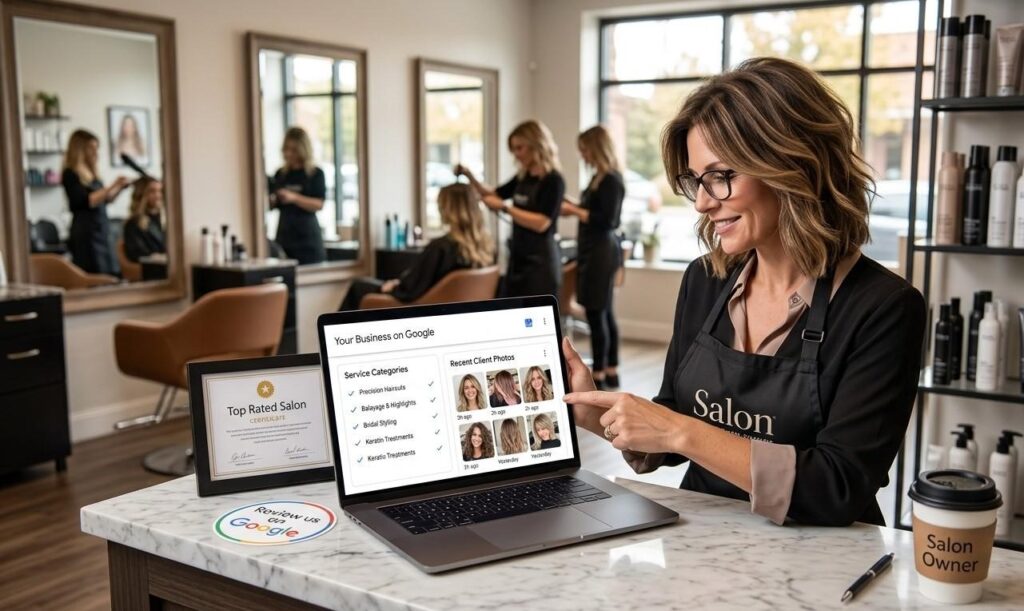
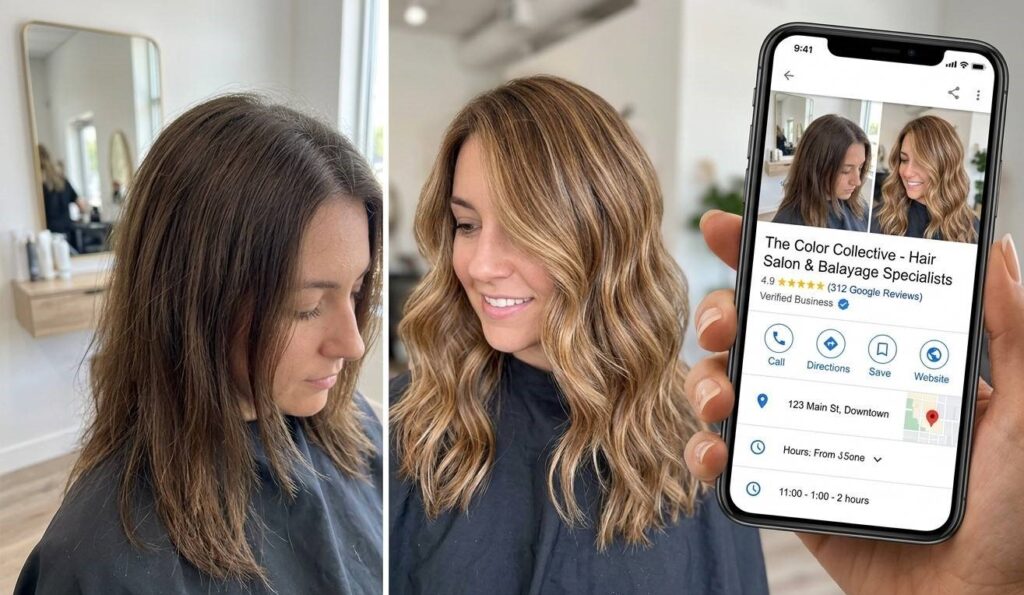
Your Google Business Profile controls your local map pack ranking more directly than any other single factor in hair salon SEO. A complete, active profile with photos, listed services and regular responses to reviews ranks above incomplete ones. According to theStacc’s 2026 salon SEO guide, salons with 100 or more photos get 520% more calls than those with fewer than 10 photos on their profile.
GBP completeness goes far beyond your name and phone number. Google lets salons list individual services with descriptions and prices, add specific categories and publish updates through Google Posts. Each detail tells Google exactly what you offer and for whom. If you also offer nail services, add “nail salon” as a secondary category. If you have a licensed esthetician, add “skin care clinic.” Specificity helps Google match your profile to searches that aren’t a perfect match for your primary category.
NAP consistency amplifies every other GBP signal. Your salon name, address and phone number must match exactly across your GBP, Yelp, Facebook and any booking platform listing your business. Inconsistent details suppress local rankings quietly. Most salons don’t catch the problem until they audit their citations and find three different phone number formats pointing to the same location.
The Google Business Profile optimization guide for 2026 covers the specific fields, photo upload cadence and post frequency that lifts map pack performance for local service businesses. The principles apply directly to salon profiles across all beauty categories.
How Service Pages and Local Keywords Fill Your Appointment Book
Each core service you offer deserves its own page on your website targeting a specific keyword combination: your service plus your city or neighborhood. “Balayage [city],” “keratin treatment [neighborhood]” and “bridal hair [city]” each draw a distinct searcher with distinct intent. One general services overview page cannot rank for all of them at the same time.
The keyword patterns that work best for salon SEO combine service specificity with location signals. Here are the keyword formats worth building dedicated pages around:
| Keyword Format | Example | Intent |
| Service + city | “balayage Chicago” | Ready to book |
| Service + near me | “keratin treatment near me” | High urgency |
| Walk-in + city | “walk-in haircut Austin” | Immediate need |
| Specialty + city | “natural hair salon Houston” | Targeted search |
| Bridal + city | “bridal hair and makeup Denver” | High value, planned |
| Barber + neighborhood | “barber shop Wicker Park” | Hyper-local |
According to Ronkot’s 2025 local salon SEO guide, 86% of salon-related searches happen on mobile devices. That means every service page must load fast and display a visible booking button without scrolling. A page that performs well in local search but fails to convert on mobile is still losing clients.
Internal links between service pages and related blog posts strengthen both. A page about color services gains authority from a blog post about “balayage vs highlights” linking to it. The blog post ranks for an informational query and steers readers toward the booking page.
The same local content logic I apply to restaurant SEO, covered in this guide on ranking and getting found in 2026, works for salons because both businesses compete for map pack visibility against dozens of nearby competitors with similar offerings.
The Review System That Separates Ranked Salons from Invisible Ones
Google weighs review quantity, recency and keyword content when ranking salons in the local map pack. A salon collecting five genuine reviews per week consistently outranks one with a higher overall score but infrequent new reviews. According to theStacc’s 2026 guide, fewer than 10% of clients leave reviews without being asked, so a proactive and repeatable system is the only reliable path to review volume.
Building a Review Intake System That Runs Every Week
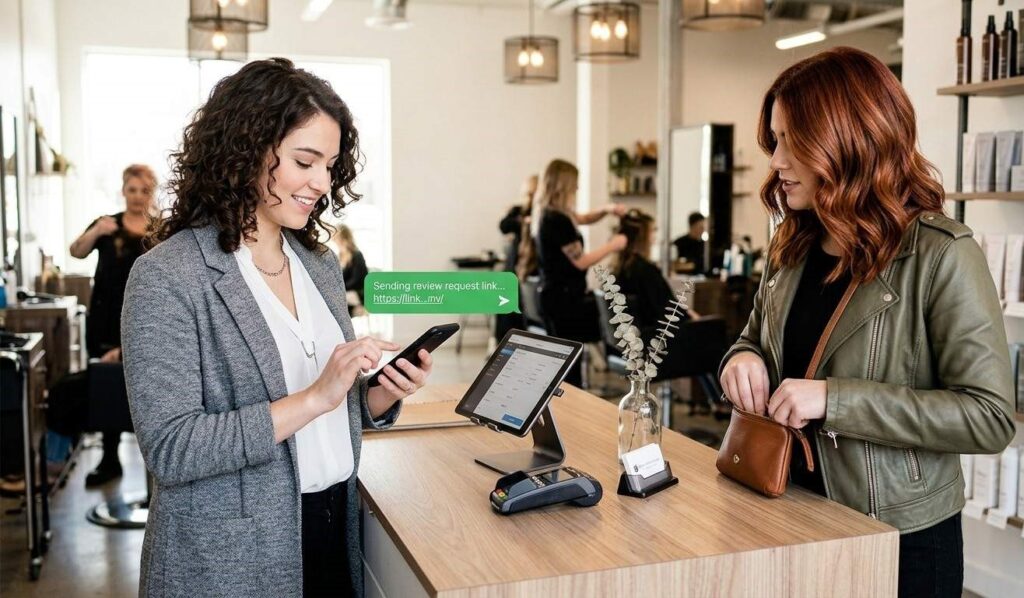
The most effective system combines an in-person ask at checkout with an automated follow-up text within two hours of the appointment. At two hours, the client still has the feeling of a fresh color result or clean style. That’s the moment when a positive review is most likely. A direct link to your Google review page removes every friction point between the ask and the action.
Train your front desk to make the ask part of checkout, not an afterthought. A simple script works: “We’d really appreciate a Google review. Can I text you the link right now?” That one line, consistently delivered, outperforms email campaigns and QR codes sitting on countertops.
How to Handle Negative Reviews Without Losing Future Clients
Respond to every negative review within 24 hours. Acknowledge the specific issue without being defensive and offer to resolve it offline. That pattern shows future clients your salon handles problems professionally. Google also confirms that responding to reviews improves local ranking, so every reply has both a client-trust and an SEO function at the same time.
Positive reviews deserve responses too. A short, specific reply to a five-star review signals an active owner and gives Google fresh indexed content on your profile at no cost.
How Local Blog Content Supports Hair Salon SEO Without Replacing Core Pages
Blog content works for salon SEO specifically when it targets informational searches clients run before booking. Posts comparing “balayage vs highlights,” explaining “how long a keratin treatment lasts” or covering “what to expect on your first visit” capture readers weeks before they decide who to call. That early touchpoint builds familiarity that converts when the client is ready.
According to SEO Sandwitch’s 2025 statistics, websites with blogs receive 55% more visitors than those without one. For salons, the most effective blog topics address local-specific concerns: humidity-related frizz for coastal markets, winter dryness for colder cities or UV damage for high-sun climates. A post like “managing color fade in Miami heat” ranks faster locally than any national-audience beauty content because it targets a problem Google can connect to a geographic area.
The content approach I use for local service businesses across contractor trades and hospitality, which I lay out in the local SEO work for plumbers, electricians and HVAC companies, follows the same structure: service pages first, then blog content targeting the questions clients research before making a call.
Blog posts work best when they link back to the relevant service page and carry a clear booking prompt at the end. The content structure I recommend to clients also appears across the local SEO work on wajahatamin.com, which covers beauty, therapy, real estate and contractor services from a consistent keyword-mapping approach.
For salons looking at which content types to prioritize, the SEO content writing services page outlines how service pages, blog content and GBP updates work together in a 90-day local ranking program.
Ready to Turn Local Searches Into Full Appointment Books?
Most salon owners already do the hard work. The SEO piece is about making sure Google knows it. If you want a content strategy built around your specific services, your city and your best clients, get in touch through my contact page and we’ll talk through what your local search presence actually looks like right now. No guesswork, just a clear look at where the ranking opportunity sits for your business.
Frequently Asked Questions
Should my salon blog or just focus on optimizing existing pages?
Start with your core website and Google Business Profile before adding any blog content. Build one service page per major treatment you offer, optimize your GBP with photos and accurate categories and get your review system running. Then add blog content in month two or three. A blog helps, but service pages are what actually rank for booking-intent searches. According to SEO Sandwitch’s 2025 research, 60% of salon appointments now originate through online search, so the pages driving those searches need to be your first priority.
Does Instagram help my salon rank on Google?
Instagram itself doesn’t directly improve your Google search rankings. But it supports salon SEO indirectly by driving brand search volume. When more people search your salon name directly on Google after discovering you on Instagram, Google interprets that as a brand authority signal. Also, Instagram content can be repurposed into website blog posts that do rank in search. The direct ranking drivers are still your GBP, website service pages and Google reviews. Instagram is brand-building, not an SEO shortcut.
Do I need a separate page for every service I offer at my salon?
Yes, for every service that has its own search demand. “Balayage,” “keratin treatment,” “bridal hair” and “men’s haircut” each attract distinct searches with distinct intent. A single services page listing everything cannot rank for all of them simultaneously because Google matches specific pages to specific queries. Start with your five highest-revenue services, build one clear page per service with your city name in the content and expand from there. Long-tail keywords like “partial highlights [city]” convert better than broad terms and face less competition.
How do I rank for “hair stylist near me” on Google?
Ranking for “hair stylist near me” requires a complete and active Google Business Profile more than anything else. Google uses your profile’s relevance, proximity and prominence to rank “near me” searches. Upload new photos weekly, collect Google reviews consistently and ensure your services are listed in your GBP with accurate descriptions. Your website also needs to mention your city name and neighborhood in the homepage copy, service pages and page titles. According to Ronkot’s 2025 salon local SEO guide, 76% of people who search for a local business visit one within 24 hours, so that near-me ranking converts quickly.
Can my stylists have their own individual pages on the salon website?
Yes, and it’s worth doing for stylists with specialized services or significant followings. A dedicated page for each stylist listing their specialties, certifications and a booking link creates additional indexed pages on your website and targets searches like “[stylist name] hair colorist [city].” These pages also build trust with new clients who prefer to research the specific person doing their hair before booking. Link each stylist page to their relevant service pages and keep the content specific: their techniques, training credentials and the types of clients they work best with.