
Keys Takeaways: Ecommerce SEO product pages that rank in 2026 share four things: original copy of 150 to 400 words, complete Product schema in JSON-LD format, keyword-focused H1 tags and verified customer reviews with AggregateRating markup. According to Charle Agency’s 2026 ecommerce SEO analysis, organic search drives 43% of all ecommerce traffic. Pages with schema markup earn 20 to 40% higher click-through rates than pages without it. Manufacturer copy, thin descriptions and Shopify’s default duplicate URL structure are the three most common reasons product pages stay stuck on page two. Structure beats keyword density in 2026.
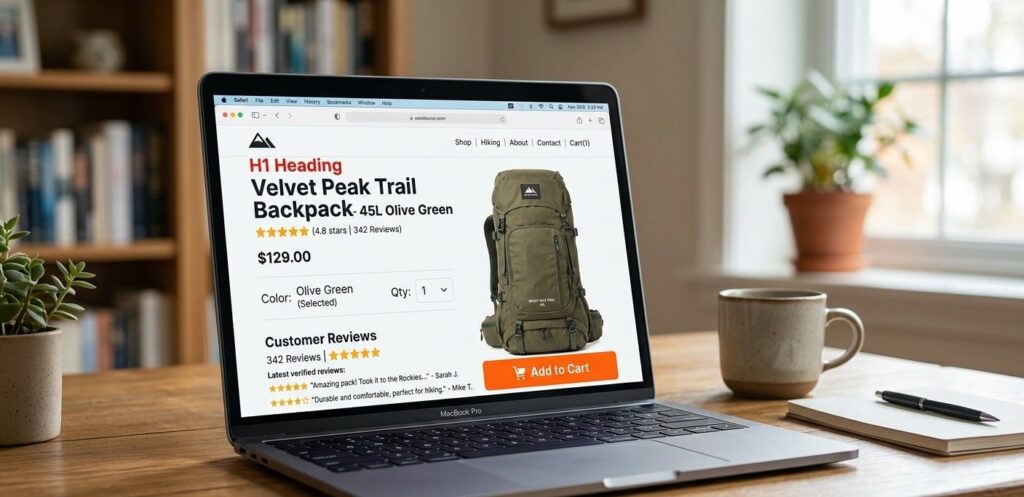
Organic search still accounts for 43% of all ecommerce traffic, yet most product pages are built to look good, not to rank. The description is a copy-paste from the distributor. The schema is missing. The H1 is the product model number with no context for what a real person would search. I’ve audited product pages across multiple online stores, and the pattern is consistent: the structural basics are almost always the problem, not the competition. Fixing ecommerce SEO product pages comes down to a handful of decisions made at the template level.
Why Most Ecommerce Product Pages Don’t Rank
Most product pages fail because they rely on thin content, manufacturer copy or duplicate URLs. According to Hashmeta’s ecommerce ranking factor analysis, product schema accounts for 35% of Google’s ranking weight on product pages, followed by page speed at 20% and reviews at 18%. Structure matters more than keyword count.
The numbers are uncomfortable. Charle Agency’s 2026 report found that 96.55% of all indexed pages get zero organic traffic from Google. For product pages, that number is likely higher because most share the same template, the same manufacturer description and no unique signal that tells Google this page is the best answer.
Product pages also fight a structural problem. Because the same SKU often lives at multiple URLs, Google has to guess which version to rank. That guess rarely lands in your favor.
What Every Product Page Needs to Be Built for 2026 SEO
Every ranking product page in 2026 needs a keyword-based H1, unique descriptive copy of 150 to 400 words, optimized image alt text and visible trust signals like reviews. These elements work together. Missing one weakens the others, so the right approach is to fix them as a group at the template level.
The Above-the-Fold Zone
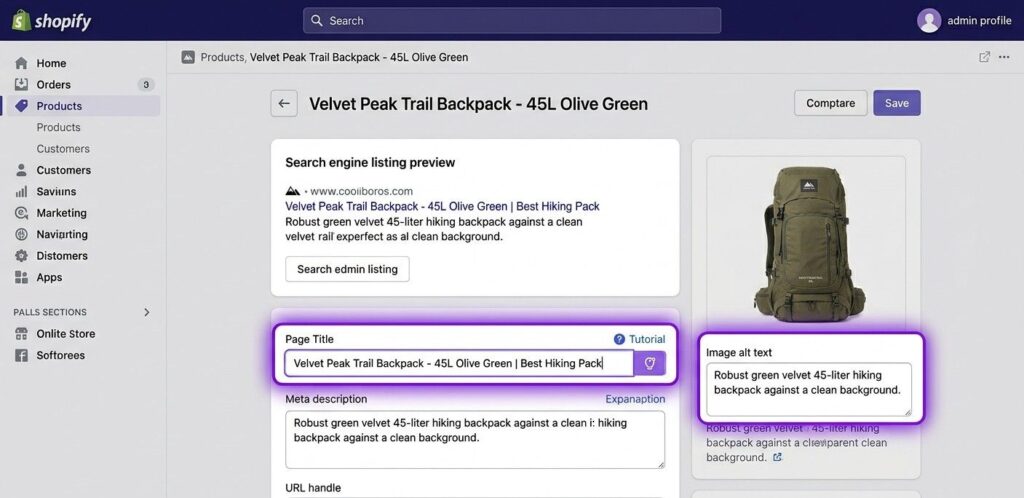
The top of your product page needs to solve a buying decision fast. That means the H1 should include the product name and a key modifier (size, use case or material), the primary image should have descriptive alt text, and the short 50 to 80 word summary should answer the buyer’s main question directly. Google reads this zone first, so keyword placement here matters more than anywhere else on the page.
At wajahatamin.com, the starting point for every ecommerce content brief is this zone. If the above-the-fold copy isn’t clear and structured, the rest of the page can’t compensate for it.
The Content Depth Layer
Below the fold, product pages need at least 300 words of original content. This is where you answer the secondary questions: who is this for, what problem does it solve, how does it compare to similar items? A well-built page also includes an FAQ section drawn from real customer questions, which feeds directly into FAQPage schema and helps capture featured snippets. The semantic signals in this layer are what separate pages that hold rankings from pages that briefly appear and then drop.
Does Ecommerce Schema Markup Actually Change Your Rankings?
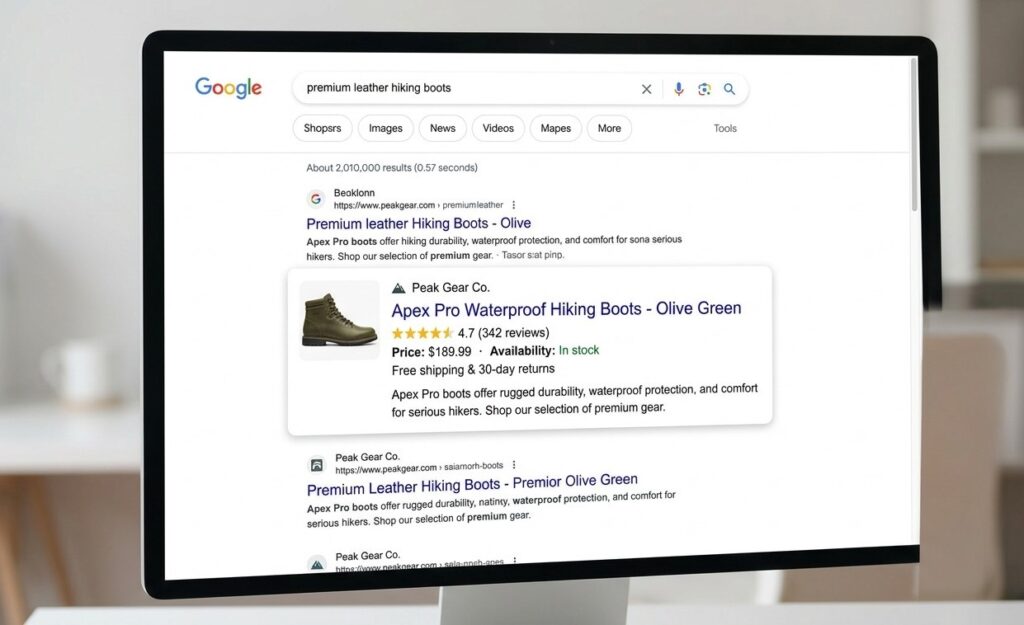
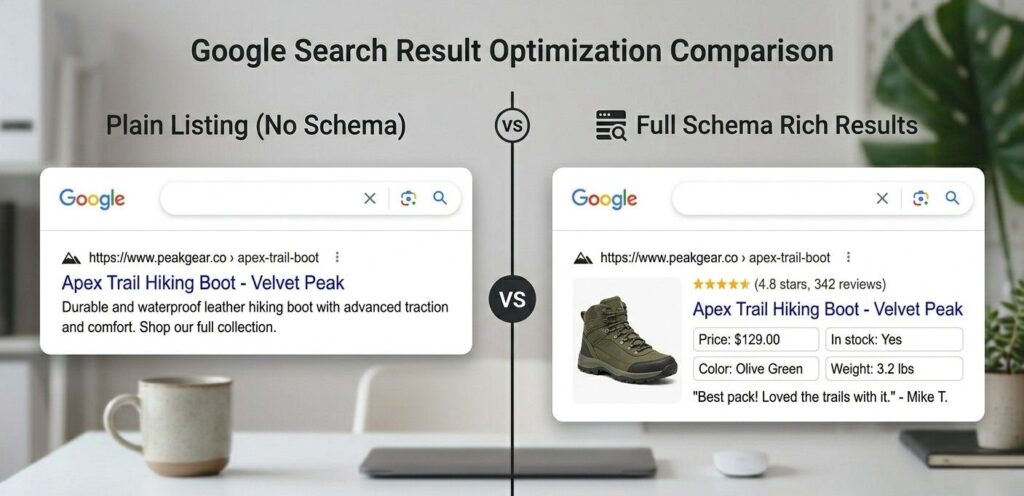
Product schema doesn’t directly boost your ranking position. Instead, it earns rich results (star ratings, price and availability in search) that lift click-through rates significantly. According to ALM Corp’s ecommerce schema markup guide, rich results achieve 82% higher CTR than standard organic listings. That CTR improvement then feeds back into your ranking as an engagement signal.
For any online store, these five schema types are non-negotiable:
| Schema Type | What It Displays in Search |
| Product | Name, image, description |
| Offer | Price, availability, currency |
| AggregateRating | Star rating and review count |
| BreadcrumbList | Site hierarchy in the URL |
| FAQPage | Expandable questions in results |
All five should run in JSON-LD format, which Google recommends because it doesn’t require changes to your visible HTML. For Shopify stores, apps like JSON-LD for SEO and Smart SEO handle most of the implementation automatically.
The connection between ecommerce schema markup and answer engine optimization is direct. AI search systems pull structured data first, so a page with complete schema has a real advantage in Google AI Overviews, ChatGPT citations and Perplexity results.
How Shopify SEO Creates Hidden Duplicate Content Problems
Shopify generates two live URLs for every product: one under /products/ and one under /collections/[name]/products/. Both are crawlable by default, which creates a duplicate content problem that splits your ranking signal and confuses Google about which version to index.
The fix is simpler than most store owners expect. According to Shopify’s own SEO checklist, canonical tags should point all collection-level product URLs back to the /products/ path. This consolidates link equity to one URL and tells Google exactly which page to rank. It doesn’t require a developer in most cases. You just need your internal navigation and links to point to /products/ consistently.
I outline content and structural pricing for ecommerce stores on my SEO content writing services page, but this canonical fix should always come before any content investment. A 2025 audit by Qualimero confirmed that Shopify’s duplicate URL structure is the platform’s single biggest ranking problem, and fixing it at the start changes what’s possible with everything that follows.
Why Product Images Are Still the Most Overlooked Online Store SEO Fix
Product images are the most visited element on any product page however most stores leave alt text blank or fill it with keyword lists. Descriptive alt text tells Google what the image shows, improves accessibility and helps products appear in Google Image Search, which drives purchase-ready traffic.
Page speed matters here too. According to Think with Google data cited in a 2026 Deloitte retail conversion study, pages that load in 2 seconds have a bounce rate of 9% while pages that take 5 seconds hit 38%. So, a 100-millisecond improvement in load time can increase retail conversion rates by up to 8.4%. Compress product images to under 200KB and serve them in WebP format.
Write alt text that actually describes the image, for example: “Black leather bifold wallet with four card slots, open on a wooden table.” That level of specificity helps both Google and users. The same principle that improves performance in generative engine optimization applies here: the more precisely you describe what’s on the page, the more confidently AI systems can surface your content.
Ready to Build Product Pages That Hold Rankings in 2026?
I work with ecommerce brands and Shopify store owners who are tired of watching traffic go to competitors with thinner catalogs and weaker products. If you want product pages that rank and stay ranked past the next algorithm update, reach out and let’s talk through what that looks like for your store.
Good structure is the most underused competitive advantage in ecommerce SEO. I’d genuinely welcome the conversation.
FAQs
How long should product descriptions be?
For flagship or high-traffic product pages, aim for 300 to 500 words of original copy below the short above-the-fold summary. For lower-traffic products, 150 to 200 words is the minimum you need to give Google something unique to index. Manufacturer copy doesn’t count because it appears across hundreds of other sites, so it contributes no unique value to your page and signals nothing distinctive to Google.
Do I need unique copy for every product variant?
Not always. If variants differ only by color or size, they can share a canonical URL with one well-written description. But if variants differ meaningfully, such as different materials or distinct use cases, then each one deserves its own URL and its own description. Use Shopify’s canonical tag to point all variant URLs back to the primary product page when the content is shared, so you consolidate ranking signals to one place.
Should I use manufacturer descriptions or write my own?
Write your own. Manufacturer copy appears across hundreds or even thousands of competing sites, so it creates no unique signal for your page. According to Shopify’s guide on SEO product descriptions, unique descriptions let you apply your brand voice and speak to your specific buyer’s pain points directly, two things a manufacturer data sheet will never do for you.
How does Product schema help rankings?
Product schema doesn’t directly change where you rank, but it changes how your listing looks once you’re already in the results. Pages with full Product schema (including Offer and AggregateRating) earn rich results showing price, availability and star ratings in search. Charle Agency’s 2026 analysis found that rich results achieve 82% higher CTR than standard listings. That CTR signal feeds back into your rankings as a positive engagement indicator over time.
Are product reviews a ranking factor?
Reviews influence rankings in two ways. First, AggregateRating schema earns star ratings in search results, which improves click-through rates. Second, Google treats review quantity and recency as a trust signal, especially since the Product Reviews Update. Research cited by GroPulse found that products with 50 or more reviews convert 18% better than products with fewer. So reviews drive both rankings and revenue, which makes them worth actively collecting through tools like Loox or Judge.me.