
TL;DR: A content brief template is a structured document that tells a writer the target keyword, search intent, audience, word count, heading structure, internal links and required sources before they write a single word. Briefs that include all of these elements produce first drafts that need fewer revisions and rank faster. According to Semrush’s 2025 data, AI Overviews appear on 88 percent of informational queries. Content built without a brief rarely includes the answer capsules, named entities and FAQ schema that AI citation requires. According to Ahrefs’ AI Overview study, only 38 percent of AI citations come from top-10 results, so brief quality directly affects whether content earns AI visibility at all.
Most content briefs fail before the writer opens them. They list a keyword, a rough word count and maybe a competitor URL, then leave the writer to guess the rest. The result is a draft that misses search intent, buries the main answer three paragraphs deep and arrives with none of the structural elements that help Google or AI engines extract a citable response. A content brief is not a suggestion document. It is the production spec that determines whether the final post earns rankings, AI citations and actual reader trust, or just takes up server space.
What a Content Brief Template Must Include
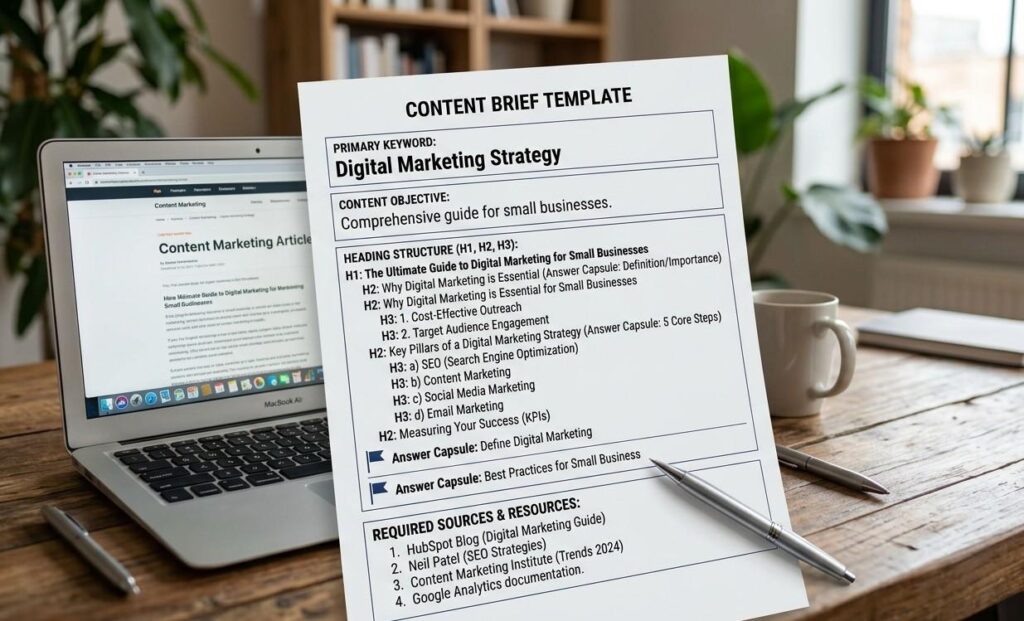
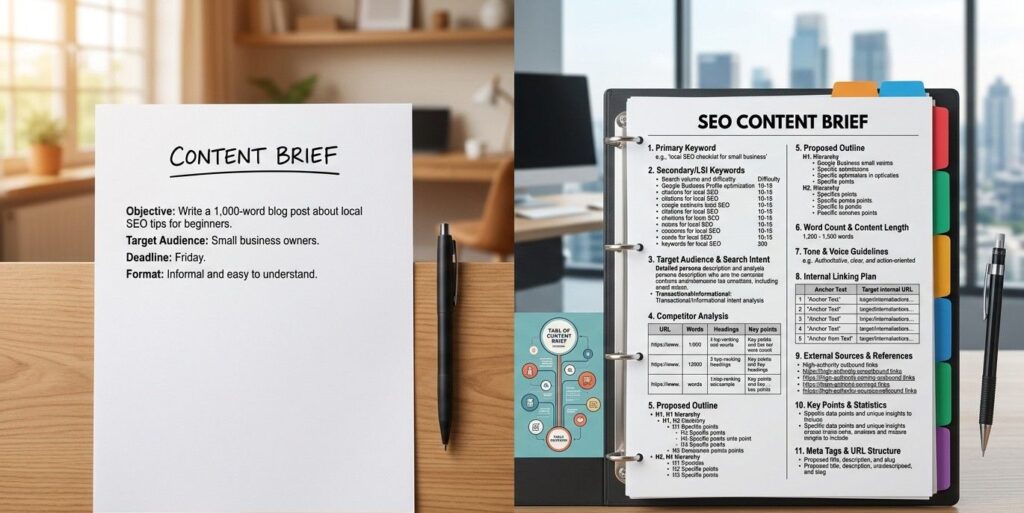
A complete content brief template includes eight core elements: primary keyword, secondary keywords, search intent, target audience, word count range, heading structure with answer capsule notes, required internal and external links and a FAQ section outline. Briefs missing two or more of these elements produce drafts that need structural rewrites rather than light edits.
Here is the full template structure I use for every brief I write, including those produced for clients through Juggernet Communications and Alpha Ahead:
| Element | What to include | Why it matters |
| Primary keyword | Exact match phrase, search volume | Sets the ranking target |
| Secondary keywords | 3 to 5 related terms | Builds topical depth |
| Search intent | Informational, commercial or transactional | Determines content structure |
| Target audience | Job title, pain point, knowledge level | Sets tone and vocabulary |
| Word count | Minimum and maximum range | Prevents over- and under-writing |
| Heading structure | H1, H2s and H3s pre-written | Gives the writer a ranking scaffold |
| Answer capsule notes | Flag each H2 that needs a 40 to 60 word direct answer | Triggers AI citation structure |
| Internal links | Full URLs with suggested anchor text | Builds site architecture |
| External links | Specific pages, not homepages | Adds citation credibility |
| FAQ outline | 5 questions with rough answers | Sets up schema markup |
| Sources | Named studies, dates and data points | Prevents invented statistics |
A brief that includes all eleven elements above takes 30 to 45 minutes to write. It saves 2 to 4 hours of revision time on every draft it produces.
How to Write the Keyword and Intent Section
The keyword and intent section of an SEO content brief tells the writer not just what to target but why the searcher typed that query. The primary keyword belongs in the H1, the meta title, the meta description, the URL slug and the first 100 words of body copy. Secondary keywords belong naturally in H2 headings and body paragraphs, once or twice each.
Search intent is the critical element most briefs skip. A writer who knows the keyword is “content brief template” but does not know whether the searcher wants to download a template, understand what goes in one or hire someone to write briefs for them will produce a post that answers the wrong question.
How to identify and document search intent
Search the primary keyword in Google and look at the top three results. Ask: are these posts informational guides, commercial landing pages or tool comparison pages? That answer tells you the intent. Document it in the brief as one of: informational (explain how), commercial investigation (compare options) or transactional (take an action). The writer needs that classification before they draft the first sentence.
What to Put in the Heading Structure Section
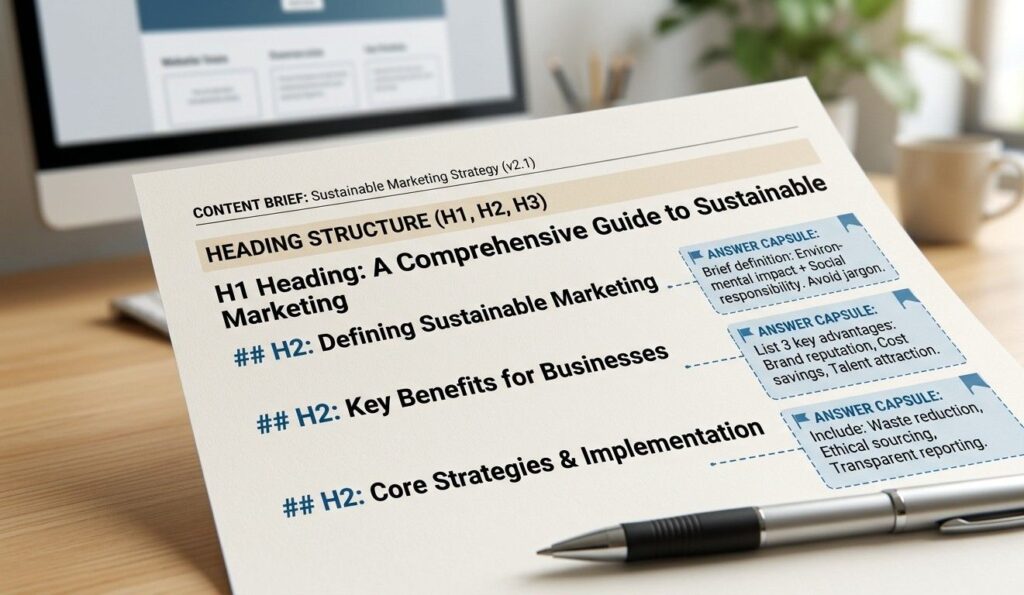
Pre-written H2 and H3 headings are the highest-value element of any content brief. They translate keyword research into a ranking scaffold that the writer follows rather than constructs. Each H2 should either pose a question the searcher is likely to ask or make a specific declarative claim. Vague H2s like “Benefits of content briefs” produce weak sections. Specific H2s like “Why briefs with pre-written headings produce better first drafts” give the writer a clear argument to support.
Flag every H2 that needs an answer capsule. An answer capsule is a 40 to 60 word direct-answer paragraph placed immediately under the heading. According to Princeton’s 2025 research cited by Search Engine Journal, content with named sources and front-loaded answers earns over 40 percent more AI visibility. Capsules are also the most common structural element missing from unbriefed content, because writers default to context-building introductions rather than direct answers when left to their own instincts.

How to Include Sources Without Doing the Writer’s Research
The sources section of a content brief lists the specific data points, studies and named experts the writer should cite inline. It does not ask the writer to find their own sources. That distinction matters because uninstructed writers either skip citations entirely or invent vague attributions like “studies show,” both of which weaken the content’s credibility with Google and with AI citation systems.
For each required source, the brief should include: the name of the study or organisation, the year, the specific claim and the exact URL of the source page, not the homepage. For example: “Ahrefs AI Overview study, 2025: only 38 percent of AI Overview citations come from top-10 organic results. URL: https://ahrefs.com/blog/ai-overviews-study/.”
This approach also protects against hallucinated statistics. A writer who receives specific source data does not need to invent any. A writer who receives no sources will sometimes create plausible-sounding but fabricated citations under deadline pressure.
My blog covering SEO content strategy covers source management and citation structure in more depth for teams producing more than 10 posts per month.
Can AI Write Content Briefs?
AI tools can draft a content brief skeleton in under two minutes, but the output requires human review before it reaches a writer. AI-generated briefs often produce generic H2 suggestions that do not reflect actual search intent, hallucinate statistics that need fact-checking and miss the internal linking architecture specific to your site.
The most effective workflow is: use an AI tool like ChatGPT or Perplexity to generate a first-pass heading structure and FAQ questions, then add your own keyword research from Semrush or Ahrefs, replace any invented data with verified sources and add your site’s specific internal links. That combined process takes 20 minutes and produces a brief as strong as one built from scratch in 45.
For an example of what a fully completed brief looks like in practice, take a look at my SEO content writing services page, which shows the brief format I use before writing any client post.
Want Briefs That Produce Better Posts From the First Draft?
A strong content brief is the single highest-leverage document in your content workflow. It determines search intent alignment, AI citation structure and revision time before the writer types a word. If you want briefs built to this standard for your own content programme, take a look at my SEO content strategy and writing services or get in touch directly. I am happy to walk through your current brief format and show you exactly where drafts are going off track.
FAQs
How detailed should a content brief be?
Detailed enough that a competent writer can produce a complete, on-brief first draft without asking a single clarifying question. In practice, that means the brief includes the primary keyword, search intent classification, pre-written H2 headings, answer capsule flags, required sources with URLs and a FAQ outline. A one-paragraph brief with just a keyword and word count produces drafts that need structural rewrites. A full brief with heading structure and sources produces drafts that need light edits at most.
Should I include the full heading structure or let the writer build it?
Include the full heading structure. Writers who build their own headings often optimise for what sounds good rather than what ranks. Pre-written H2s translate your keyword research into a ranking scaffold the writer executes rather than invents. You can invite the writer to suggest alternative headings, but give them a complete structure as the default. The time you spend writing ten H2s saves two rounds of structural revision on the draft they produce.
What is the biggest mistake in content briefs?
Skipping search intent. A brief that lists a keyword but does not specify whether the searcher wants an explanation, a comparison or a template to download produces a post that answers the wrong question. The second most common mistake is omitting sources, which leads writers to either skip citations or invent them. A brief without named sources and specific data points produces content that fails Google’s E-E-A-T quality signals and earns no AI Overview citations.
How long does a good content brief take to write?
A complete brief with all eleven elements takes 30 to 45 minutes. That includes keyword research in Semrush or Ahrefs, competitor analysis on the top three ranking pages, search intent classification, heading structure, source collection and FAQ outline. Briefs written in under 15 minutes are almost always missing at least two critical elements. The 30-minute investment consistently saves 2 to 4 hours of revision time per post, making it the highest-return task in any content production workflow.
Can AI write content briefs reliably?
Partially. AI tools like ChatGPT and Perplexity can generate a useful heading skeleton and FAQ questions in under two minutes. But AI-generated briefs often contain hallucinated statistics, generic headings that do not reflect real search intent and no site-specific internal links. The most effective approach is to use AI for the first-pass structure, then add verified keyword data from Semrush or Ahrefs, replace invented figures with real cited sources and layer in your own internal linking architecture before the brief reaches a writer.