
Quick Answer
A marketing agency manages and executes a business’s marketing across multiple channels, typically including SEO, content, paid ads, social media and email, under one coordinated strategy. Instead of hiring separate specialists or managing freelancers yourself, an agency brings a team that already works together, plus tools and reporting most small businesses cannot justify buying alone. Retainers usually run from $5,000 to $25,000 a month depending on scope, according to Stackmatix’s 2026 hiring comparison data. The core value is coordination across channels, not just execution of any single one.
- Marketing agency retainers typically range from $5,000 to $25,000 a month for a coordinated team covering multiple channels, based on Stackmatix’s 2026 agency comparison data.
- 53% of agency owners report that AI is changing how agencies price and deliver work, with 34% having already implemented AI across their entire business by early 2026, according to Promethean Research’s 2026 State of Digital Services survey.
- 63% of companies fall into the $500 to $5,000 monthly SEO spending bracket, with average agency-led programs running $3,209 a month, per Revenue Memo’s 2026 small business budget analysis.
- The U.S. Small Business Administration recommends businesses under $5 million in revenue spend 7% to 8% of gross revenue on marketing, a benchmark most small businesses still fall short of.
- 73% of small businesses worldwide are not confident their current marketing strategy is working, according to Constant Contact’s 2024 SMB Guide research, which is usually the moment an agency conversation starts.

Introduction
Most founders ask what a marketing agency does only after a sales call leaves them more confused than when they started. Running new client conversations at Adnnel across real estate, restaurant and growing B2B brands has shown the same gap every time. Business owners know they need help. They do not know what they are actually buying when they sign a retainer. Wajahat Amin’s work in SEO strategy and agency operations sits on both sides of that conversation, which is why this post skips the pitch deck language and explains, in plain terms, what a marketing agency does day to day, what you get for the money and how that compares to hiring a freelancer or building an in-house team instead.
What Does a Marketing Agency Actually Do?
A marketing agency runs your marketing the way an internal department would, except the team works across multiple clients and brings tools, processes and channel expertise that would take years to build in-house. The core function is coordination. An agency does not just write blog posts or manage one ad account. It builds a strategy, assigns specialists to execute pieces of it, and reports back on what worked. The work usually spans SEO, content creation, paid search and social, email marketing and increasingly AI search visibility, all moving toward the same goals rather than operating as disconnected tasks.
A full-service marketing agency typically provides a broad spectrum of services including SEO, paid search, social media marketing, email marketing and content creation, all integrated into a single coordinated plan. This is the part that gets lost in agency sales pitches. The deliverable is not “a blog post” or “an ad campaign.” It is the coordination between those things, so a blog post supports the keyword strategy, the ad campaign retargets people who read the blog post, and the email sequence follows up with people the ads converted.
The Channels Most Agencies Actually Cover
Search engine optimization sits at the center of most agency retainers, covering technical site health, content strategy and link building aimed at organic visibility. Paid advertising, primarily Google Ads and Meta Ads, runs alongside SEO to capture demand that organic rankings have not reached yet. Content marketing produces the blog posts, case studies and on-site copy that support both SEO and paid landing pages. Social media management covers organic posting, community management and increasingly paid social campaigns. Email marketing nurtures leads that the other four channels generate, since acquisition without follow-up wastes most of the value those channels create.
What an Agency Does Not Typically Do
An agency builds and executes marketing strategy. It does not usually run your sales process, manage your product roadmap or sit in your daily team standups. This distinction matters because some founders expect an agency to function as an embedded employee who happens to also know marketing. Agencies work best when given clear access to brand assets, product information and decision-making speed, then left to execute against an agreed plan. The businesses that get the least value from an agency relationship are usually the ones treating it like a part-time hire rather than a specialized vendor with its own internal process.
How Much Does a Marketing Agency Actually Cost?
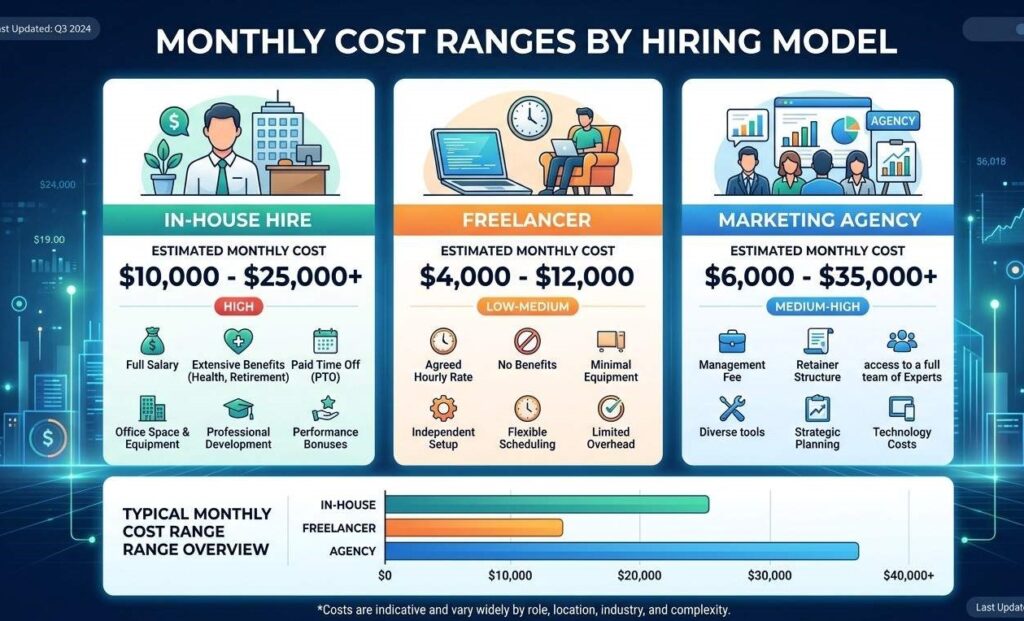
Marketing agency retainers in the United States typically run from $5,000 to $25,000 a month, with the variation driven almost entirely by how many channels are included and how much content or ad spend the work involves. For comparison, the average agency-led SEO program alone runs $3,209 a month, while a freelancer covering the same scope averages $1,348, based on Revenue Memo’s 2026 small business marketing budget research.
| Marketing model | Typical monthly cost | Best fit |
| In-house senior hire | $10,000 to $16,700 (salary plus benefits and tools) | Ongoing, single-channel work needing daily brand context |
| Freelancer or contractor | $75 to $200 per hour, project-based | Narrow, well-defined tasks with a clear scope |
| Full-service agency | $5,000 to $25,000 monthly retainer | Coordinated, multi-channel execution with strategic oversight |
Source: Stackmatix’s 2026 agency hiring comparison and Revenue Memo’s 2026 SMB marketing budget analysis.
The U.S. Small Business Administration’s long-standing benchmark recommends businesses under $5 million in annual revenue allocate 7% to 8% of gross revenue to marketing. Most small businesses fall well under that figure, which is one reason 73% report they are not confident their current strategy is working, according to Constant Contact’s 2024 SMB Guide data. Underinvestment, not bad strategy, is frequently the actual problem.
How Does an Agency Compare to a Freelancer or In-House Hire?
An agency makes sense when a business needs coordinated execution across several channels at once, while a freelancer fits narrow, well-defined tasks and an in-house hire fits ongoing work that needs daily brand context. None of the three options is universally better. The right choice depends on how many channels need to move together and how much internal bandwidth exists to manage the work.
Freelancers offer the most flexibility and the lowest cost for narrow scopes, but coordinating several freelancers across channels becomes its own job, and over 50% of companies that try this report the coordination overhead as a real burden, based on a 2025 freelancer market study. In-house hires bring daily brand immersion and full control, but a competent senior marketer costs $120,000 to $150,000 in base salary before benefits, tools and management overhead push the real number toward $200,000.
A full-service agency creates a unified marketing strategy that ensures brand consistency across all touchpoints, which is the structural advantage over piecing together multiple freelancers. The most pragmatic structure for many growing businesses is a hybrid: one in-house marketing lead who owns strategy and brand voice, supported by an agency that executes the coordinated multi-channel work. For a deeper breakdown of how this decision plays out by company size and budget, full-service marketing agency vs freelancer covers the cost and control trade-offs in more detail, and the hidden ROI of hiring a senior marketing freelancer over a junior agency team makes the case for when a senior freelancer actually outperforms a junior agency account team.

What Should You Expect in the First 90 Days With an Agency?
The first 90 days with a marketing agency should produce an audit, a documented strategy and the first wave of live execution, not finished results. Agencies that promise major ranking or revenue gains inside the first month are setting an expectation the channel cannot support. SEO in particular takes months to show movement because search engines need time to recrawl, reindex and trust new or updated content.
A reasonable 90-day arc looks like this: weeks one through two cover the audit and access setup, weeks three through six cover strategy documentation and the first content or campaign builds, and weeks seven through twelve cover the first full reporting cycle with early directional signals. Demanding concrete numbers with disclosed methodology, rather than polished case studies alone, is one of the better ways to evaluate whether an agency relationship is delivering. Five things worth checking from the start: demonstrable results with real numbers, transparency about what work is happening and why, your own ownership of accounts and data, contract flexibility rather than long lock-ins, and genuine industry familiarity rather than generic playbooks.
Choosing the Right Marketing Partner for Where You Are
If the channels above sound right but the idea of managing five vendors does not, that coordination is exactly what a full-service agency exists to remove. Explore Adnnel Services to see how the SEO, content and paid channels described in this post come together under one team and one strategy. The contact page is the fastest way to talk through where your business actually stands before committing to any retainer.
Frequently Asked Questions
What does a marketing agency do that I cannot do myself?
A marketing agency brings coordinated specialist expertise across channels, proprietary tools most businesses cannot justify buying alone, and the capacity to execute consistently without competing against your own daily operations. The advantage is not that the work is impossible to learn. It is that running SEO, paid ads, content and email well simultaneously requires more hours and more specialized knowledge than most founders can spare.
How do I know if a marketing agency is actually working?
Look for documented strategy, transparent reporting with real numbers rather than vague summaries, and clear ownership of your own data and accounts throughout the relationship. Early movement in branded search volume, lead quality and channel-specific metrics matters more in the first few months than overall revenue, since revenue lags behind marketing changes by design.
Should a small business hire a marketing agency or a freelancer first?
This depends on how many channels need to move at once. A single, well-defined task like a website redesign or one ad campaign setup usually fits a freelancer better. Coordinated, ongoing work across SEO, content and paid channels together usually justifies an agency, since the coordination overhead of managing multiple freelancers often costs more in time than the agency retainer would.
How much should a small business actually spend on a marketing agency?
The U.S. Small Business Administration recommends 7% to 8% of gross annual revenue for businesses under $5 million, though most full-service agency retainers in practice run between $5,000 and $25,000 a month depending on how many channels are included. A single-channel program, such as SEO alone, usually starts closer to $3,000 a month.
Can ChatGPT or AI tools replace what a marketing agency does?
AI tools can speed up content drafting, ad copy variations and some reporting tasks, and most agencies already use AI somewhere in their workflow. AI cannot replace strategic judgment, channel coordination or the accountability of a team that owns the outcome. The agencies adapting fastest are using AI to deliver more work per hour, not to remove the strategic layer entirely.