
Quick Answer
Private therapy practices can rank in both Google and AI search engines in 2026 by building a content cluster around their specialties, optimizing their Google Business Profile for local discovery, and structuring every key page with a direct-answer opening that AI engines can cite. You do not need an agency. The core tasks are: specialty-specific service pages, FAQ sections on every page, schema markup, and consistent NAP citations across directories. According to research cited by Koppla Marketing (2025), practices that apply structured AI optimization strategies improve their search visibility by up to 40%.
- Google Business Profile signals account for roughly 32% of local pack ranking weight for therapy practices, per Whitespark’s 2026 Local Search Ranking Factors survey.
- AI recommendations are influenced by list mentions across reputable sites (41% weight) and reviews (16%), according to Onely’s 2025 research, meaning your website structure matters more than your Psychology Today profile.
- Psychology Today referrals dropped 77 to 94% for many therapists between 2023 and 2025, per therapist-reported data compiled by Reframe Practice (2025), making organic SEO a survival tool rather than an optional extra.
- AI search visitors convert at 4.4 times the rate of standard organic visitors, according to Mental Health IT Solutions’ 2026 analysis, making AI citation the single highest-priority channel for practice growth.
- Ongoing SEO for a solo therapy practice costs $0 to $697 per month depending on DIY vs. specialist support, per Reframe Practice’s March 2026 pricing benchmarks, a fraction of what generic agencies charge.

Introduction
Most private therapy practices have the same growth problem: a Psychology Today profile that used to bring in two or three new clients a month now brings in almost none. At Adnnel, auditing healthcare and mental health practice websites over the past two years has shown us that the therapists who are growing their caseloads in 2026 are not the ones spending $2,000 a month on an SEO agency. They are the ones who built a clear content structure around their specialties and made their websites readable by both Google and AI engines. This post breaks down exactly how to do that without a team, without a large budget and without writing a single sentence that sounds like marketing copy. The strategies here come from the same playbook we use for healthcare clients at Adnnel’s SEO and GEO optimization for healthcare practices, applied at a scale any solo practitioner can manage.
Why AI Search Changed the Game for Therapy Practices
In 2026, a client searching for a therapist no longer just types a phrase into Google and scrolls through a list. Increasingly, they ask ChatGPT or Perplexity a question and receive a shortlist of recommended practices, complete with specialties, locations and a brief reason for each recommendation. If your website is not structured to answer that question directly, your practice will not appear in that shortlist, regardless of how good your profile looks on a directory.
According to research from Onely (2025), AI recommendation engines weight mentions across reputable sites at 41% of their recommendation signals. Reviews and ratings account for 16%, and brand mentions on the web account for 11%. The important point is that ChatGPT reads your actual website, not your directory profile. A well-structured site with clear specialties and FAQ sections is what gets you cited.
Meanwhile, Google’s AI Overviews now reach over two billion monthly users, which means the fight for visibility is no longer just about ranking on page one. It is about being the source an AI engine quotes when it answers a mental health question.
The Directory Decline Is Real
Psychology Today referrals dropped 77 to 94% for many therapists between 2023 and 2025, according to therapist-reported directional data compiled by Reframe Practice’s 2025 cost analysis. That is not a trend you can wait out. It reflects a structural shift in how clients find healthcare providers. The client who used to scroll through 40 directory profiles is now asking an AI tool for three specific recommendations based on specialty, location and insurance. Your website either answers that query or it does not.
What AI Engines Actually Look For
AI engines do not rank websites the way Google does. They pull from structured content that directly answers a user’s question. For a therapy practice, this means three things: a service page that names the modality and the population served, a FAQ section that addresses the exact questions clients type into AI tools, and a clear, specific opening answer on every key page. A page titled ‘Services’ with a paragraph that says ‘I work with clients experiencing a range of challenges’ will never be cited by ChatGPT. A page titled ‘EMDR Therapy for Adults with Complex Trauma in Austin, Texas’ with a 60-word direct answer at the top will be.

The Five SEO Tasks That Actually Move the Needle
Private therapy practice SEO in 2026 comes down to five tasks. None require technical expertise. All require specificity, because specificity is what both Google and AI engines reward in the healthcare space.
Task 1: Build One Service Page Per Specialty
Therapists with a single generic services page are invisible to specialty-based searches. Each modality or population you serve needs its own page. That page needs a descriptive title, a direct-answer opening paragraph of 60 words or fewer, the geographic area you serve, and the specific client type. For background on the local SEO mechanics that power these pages, see our guide to local SEO for therapists: a 2026 playbook that respects your ethics.
A therapist who offers CBT, EMDR and somatic therapy to adults should have three separate specialty pages, not one page with three bullet points. Each page can rank independently for a specific search query, which triples your surface area in local results.
Task 2: Optimize Your Google Business Profile
Google Business Profile signals account for roughly 32% of local pack ranking weight, according to Whitespark’s 2026 Local Search Ranking Factors survey. Your primary category, business description, listed services and photo quality all affect how prominently you appear in local results. Choose the most specific available category, such as Psychotherapist, Marriage and Family Therapist or Clinical Psychologist. Add every insurance panel you accept as a service. Post a brief update at least once a month. These are free actions that have a direct, measurable impact on local visibility.
Task 3: Add a FAQ Section to Every Key Page
FAQ sections serve two purposes in 2026. First, they answer the exact questions clients type into search engines, which HubSpot’s 2025 content marketing research consistently identifies as a driver of on-page engagement and reduced bounce rates. Second, FAQ content structured with the question as a heading and a direct answer beneath it is the format AI engines are most likely to pull into a response. Each therapy specialty page should have five to seven FAQs. Questions like ‘How long does EMDR therapy take?’ or ‘Do you offer evening appointments?’ are exactly what clients ask AI tools before they ever visit your website.
Task 4: Fix Your Insurance Panel Pages
Insurance-based clients search differently from private-pay clients. They search by insurance panel first, specialty second, location third. A page titled ‘Aetna Therapist in Denver’ that answers the question directly and lists the therapist’s specialties will outrank a generic ‘accepted insurance’ section buried in a contact page. For a detailed breakdown of how to build these pages correctly, see our full guide to therapy insurance panel page SEO.
Task 5: Earn Local Citations and Mentions
Consistent NAP citations (name, address, phone number) across directories like Healthgrades, Zocdoc and Psychology Today still matter for local ranking. But in 2026, what matters more is mentions across reputable mental health platforms. Being included in a ‘best therapists in [city]’ roundup on a regional health magazine website, or having your practice listed in a SAMHSA-affiliated resource directory, contributes to the brand signal weight that AI engines use to select citation sources. Ethical outreach to local mental health organizations for directory inclusion is one of the highest-ROI activities a solo practice can do.
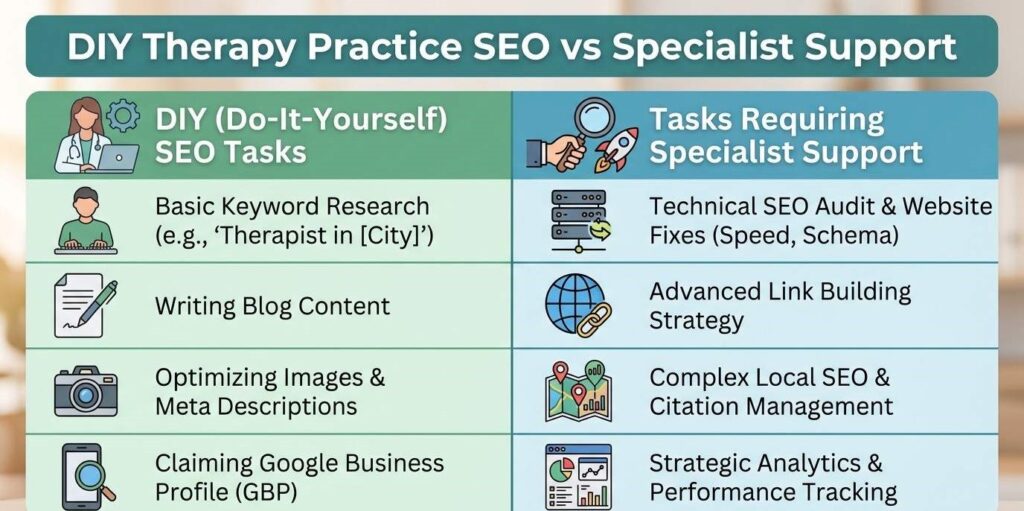
DIY vs. Specialist Help: When to Do It Yourself and When to Get Support
The question of whether to handle SEO yourself or pay for help comes down to one calculation: what is your hourly rate as a clinician, and how many hours per month will SEO realistically take you?
According to Heard’s 2025 Financial State of Private Practice Report, the average private pay rate for individual therapy across all license types is $159 per session. If DIY SEO costs you five hours a month, you are forgoing $795 in potential billable time. Most therapist-specific SEO services charge between $297 and $697 per month for a full visibility setup. The math often favors specialist support, especially in the first six months when the technical foundation is being built.
| Task | DIY Approach | When to Get Help |
| Google Business Profile | Set it up yourself (free, 1-2 hours) | If it has errors or duplicate listings |
| Service page copy | Write it yourself with a clear brief | If writing takes you more than 2 hours per page |
| FAQ schema markup | Use Yoast or RankMath plugin (free) | If your site is custom-built without a CMS |
| Local citation cleanup | DIY via BrightLocal audit ($30) | If you have duplicate or inconsistent NAP data |
| Content cluster planning | Use our free brief format and write monthly | If keyword research feels overwhelming |
For a broader view of what different levels of SEO investment actually produce, including the difference between practitioner-run content and a managed growth strategy, see what actually works for therapist SEO in 2026.
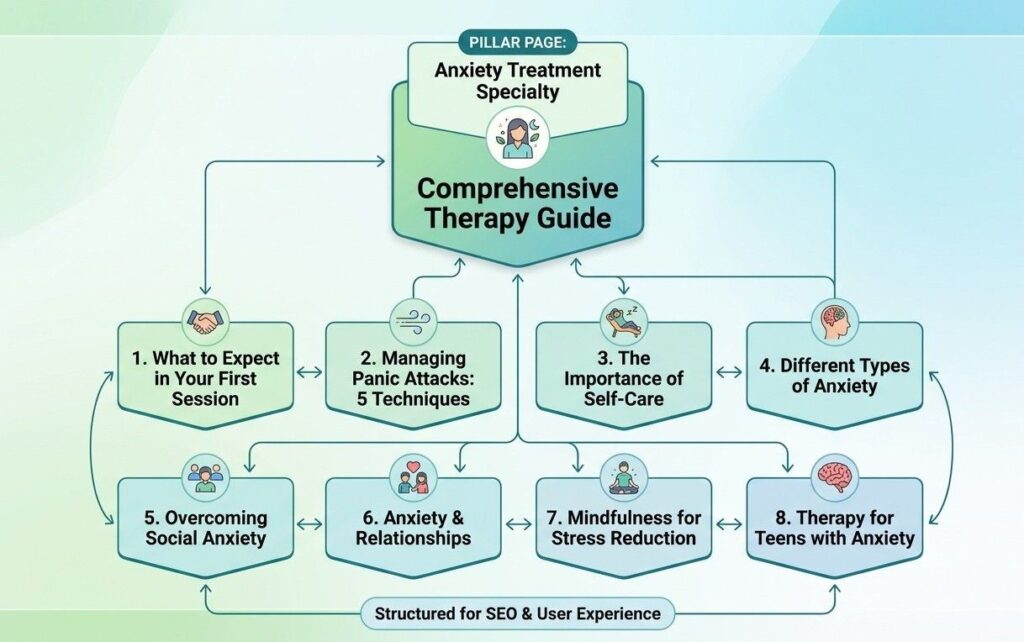
Building a Content Cluster Around Your Therapy Specialties
Topical authority is the structural principle that separates therapy practice websites that rank consistently from those that publish one or two blog posts and disappear from search. According to Backlinko’s 2025 content ranking analysis, sites that build content clusters around a central topic outperform thin sites across every measurable ranking signal. For a therapy practice, a content cluster looks like this:
A pillar page covers the specialty at a broad level: ‘Anxiety Therapy in Seattle.’ Supporting posts answer specific questions within that topic: ‘How many therapy sessions does it take to manage anxiety?’, ‘What is the difference between CBT and ACT for anxiety?’, ‘What to expect at your first anxiety therapy appointment.’ Each supporting post links back to the pillar page. The pillar page links to each supporting post. Google sees this structure as a signal of genuine topical depth, not just keyword stuffing.
The mental health market in 2026 has a specific advantage for practices willing to build this structure: according to the American Psychological Association’s 2025 Stress in America report, demand for mental health services continues to outpace supply in most US markets. That means search volume for therapy-related queries is growing, and the practices with the most organized content structures will capture a disproportionate share of that traffic.
The content cluster does not need to be large to work. For a solo practitioner with two or three specialties, a cluster of eight to twelve posts per specialty, published consistently over six months, builds enough topical authority to compete with larger group practices that rely on their domain age rather than their content depth.
SEO for Therapists: The HIPAA and Ethics Constraints You Cannot Ignore
Therapy practice SEO operates under ethical and legal constraints that do not apply to most other local businesses. Google reviews cannot confirm a patient relationship. Testimonials on your own website require specific consent processes that vary by licensing board. Case studies, even anonymized, require careful review before publication. These constraints are real and non-negotiable.
However, they do not prevent you from building authority. They simply redirect where your proof lives. Instead of client testimonials, you build authority through educational content that demonstrates your clinical depth. Instead of before-and-after case narratives, you publish ‘what to expect’ guides that pre-educate prospective clients and answer the questions they are already typing into search engines.
The ethical SEO path for therapists is also the more durable one. Content that educates builds the kind of trust that Google’s December 2025 E-E-A-T guidance identifies as the single most important ranking signal for healthcare content. A therapist who has published twenty substantive articles about anxiety treatment in their local market is not just ranking higher. They are also converting at a higher rate, because prospective clients arrive pre-educated and pre-qualified.
Ready to Build a Therapy Practice Website That Clients and AI Engines Both Find?
The strategies in this post work, but they take time to implement correctly when you are also running a full caseload. If you want a structured approach tailored to your specialties, service area and target client type, the wajahatamin.com services page outlines how I approach content strategy for healthcare practices specifically.
For practices that need hands-on implementation rather than a strategy document, Adnnel’s SEO and GEO optimization for healthcare practices covers the full execution layer: technical setup, content cluster build, schema markup and AI citation structure. Reach out with your practice details and we will tell you exactly what your site needs before we touch anything.
Frequently Asked Questions
How long does SEO take to work for a private therapy practice?
Most therapy practice websites start to see meaningful organic traffic improvements between three and six months after implementing the foundational changes: specialty service pages, Google Business Profile optimization, and consistent FAQ content. Google indexes and re-evaluates pages on a rolling schedule, so improvements compound over time rather than appearing overnight. AI citation can happen faster, sometimes within weeks, if your content is structured for direct-answer extraction from launch.
Can I do therapy practice SEO myself without any technical knowledge?
Yes. The highest-impact tasks require no technical skills. Writing specialty-specific service pages, optimizing your Google Business Profile, adding FAQ content to key pages, and building local directory citations are all actions a non-technical practitioner can complete. Schema markup and site speed optimization are technical but can be handled through free WordPress plugins like Yoast SEO or RankMath. The main barrier is time, not complexity.
What should I ask ChatGPT about ‘best therapists near me’ to see if I appear?
This is one of the most practical tests a therapist can run. Open ChatGPT or Perplexity and type: ‘Who are the best anxiety therapists in [your city]?’ or ‘Recommend a trauma therapist near [your zip code] who accepts Aetna.’ If you do not appear, the most common reason is that your website does not have a clear specialty-specific page with a direct answer at the top. AI engines cite pages, not practitioners, so the fix is structural, not promotional.
How is SEO for a therapy practice different from SEO for other small businesses?
Therapy practice SEO operates on Google’s YMYL (Your Money or Your Life) classification, which means Google applies higher E-E-A-T scrutiny to healthcare content than to most other local business categories. Reviews must be handled without confirming client relationships. Content must demonstrate clinical expertise rather than just keyword relevance. Backlinks from healthcare directories, licensing board pages and hospital systems carry more weight than equivalent links from general business directories.
Do I still need a Psychology Today profile if I am doing SEO?
Yes, but not for the same reasons as before. Psychology Today referrals have declined significantly for many therapists since 2023. However, a PT profile still contributes to your NAP citation consistency and gives AI engines another place to see your name, specialty and location. Think of it as one citation in a portfolio rather than a primary client acquisition channel. Your website, not your PT profile, is now the asset that brings in new clients.