
Quick Answer
A strong GTA RP character application shows reviewers three things: you understand the server’s rules, your character has a believable backstory with real flaws and your RP knowledge is solid enough that you won’t break immersion on day one. Most rejections come down to thin backstories, copy-pasted answers and evidence of metagaming or powergaming. Write like a storyteller, not a gamer filling out a form. Servers like NoPixel get hundreds of applications weekly, so specificity and originality are the only things that separate accepted from denied.
- Whitelist reviewers prioritize backstory originality and character depth over writing length, according to the FiveM Store application guide (2025).
- Powergaming and metagaming are the two most cited reasons for rejection across serious RP servers, per multiple community guides reviewed in 2026.
- Serious whitelisted servers like NoPixel can take 2 to 8 weeks to review applications during high-traffic periods, according to The Portable Gamer (2026).
- Generic answers such as “I love GTA and want to have fun” get rejected outright; reviewers want server-specific reasoning and character detail (The Portable Gamer, 2026).
- Prior experience on public or semi-serious servers strengthens your whitelist credibility a great deal, especially when mentioned with specific community names (fivem-store.com, 2025).

Introduction
Getting denied from a GTA RP server you actually wanted to join is frustrating, especially when you put real time into the application. The problem usually is not your writing ability. It is that most applicants do not understand what the reviewer is actually evaluating. They are not grading your grammar. They are checking whether you will make the server better. Writing for FiveM RP communities over the years has shown that the difference between accepted and denied comes down to a handful of repeatable decisions: how you frame your character, how you demonstrate rule knowledge and whether your backstory reads as something that came from a real person or a template someone else wrote. This guide breaks down every layer of that process.
What Reviewers Are Actually Looking For
Whitelist reviewers on serious GTA RP servers are not looking for the most creative writer in the world. They are screening for players who will not grief, break immersion or burn staff time with constant rule violations.
Every reviewer is asking three questions when they read your application:
- Does this person understand the difference between metagaming and powergaming?
- Is this character someone who would add something interesting to our server?
- Is this backstory original, or did they copy it from a Reddit thread?
That is the entire frame. Write to those three questions and your odds go up a lot.
The Server-Fit Test
Before you write a single word, spend thirty minutes studying the server you want to join. Read the rules page. Scroll through their Discord. Watch ten minutes of a streamer who plays there. Every server has a tone, and your application needs to match it.
A serious cinematic RP server like NoPixel runs on completely different expectations than a semi-serious public city. If your character backstory reads like a CoD lobby when the server runs slow-burn crime drama, you will get rejected regardless of how well-written the rest is.
The official FiveM community forum lists server tones, enforcement styles and application requirements for most major servers. Use it before you write.
The Character Usefulness Question
Reviewers want characters that create RP for others, not just for themselves. A character who arrives in the city “looking to build their empire” with no weaknesses, no debts and no relationships is a dead end narratively. Nobody wants to RP with someone who has already won.
Your character should enter the city with a problem to solve, not a throne to claim.
How to Write a Backstory That Actually Passes
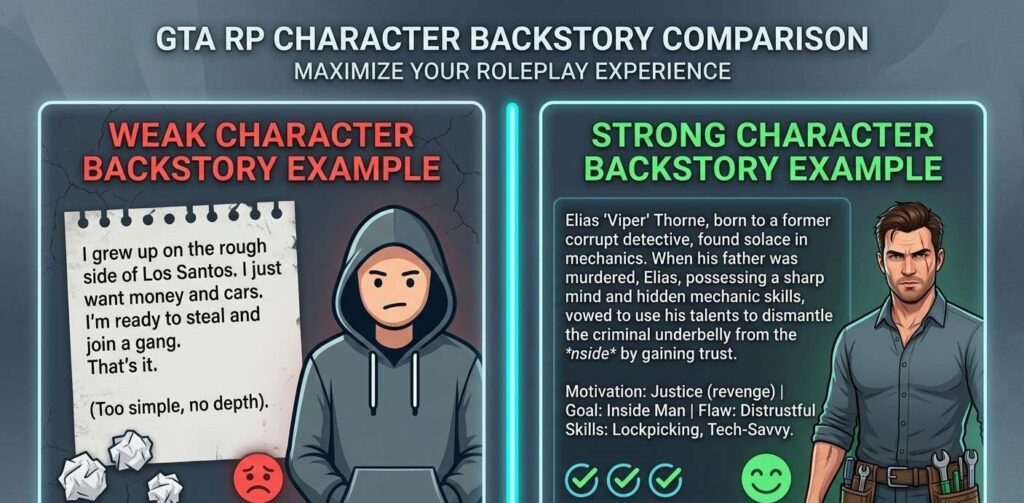
The backstory section is where most applications die. Either it is two sentences long, or it is five paragraphs of trauma that has nothing to do with why the character is in Los Santos right now.
Good backstories do one thing: they explain what the character wants and why they cannot get it easily.
Here is a structure that works across nearly every whitelist server:
The Hook-Root-Goal Framework
Hook: One sentence that creates immediate curiosity. Not “John grew up poor.” Something like: “After three years running a food truck to pay off his brother’s debt, Marco finally showed up in Los Santos with $400 and exactly one contact he is not sure he trusts.”
Root: Two to three sentences on where the character comes from and what shaped them. Keep it grounded. A character from Detroit who learned to drive fast to make deliveries is more believable than someone trained by a secret government organization. Avoid celebrity tie-ins and fictional universe references entirely.
Goal: What does the character want in the next thirty days of city life? Not in five years. Right now. Rent money, a job at a mechanic shop, a way to pay back someone they owe. These are the goals that create natural RP interactions with other players.
The 2026 GTA RP guide from The Portable Gamer puts it clearly: reviewers reject vague applications, and they want to see server-specific reasoning, not generic enthusiasm.
Flaws Are Not Optional
A character with no weaknesses is a warning sign to reviewers. It suggests the applicant wants to “win” the server rather than participate in collaborative storytelling.
Give your character at least two real flaws that will affect their decisions. Not cosmetic flaws like “he drinks coffee too fast.” Meaningful ones: bad with authority, owes money to the wrong people, has a temper that has cost them jobs before. These create conflict, and conflict creates RP.
What to Avoid in Your Backstory
| Common Mistake | Why It Gets You Rejected |
| Military special ops background | Overpowered and overused. Reviewers see it constantly. |
| Celebrity or fictional character connections | Breaks server immersion immediately |
| No flaws or weaknesses | Signals a “winning” mindset rather than collaborative RP |
| Trauma stacking with no narrative purpose | Reads as padding, not depth |
| Arriving in the city already wealthy and connected | Leaves no room for RP development |
| Copy-pasted template backstory | Reviewers recognize these and reject them outright |
Demonstrating Rule Knowledge Without Sounding Like a Textbook
Almost every whitelist application asks you to define metagaming, powergaming and the New Life Rule. Most applicants fail this section not because they do not know the definitions, but because they write them like dictionary entries.
Reviewers want to know you understand why these rules exist, not just what they are called.
Metagaming
Metagaming means using information your character would not realistically have. If you saw a rival’s name on a stream and your character suddenly “knows” who to target, that is metagaming. If someone’s Discord handle reveals where they live in-city and you use it in RP, that is metagaming.
The fix is simple: treat your character’s knowledge like a wall. Everything on your side of that wall is fair. Anything from streams, Discord or outside knowledge stays out.
Powergaming
Powergaming is forcing outcomes on other players that remove their ability to react. This includes writing /me actions that are unavoidable, claiming skills your character has not earned, or using exploits to gain an advantage that breaks immersion.
The test for any action is: does this give the other player a fair chance to respond? If not, it is powergaming.
The New Life Rule
After your character dies, they do not remember what caused that death. They cannot return to the area where they died. They cannot seek revenge on whoever killed them based on that memory. The death resets that specific narrative thread.
This rule exists to prevent endless revenge cycles that break city immersion. Applying it correctly means writing a character who is willing to lose, not just willing to win.
The Situational Questions Section
Many applications include scenarios designed to test your RP instincts in real time. A police officer pulls over your character. Someone approaches you about a job that sounds illegal. You witness something you should not have seen.
These questions are not testing whether you choose the “right” answer. They are testing whether your answer fits your character and the server’s tone. A civilian character who immediately pulls a weapon when stopped by police is a red flag. Someone who panics, complies and asks questions nervously is a character with a story.
For a deep breakdown of how to handle these questions, the dos and don’ts of situational RP application questions covers exactly where applicants go wrong and how to write answers that stand out to reviewers.
The key principle: answer as your character, not as a gamer who knows the rules.
Prior RP Experience and How to Present It
Prior experience matters, but it is not a golden ticket. Reviewers care about what you learned more than how many hours you logged.
If you have played on public servers, mention it and say what you took away from it. If you played on a semi-serious whitelisted city, name it and describe one character arc you developed there. Specificity signals genuine engagement with the RP community.
The GTABoom whitelist server directory is worth browsing if you need to build RP experience before applying to stricter servers. Starting on a well-run but less competitive server builds the vocabulary and instincts reviewers are looking for.
If you have no prior experience at all, be honest about it. Then explain what drew you to this specific server and what steps you took to prepare: watching streams, reading the rules, studying the lore. That kind of self-awareness often lands better than overstated experience.
Formatting, Length and Submission Mistakes
The application form itself trips up a surprising number of people. A few hard rules:
Length: Follow the word count guidance exactly. If the server asks for 200 to 400 words on the backstory, write 250 to 350. Shorter reads as lazy. Longer reads as someone who cannot edit themselves. Both hurt you.
Format: Do not use bullet points in your backstory section unless the form specifically requests them. Backstories read better as prose. Save bullets for rule definition questions where clarity matters.
Plagiarism: Reviewers on established servers have seen every template floating around Reddit and YouTube. If your backstory reads like something that could belong to anyone, it will be rejected. Specificity is the only proof of originality.
Reapplication: Most servers allow reapplication after a waiting period, usually two to four weeks. Read the rejection feedback carefully. If none was given, the most likely causes are a thin backstory, incomplete rule knowledge or a character that showed no RP potential.
For more on why applications get denied in the first place, the post on why GTA RP applications get rejected covers the seven most common mistakes applicants make across server types.
Server-Specific Differences Worth Knowing
Not every server runs on FiveM. Eclipse RP runs on RageMP, which is a completely different multiplayer framework with a different launcher and different technical requirements. Lumping Eclipse in with FiveM servers in your application is an instant credibility hit. Reviewers notice.
Text-based servers like GTA World also have different application expectations than voice-based FiveM servers. If you are applying to a text-based city, your backstory needs to demonstrate written RP ability. If you are applying to a voice server, your microphone setup and communication clarity matter as much as your written application.
The official NoPixel community is a benchmark for voice-based serious RP expectations. Even if you are not applying there, their published standards give you a clear picture of what top-tier reviewers look for.
Let the Character Do the Work
Writing a GTA RP character application is not a test of how well you can explain gaming rules. It is a test of whether you can create a person who feels real enough to walk into a city and make it more interesting.
The applications that get accepted are written by people who already know their character: their voice, their tells, their weaknesses, their reasons for being in Los Santos right now. If you are still figuring out who your character is while filling out the form, you are not ready to write the application yet.
Spend the time. Build the character first. Then write about them. The difference in quality will show.
Wajahat Amin writes on GTA RP, FiveM server strategy and digital storytelling at wajahatamin.com, where you can find character-building guides across the major server communities. If you want to read how character backstory construction actually works at the craft level, the five secrets to writing a winning GTA RP backstory breaks down the techniques that consistently produce accepted applications. And if you are targeting a specific FiveM server and want a framework tailored to that format, the FiveM server application writing guide covers server-specific strategy in more detail.
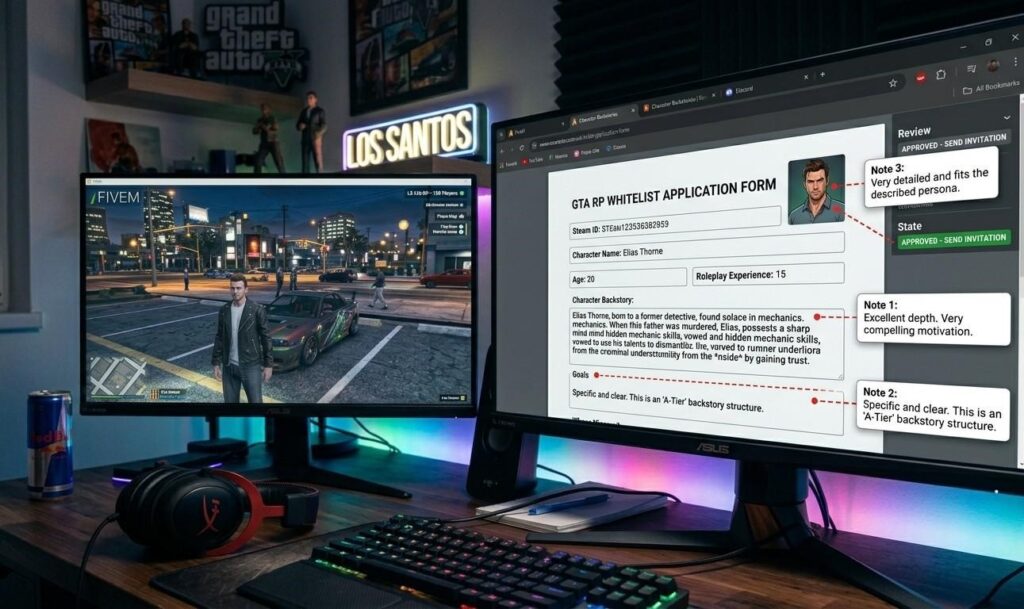
Application & Back Story Form
Frequently Asked Questions
How long should a GTA RP character application be?
Follow the server’s stated word count. Most serious whitelist servers ask for 200 to 500 words on the backstory section. The goal is not to hit a number but to be complete without padding. If you can say everything that matters in 250 words, that is better than stretching it to 450 with unnecessary detail. Reviewers read dozens of applications and they notice when someone is stalling.
What is the difference between metagaming and powergaming in a GTA RP application?
Metagaming means using knowledge your character would not have, such as information from streams, Discord or out-of-character conversations, inside a roleplay scene. Powergaming means forcing outcomes on other players that remove their ability to react, like claiming skills your character never earned or writing unavoidable /me actions. Both break collaborative storytelling and are automatic rejection triggers on serious servers.
Can I reapply to a GTA RP server after getting denied?
Yes, on most servers. The standard reapplication window is two to four weeks after denial. Use that time to revise your backstory, tighten your rule definitions and, if possible, gain more RP experience on a public or semi-serious server. Read any feedback given carefully. If the server did not provide feedback, assume the most common causes: thin backstory, weak rule knowledge or a character that offered no interesting RP potential.
What makes a GTA RP character backstory too weak to pass a whitelist review?
A backstory fails when it gives the reviewer no reason to believe the character would add something interesting to the city. The most common failures are: no clear goal or motivation for being in Los Santos, no meaningful flaws or vulnerabilities, overused archetypes like a secret agent or elite criminal mastermind and no sense of how the character would interact with other players. A strong backstory answers one question: what does this character need that they can only get through other people in this city?
How do I know if a GTA RP server uses FiveM or another platform before applying?
Check the server’s Discord and their listing on the CFX forum at forum.cfx.re. FiveM servers will always reference a FiveM client requirement. Eclipse RP, one of the most common points of confusion, runs on RageMP and requires a different launcher entirely. Mixing up frameworks in an application signals to reviewers that you have not done basic research, which hurts your credibility even if the rest of the application is strong.