Keys Takeaway: How ChatGPT chooses sources depends on two separate systems. In default mode, it generates answers from training data without accessing any live sources. In browsing mode, it searches the web via Bing and returns 3 to 6 citations per response. According to Profound’s analysis of 680 million citations from August 2024 to June 2025, Wikipedia accounts for 47.9% of ChatGPT’s top-10 citation volume. Only about 18% of ChatGPT conversations trigger a web search at all. When retrieval does happen, ChatGPT favors pages with domain authority, structured content and editorial credibility. According to Digital Bloom’s 2025 LLM visibility report, brand search volume is the strongest predictor of AI citations at a 0.334 correlation, outweighing backlinks.

Most marketers assume ChatGPT is constantly scanning the web and selecting the best sources for every answer. It isn’t. ChatGPT answers 60% of queries from memory alone, no retrieval at all. For the 40% of queries that do trigger a search, the source selection follows patterns that look very different from Google’s ranking signals. Understanding how ChatGPT chooses sources is the starting point for any content strategy that aims to get cited by AI, not just to rank in search. The gap between Google visibility and AI visibility is real and it’s already costing brands their share of high-intent answers.
ChatGPT Runs Two Completely Different Source Systems
ChatGPT operates in either memory mode or retrieval mode, and most users don’t know which one is active. In memory mode, it answers from its training data without any live web access and returns no citations. In retrieval mode, it queries Bing, pulls 3 to 6 sources and generates a cited response. According to ZipTie’s 2026 source selection breakdown, browsing mode weighs domain authority at roughly 40%, content quality at 35% and platform trust at 25%.
The trigger for retrieval matters enormously for content strategy. According to Profound’s October to December 2025 study of 730,000 conversations, the first question in a conversation is 2.5 times more likely to trigger a web citation than the tenth. That means first-question queries, the ones that kick off a research session, represent prime real estate for any brand that wants to get cited.
When retrieval does fire, ChatGPT searches via Bing rather than Google. So strong Bing indexation and Bing ranking correlate directly with ChatGPT citation frequency. Most SEO teams focus exclusively on Google and miss this parallel track entirely.
The content structure I build into every brief at wajahatamin.com accounts for both retrieval modes because a page that performs well in training-data recall and scores on Bing has two separate paths into ChatGPT answers.
Why Wikipedia Dominates ChatGPT Citations and What That Reveals
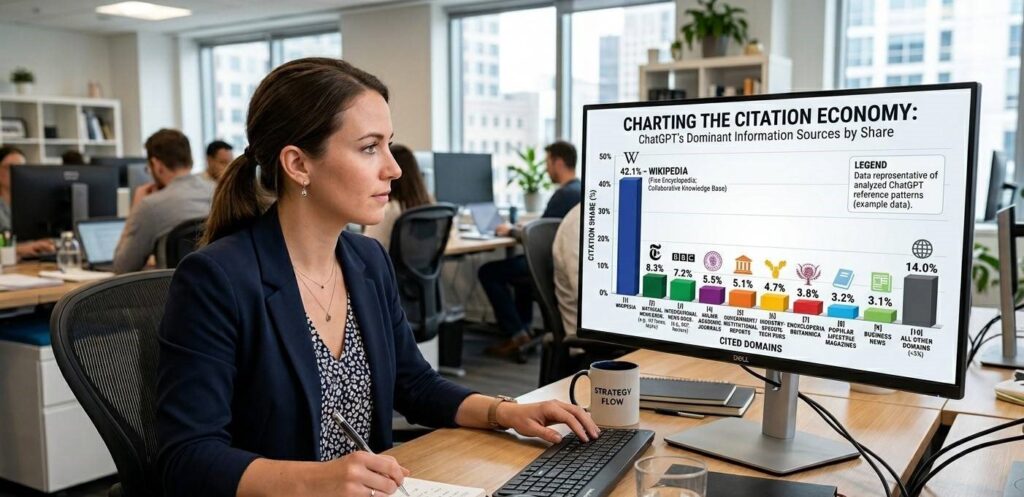
Wikipedia accounts for 47.9% of ChatGPT’s top-10 citation volume and 7.8% of all citations across the full dataset, according to Profound’s 680-million-citation study. That concentration from a single domain tells you what ChatGPT’s scoring system values most: encyclopedic structure, factual density, neutral tone and consistent internal citation.
The practical signal here is structural, not brand-based. Wikipedia pages are heavily structured with clear headings, defined terms, cited statistics and no promotional language. A business page that mirrors those structural qualities performs better in RAG retrieval because the model’s chunking process, which breaks pages into fragments, finds more usable content per section.
According to Discovered Labs’ 2025 citation pattern analysis, ChatGPT also favors publications with editorial standards and fact-checking processes: Reuters, Forbes and Business Insider all appear in the top-10 citation list alongside Wikipedia. The pattern is authority plus structure, not freshness or volume.
How the Three Major AI Platforms Pick Sources Differently
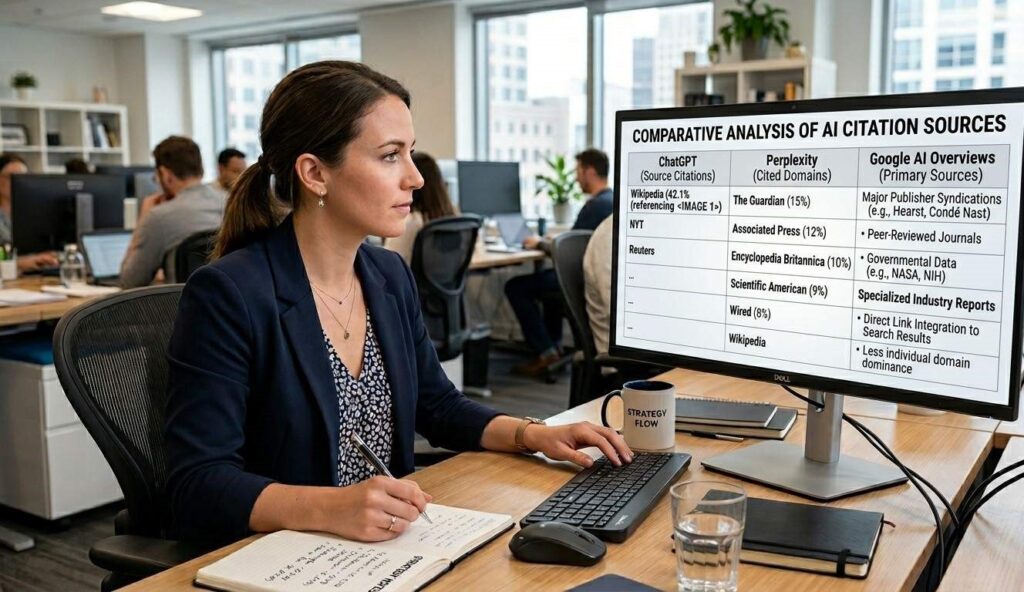
ChatGPT, Perplexity and Google AI Overviews each run distinct retrieval systems, which means a single content strategy can’t optimize for all three simultaneously without knowing where the approaches diverge.
| Platform | Top Citation Source | Share of Top Citations | Retrieval Method |
| ChatGPT | Wikipedia | 47.9% | Bing RAG + training data |
| Perplexity | 46.7% | Continuous web crawl | |
| Google AI Overviews | 21% | Google index | |
| Claude | Training data only | No live citations | Knowledge cutoff Jan 2025 |
According to Discovered Labs’ 2025 research, only 11% of domains are cited by both ChatGPT and Perplexity. That low overlap confirms these platforms pull from genuinely different source pools, which is why a brand visible in one may be absent from another entirely.
What Gets You Cited by ChatGPT Specifically
ChatGPT’s Bing-powered retrieval favors pages with strong organic rankings on Bing, clear H2 and H3 structure that makes chunking straightforward and direct factual statements with named sources. According to Digital Bloom’s 2025 report, adding statistics to content increases AI visibility by 22% and using original quotations boosts it by 37%. Front-loaded direct answers capture the highest share of retrieval because the model evaluates the opening paragraph first.
What Gets You Cited by Perplexity Specifically
Perplexity crawls the web continuously and carries a strong bias toward Reddit and community content. According to Profound’s data, Reddit accounts for 46.7% of Perplexity’s top-10 citations. That figure collapsed in ChatGPT after September 2025, when Google’s indexing changes cut Reddit’s presence in ChatGPT from 14% to just 2%, but Perplexity maintained its Reddit access through its own crawler. For brands targeting Perplexity, community presence on Reddit and authentic user-generated discussion are genuinely useful citation sources in a way they simply aren’t for ChatGPT.
The Structural Content Signals That Lift ChatGPT Citation Rate
Content that ChatGPT retrieves and cites shares four structural features: a direct answer in the opening paragraph, named sources with specific statistics, clear H2 and H3 headings that define distinct subtopics and a writing style without promotional language. These features make it easier for RAG chunking to extract usable fragments.
Brand search volume is the strongest single predictor of LLM citations, according to Digital Bloom’s 2025 data, with a 0.334 correlation coefficient. That figure outweighs backlinks and publishing frequency as citation predictors. This is why brands with strong audience recognition get cited even when their domain authority is moderate: the model already encodes them as known entities and retrieves their content preferentially.
The average domain age of ChatGPT-cited sources is 17 years, according to Derivatex’s April 2026 LLM citation breakdown. Newer sites aren’t locked out, but they need to compensate with stronger structural signals and more third-party mentions to overcome the domain age gap.
The GEO content framework I outline on my SEO content writing services page applies these structural principles directly: answer first, cite sources inline and use named entities throughout every section. The reasoning behind that approach connects to the broader zero-click and AI Overview shift covered in the zero-click search explainer.
For a complete breakdown of how to structure content for AI retrieval across ChatGPT, Perplexity and Google AI Overviews, the generative engine optimization guide for content teams covers each platform’s citation triggers in detail.
The relationship between traditional SEO and AI citation is not one-to-one, but they share enough overlap to make your starting point clear. Because Google AI Overviews pull 76.1% of cited URLs from Google’s top 10, ranking well in organic search still feeds AI visibility more than any other single action, especially for Google’s own system. The SEO vs AEO vs GEO breakdown explains how these three optimization tracks interact and which one to prioritize first.
Want Content That Gets Cited, Not Just Content That Ranks?
Ranking on Google and getting cited by ChatGPT are related but different goals, and most content currently optimized for one misses the other. If you want to build a content strategy that covers both, start the conversation on my contact page and we’ll look at how your current pages perform against the citation signals that matter in 2026. The structural changes are smaller than most people expect, and the upside is a presence in AI answers that compounds alongside your organic rankings.
Frequently Asked Questions
Why does ChatGPT cite Wikipedia so often compared to other sources?
Wikipedia accounts for 47.9% of ChatGPT’s top-10 citation volume, according to Profound’s August 2024 to June 2025 study of 680 million citations. ChatGPT favors it because of its encyclopedic structure, internal citations, neutral tone and factual density, which are the exact qualities that make RAG chunking easy. If your content mirrors those structural features: direct answers, named sources, clear headings and no promotional language, it performs better in retrieval for the same reason Wikipedia does.
How do I get my website into ChatGPT’s training data for future citations?
You can’t submit content directly to OpenAI’s training pipeline, but you can increase the probability your site is included in future training runs. Publish factual, structured content with named sources on a domain with a clean indexation history. Get your brand mentioned in publications that already appear in training data: major news outlets, Wikipedia entries, industry directories and G2 or Capterra profiles. According to Digital Bloom’s 2025 report, brand search volume is the strongest predictor of LLM citations at a 0.334 correlation, so building brand recognition compounds over time.
Does ChatGPT still cite Reddit and forum content in 2026?
Much less than it used to. According to Am I Cited’s 2026 research, Reddit’s presence in ChatGPT citations dropped from 14% to just 2% in mid-September 2025, following Google indexing changes that reduced LLM access to Reddit content. However, Reddit still accounts for 46.7% of Perplexity’s top citations and 33% of Grok’s, so the platform remains a strong citation source if Perplexity visibility is part of your strategy. The platforms pull from genuinely different source pools, so Reddit and ChatGPT are now largely separate conversations.
Can I pay OpenAI to have my content cited by ChatGPT?
No. OpenAI does not sell citation placement. ChatGPT’s source selection happens through its RAG retrieval system and training data, both of which are algorithmic rather than paid. The citation signals that matter are domain authority, content structure, named entity density and Bing indexation. That said, OpenAI has signed content licensing deals with publishers like The Associated Press, Axel Springer and News Corp. Those deals affect training data inclusion for large publishers, but there’s no equivalent paid access for individual businesses or websites.
How often does ChatGPT update its source citations as the web changes?
It depends on which mode is active. In default mode, ChatGPT’s knowledge comes from its training data, which has a fixed cutoff and doesn’t update with the live web. In browsing mode with Bing, citations reflect real-time search results and can change with every query. According to Digital Bloom’s 2025 data, 40 to 60% of cited sources rotate monthly in actively retrieved responses. That rotation means a single strong appearance in ChatGPT answers isn’t a permanent position. Consistent publishing, Bing indexation and brand authority are what sustain citation frequency over time rather than a one-time optimization.