
Keys Takeaways: Semantic SEO is Google’s primary method for understanding and ranking content in 2026. Rather than counting how often a keyword appears on a page, Google reads the relationships between topics, entities and concepts. According to Semrush 2025, Google’s AI Overviews appear on 88 percent of informational queries, and those overviews pull from pages with strong topical coverage rather than high keyword density. Keyword density became irrelevant after Google’s BERT update in October 2019 and its MUM update in 2021, both of which shifted ranking signals toward meaning over repetition. Pages that cover a topic fully, cite named entities and answer related questions consistently outrank pages that repeat one keyword phrase across 1,500 words.
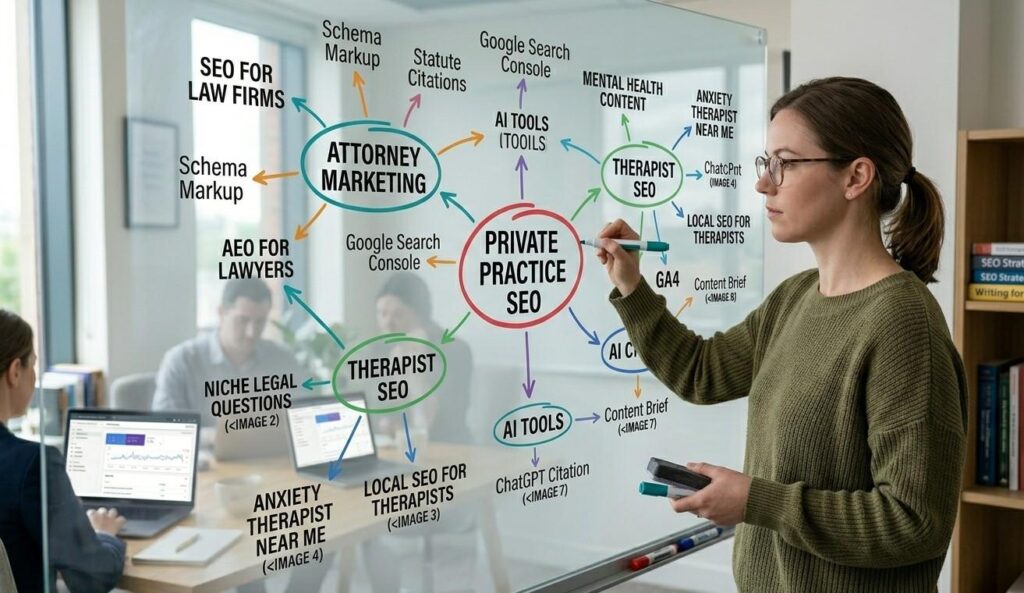
If you’re still aiming for a 1 to 2 percent keyword density on your blog posts, you’re optimizing for a version of Google that stopped existing in 2019. Semantic SEO is how Google reads, understands and ranks content in 2026, and the rules are genuinely different from what most pre-2020 guides still teach. The shift isn’t subtle. It’s the difference between a page that ranks on page one and a page that sits on page four despite having all the “right” keywords in all the “right” places. This post covers what semantic SEO means in practice, why keyword density stopped working and what your content strategy needs instead.
What Semantic SEO Actually Is and Why Google Switched to It
Semantic SEO is the practice of building content around topics, entities and the relationships between them rather than around a target keyword count. Google reads pages the way a subject-matter expert would: looking for depth, context and full coverage of a topic rather than evidence that a keyword appears a set number of times per 100 words. A semantically strong page on “personal injury law in Texas” covers statute of limitations periods, comparative fault rules and common claim types. It doesn’t just repeat “personal injury lawyer” in every paragraph and call it optimized.
How Google Uses Entities to Understand Your Content
Google’s Knowledge Graph, which the company introduced in 2012, maps real-world entities: people, places, organizations, concepts and the connections between them. When Google crawls your page, it checks whether the entities present match the topic you’re trying to rank for. A page about corporate tax law that mentions the IRS, Schedule C, S corporations and Form 1120 gives Google a set of entity signals that confirm the topic. A page that just repeats “corporate tax lawyer” 14 times, however, gives Google almost nothing to work with beyond the keyword itself.
Tools like Google’s Natural Language API let you test how Google reads your content at the entity level. Run your draft through it and check which entities Google extracts. If those entities don’t match the topic you’re targeting, the content isn’t communicating what you think it is, regardless of how well-written it reads to a human.
What Topical Authority Means for Your Site’s Rankings
Topical authority is the depth of coverage your site builds around a subject over time. A site that publishes 40 interconnected articles on personal injury law, covering car accidents, premises liability and medical malpractice, builds authority that a site with one general “personal injury” page cannot match. Google rewards sites that cover a topic completely, not sites that publish one well-crafted post and stop.
According to Ahrefs’ research on topical authority, sites with strong topic clusters consistently outperform single-page competitors in niche queries, even when those competitors have higher overall domain authority. This means a focused, smaller site can outrank a large general site if it covers the topic with greater depth and specificity. That’s one of the clearest practical payoffs of semantic SEO done right.
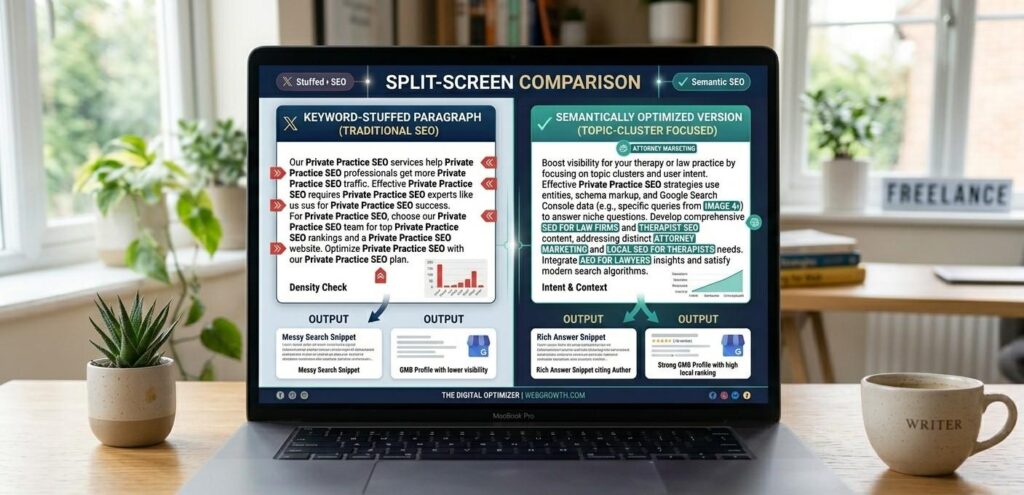
Why Keyword Density Stopped Working After Google’s BERT Update
Keyword density was a useful proxy in early search. It helped simpler algorithms figure out what a page was about because they couldn’t infer meaning from context. Google’s BERT update in October 2019 changed that entirely. BERT processes words in relation to all other words in a sentence, not in isolation. So Google stopped needing keyword repetition as a signal because it could infer topic from context and sentence structure alone.
By 2021, Google’s MUM update added multimodal understanding across 75 languages and multiple content formats. Keyword density didn’t just become irrelevant. In some cases it became actively harmful, because pages stuffed with a keyword to hit a frequency target often disrupted the natural language patterns that BERT and MUM rewarded. This is why dropping the density target isn’t just a modern style preference. It’s the technically correct call based on how the algorithm actually works now. The post on why you need an expert SEO content writer covers how this structural shift separates writers who still rank from those who don’t.
How LSI Keywords and Topical Coverage Work Together
Latent semantic indexing keywords, or LSI keywords, are terms that appear naturally in well-written content about a given topic. They aren’t synonyms. Instead, they’re the words and phrases that co-occur with a subject across the web. A page about “home insurance” that also covers deductibles, replacement cost coverage and flood exclusions gives Google a richer semantic picture than a page that repeats “home insurance” as a phrase 20 times.
The most reliable way to find these terms isn’t a dedicated LSI tool. According to Semrush’s guide to semantic SEO, the strongest method is analyzing the top 10 ranking pages for your target topic and noting which subtopics, questions and entity terms they all cover. That overlap tells you what Google has already confirmed as complete coverage for that topic. The content writing services I offer start from exactly this analysis because it determines the architecture of the content before any writing begins.

How to Apply Semantic SEO to Your Content Right Now
Building semantically strong content follows a clear process. Each step moves you away from keyword counting and toward topic coverage that Google can read and reward.
- Start with topic research, not keyword research. Use Semrush’s Topic Research tool or Ahrefs’ Content Explorer to find every subtopic, question and related concept before drafting.
- Map entities before writing. List the real-world entities, named organizations, tools, locations and technical terms, that belong on a page about this topic. These become your content anchors.
- Cover every major subtopic in the same piece or in a linked cluster. Your site’s content cluster should leave no significant question about the topic unanswered across its pages.
- Run your content through Google’s Natural Language API before publishing. If the entities it extracts don’t match your target topic, rewrite before you hit publish.
- Use Google Search Console to check which related queries your page already ranks for. Those queries show you which semantic signals are working and which coverage gaps are costing you additional visibility.
Most writers skip step one entirely. They start with a keyword, write around it and then wonder why the page doesn’t rank. The topic research step takes 30 to 45 minutes, but it determines whether the whole piece earns any visibility at all. Every project at wajahatamin.com starts here because the research sets the architecture of the content, not the other way around. For a practical walkthrough of how this research translates into a brief before writing begins, the content brief template post lays out the full process step by step. The GEO content guide for 2026 also covers how semantic structure directly raises AI citation rates alongside standard rankings.
Ready to Build Content That Google’s Semantic Algorithm Rewards?
Most content strategies still run on keyword density targets that stopped working five years ago. If your pages are well-written but not ranking, the problem is usually semantic coverage and topic architecture, not writing quality. I build content strategies for brands and niche businesses that match what Google’s current algorithm actually rewards, from entity mapping to topic clusters to FAQ structure. If that’s what your content is missing, start the conversation on the contact page and I’ll take an honest look at where your current pages are losing ground.
FAQs
Is keyword density still a ranking factor in 2026?
No. Google confirmed through its BERT update in 2019 that keyword density is not a meaningful ranking signal. The algorithm reads semantic relationships between words and concepts rather than counting phrase repetitions. Forcing a keyword into a specific percentage of your word count now hurts readability without producing any ranking benefit. Focus instead on topic coverage, entity density and content that answers the full range of questions a reader has about a subject, because those are the signals Google actually measures.
What replaced keyword density as a ranking signal?
Topical authority, entity coverage and semantic relevance replaced keyword density as the primary signals. Google now measures whether your content covers a topic completely, references the correct real-world entities and answers the questions people actually ask around that subject. Sites that build structured content clusters around a topic consistently outrank sites with isolated high-keyword-density pages. Content depth, internal linking between related pieces and FAQ coverage all contribute more to ranking in 2026 than any keyword frequency metric from the previous decade.
How do I find related entities for a topic I’m writing about?
Start by analyzing the top 5 ranking pages for your target topic in Ahrefs’ Site Explorer or Semrush’s Keyword Overview. Note the specific organizations, tools, people, locations and technical terms those pages reference. Then run a draft of your content through Google’s Natural Language API to see which entities it extracts. If the extracted entities don’t match the topic you’re targeting, the content needs more specific language and named references, not more keyword repetitions across existing sentences.
Does my content need synonyms of the main keyword?
Not synonyms exactly, but related terms that co-occur with your topic naturally across the web. For example, a page about “content marketing” benefits from referencing editorial calendars, content distribution and audience segmentation because those terms appear alongside the topic on authoritative pages. According to Ahrefs’ research on LSI keywords, these co-occurring terms help Google confirm that a page covers the topic at the depth it expects. The goal is natural language that covers the topic well, not a checklist of synonym swaps inserted into existing sentences.
How many keywords should one page target in 2026?
One primary topic or keyword cluster per page, with related secondary terms woven naturally through the content. Targeting more than 3 to 4 related keyword variations on one page rarely works because Google ranks pages for a primary intent. If you have strong secondary keywords, they often perform better as separate pages in a content cluster that links back to the main pillar. Trying to rank one page for 10 distinct keywords usually results in the page ranking weakly for all of them rather than strongly for one.