
Keys Takeaways: Local SEO for therapists builds on three pillars: a verified Google Business Profile, content structured around what clients type into search and a review strategy that stays inside your professional ethics code. According to Ahrefs’ AI Overview study, 62 percent of AI Overview citations come from pages outside the top 10 organic results, so even a new therapy practice can earn AI visibility before it cracks page one. The compliance risks are specific. Google Analytics is not HIPAA compliant without a Business Associate Agreement, the APA Ethics Code prohibits soliciting testimonials from current clients and no published content should ever identify a visitor as a patient. Each risk has a clean, practical fix. This guide covers all three.

Most therapists fill their first 10 clients through referrals. Then the network hits its limit. Local SEO for therapists is the channel that keeps a caseload growing past that ceiling without depending on colleagues for every inquiry. It is also one of the most misunderstood topics in private practice marketing. Therapists reasonably worry it requires chasing reviews, sharing data or writing content that reads like a sales pitch. None of that is true. In fact, the most effective mental health marketing strategies put privacy, clinical honesty and genuine usefulness at the center. This post covers what actually works in 2026, ethically and technically.
Why Local SEO Beats Word-of-Mouth as a Caseload Builder
Local SEO puts your practice in front of people who are actively searching for a therapist right now. Because searches like “anxiety therapist accepting new clients near me” carry high intent, they convert at a far higher rate than passive referrals. A well-optimized Google Business Profile and location-targeted content can fill an open caseload within 60 to 90 days.
Word-of-mouth has a ceiling. A colleague sends 3 or 4 referrals per year at best. Search runs 24 hours a day and reaches people your network has no access to. According to Ahrefs’ AI Overview study, 62 percent of AI citations come from pages outside the top 10 organic results, so even a newly optimized therapy site can appear in ChatGPT answers and Google AI Overviews before it breaks onto page one.
I saw this with Mayfair Therapy directly. Four months of local SEO work, no paid ads, moved the practice from page three to page one for its three primary therapy search terms. Most practices handle GBP setup in-house. The question of whether to outsource content, a decision my freelance SEO vs agency guide walks through for small practices specifically, usually comes down to available writing time.
How to Set Up Your Therapist Google Business Profile
Your Google Business Profile is the most important local ranking signal for a therapy practice. A verified, complete and actively managed listing places you in the Google Maps 3-Pack for searches like “therapist near me” or “trauma therapist in [city].” Without one, local rankings are nearly impossible regardless of your website’s quality.
In fact, setting up your Google Business Profile takes under two hours. These are the steps that actually move the needle:
- Verify your listing at your practice address. Telehealth-only practices can use a service-area listing without displaying a public address.
- Choose the right primary category. “Mental Health Service” or “Psychotherapist” are the strongest options for most practices
- List every modality as a service. CBT, EMDR, DBT and couples therapy each work as secondary keywords that filter traffic to clients who already know what they need.
- Add professional photos. Profiles with photos earn more website clicks and direction requests than those without.
- Post at least twice a month. Seasonal mental health awareness notes and availability updates both qualify. Never include any client-identifying content.
- Answer every Q&A entry yourself. If questions go unanswered, Google may generate its own responses in that field.
A GBP listing works best when it connects to dedicated location pages on your website. I explain how those two signals reinforce each other in my guide to city-specific landing pages, which also covers how to avoid the duplicate content trap most practices fall into.
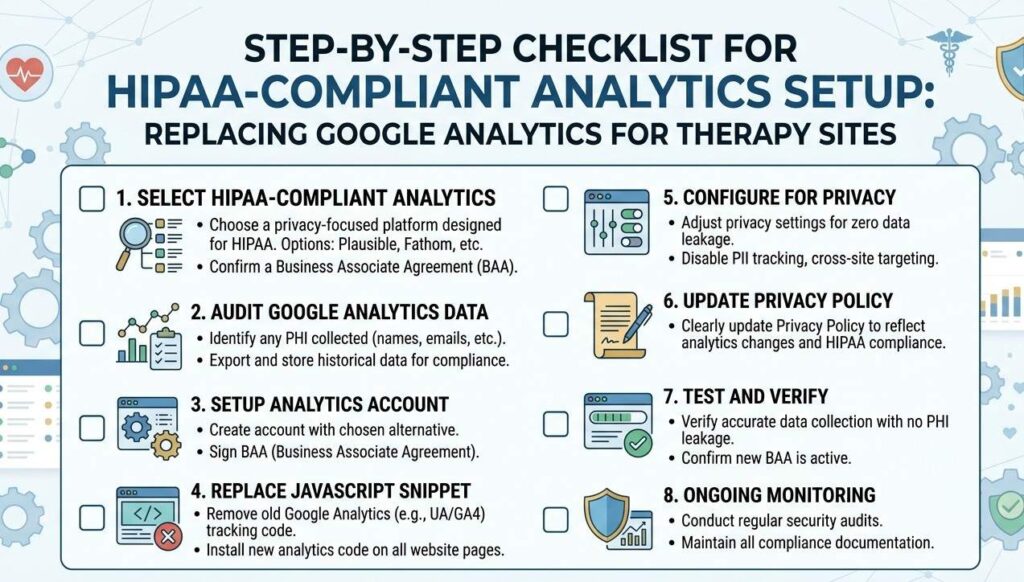
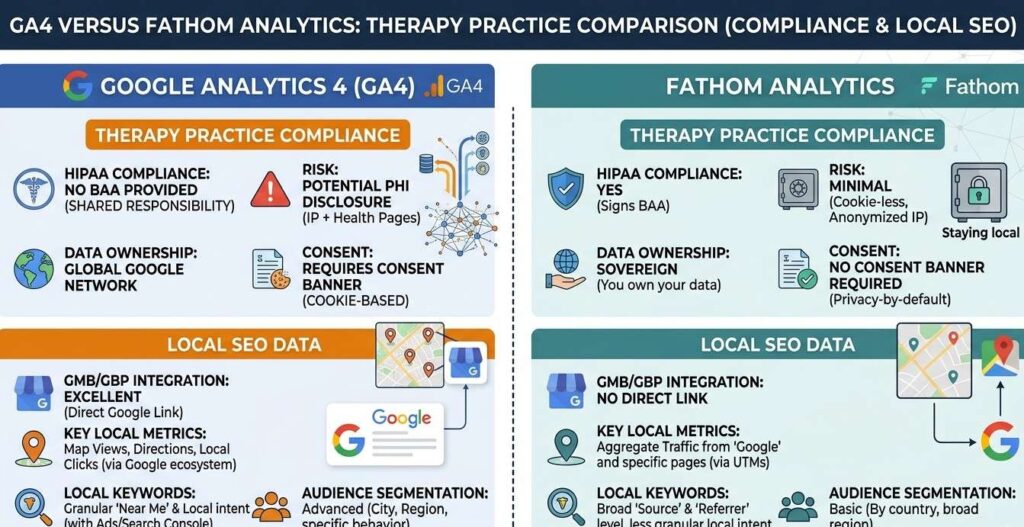
Is Google Analytics HIPAA Compliant for a Therapy Practice?
No. Google Analytics, including GA4, is not HIPAA compliant because Google does not sign a Business Associate Agreement for Analytics. Under HIPAA, any vendor handling protected health information on your behalf must sign a BAA. Standard GA4 creates compliance exposure for therapy practices and requires a replacement, not just a settings change.
The HHS guidance on Business Associate Agreements makes the line clear. Google signs BAAs for Google Workspace products like Gmail and Drive, but not for Analytics. That distinction catches most therapists off guard because both products sit under the same Google account.
The practical fix is to replace GA4 with Fathom Analytics or Plausible Analytics. Both tools operate without cookies, collect no personally identifiable information and require no BAA because they never touch protected health data. Both still give you the core SEO data you need: page views, referral traffic sources and geographic breakdown.
Switching takes about 30 minutes. As a result, you remove a compliance risk that most practices are not even aware they carry.
Can Therapists Ask Clients for Google Reviews?
Not current clients. The APA Ethics Code prohibits soliciting testimonials from current therapy clients because the therapeutic relationship creates a power dynamic that makes truly voluntary feedback impossible. This applies regardless of which professional license you hold or which state you practice in.
That said, you have more options than you might think:
- Ask non-client audiences. Workshop attendees, podcast listeners and speaking event participants are not clients. Asking them for a review after a positive interaction is entirely appropriate.
- Let your profile draw organic reviews. A complete, active GBP often attracts voluntary reviews from former clients who choose to leave feedback on their own.
- Respond to every review you receive. Responding to both positive and critical reviews signals an engaged, accountable practice. Never include clinical details in any response, even general ones.
Actively soliciting former clients, even after treatment ends, still carries ethical risk. When in doubt, consult your state licensing board’s specific guidance on solicitation before reaching out to anyone from your caseload history.
What Content Strategy Drives Local Rankings for a Private Practice?
The content that ranks for local therapy searches is specific, modality-focused and written for the person typing the search rather than for an algorithm. A service page targeting “CBT for anxiety in [city]” outperforms a generic “therapy services” page because it matches both the search query and the searcher’s actual need at the same time.
Blog posts help when they answer the real questions prospective clients type at 11pm before deciding whether to call anyone. “How do I know if I need a therapist?” ranks for far more searches than “The benefits of therapy” because it mirrors a real query, not a category label.
According to Princeton research (2025), content that cites specific data earns AI visibility at over 40 percent higher rates than unsourced content. Even one named statistic per post lifts citation probability across ChatGPT, Perplexity and Google AI Overviews.
The approach I use for therapy practices at wajahatamin.com follows one rule: write what your prospective client would type at their most uncertain moment. That question format wins featured snippets and AI citations alike.
For practices weighing whether to write content in-house or bring someone in, the format and process I use are covered in my expert SEO content writing guide.
FAQs
Is Google Analytics HIPAA compliant for therapists?
No. Google does not sign a Business Associate Agreement for Google Analytics, including GA4. Under HIPAA, any vendor handling protected health information on your behalf requires a BAA. Without one, using standard GA4 on a therapy site creates compliance exposure. Replace it with Fathom Analytics or Plausible Analytics. Both operate without cookies, collect no personally identifiable information and still provide the SEO traffic data you need.
Can therapists ask clients for Google reviews?
Not current clients. The APA Ethics Code prohibits soliciting testimonials from current therapy clients because the therapeutic relationship creates conditions that compromise voluntary consent. You can, however, ask non-client audiences like workshop attendees or podcast listeners. A complete, active Google Business Profile also draws organic reviews from former clients who choose to leave feedback without any prompting.
How long does SEO take for a therapy practice?
Most therapy practices see meaningful local ranking movement within 3 to 6 months of consistent effort. A complete Google Business Profile can produce local pack appearances within the first 30 days. Blog content and service pages typically take 4 to 6 months to gain traction because Google evaluates content quality over time. Practices that start with GBP optimization first tend to see the fastest early results.
Should therapists write their own content?
Yes, if you have the time and can write with clinical specificity. Your lived experience with a particular modality adds authentic authority that no generalist writer can replicate. However, if you are choosing between one generic post per month and consistently well-structured, keyword-researched content from an outside writer, the second option almost always produces better SEO results over a 6-month horizon.
Is local SEO worth it for telehealth-only practices?
Yes. People still search for therapists by location even for telehealth, often because they want someone licensed in their state or familiar with their regional culture. A telehealth practice can create a service-area Google Business Profile, build state-specific pages for each license it holds and target location-based keywords without ever listing a physical address. Local SEO for telehealth is a real, effective strategy.
If you run a private practice and want your site to show up when clients search for help, the place to start is usually a GBP audit and a content gap review. I work with therapists through my SEO content writing and strategy services, with an intake process built around ethics and compliance from day one. If you’d like to see whether we’re a good fit, reach out directly and I’ll take a look at what you’re working with.