
TL;DR: Law firm SEO fails most often because attorney websites target broad practice area keywords, skip local optimisation and publish thin content that Google’s E-E-A-T quality system actively downgrades. Legal is one of the most competitive verticals in organic search. According to Semrush’s 2025 data, Google AI Overviews appear on 88 percent of informational queries, including legal how-to searches. According to Ahrefs’ AI Overview study, only 38 percent of those AI citations come from top-10 organic results. Law firms that combine local SEO, practice area pages built for specific queries and FAQ content structured for AI citation consistently outperform firms that publish generic service pages and stop there.

Most law firm websites look professional. They have a headshot, a practice area list and a contact form. But professional-looking and search-optimised are not the same thing. The attorney websites that rank on page one share specific structural and content choices that their competitors skip, usually because no one explained why those choices matter. This guide covers the real reasons law firm SEO underperforms and what your firm can do differently starting this month.
Why Law Firm SEO Is Harder Than Most Industries
Legal SEO is harder than most niches because it combines extreme keyword competition with Google’s highest E-E-A-T scrutiny. Legal queries fall under Google’s “Your Money or Your Life” (YMYL) category, which means Google applies stricter quality standards to legal content than to, say, recipe blogs or travel guides.
That scrutiny means thin pages, generic firm descriptions and practice area pages without substantive answers all underperform. Google needs clear signals of legal expertise before it ranks a page where a searcher might act on the advice given.
What makes legal SEO uniquely competitive
- Competitor firms often spend $5,000 to $15,000 per month on SEO and paid search
- Personal injury, criminal defence and family law terms carry some of the highest cost-per-click rates in Google Ads, which inflates organic competition too
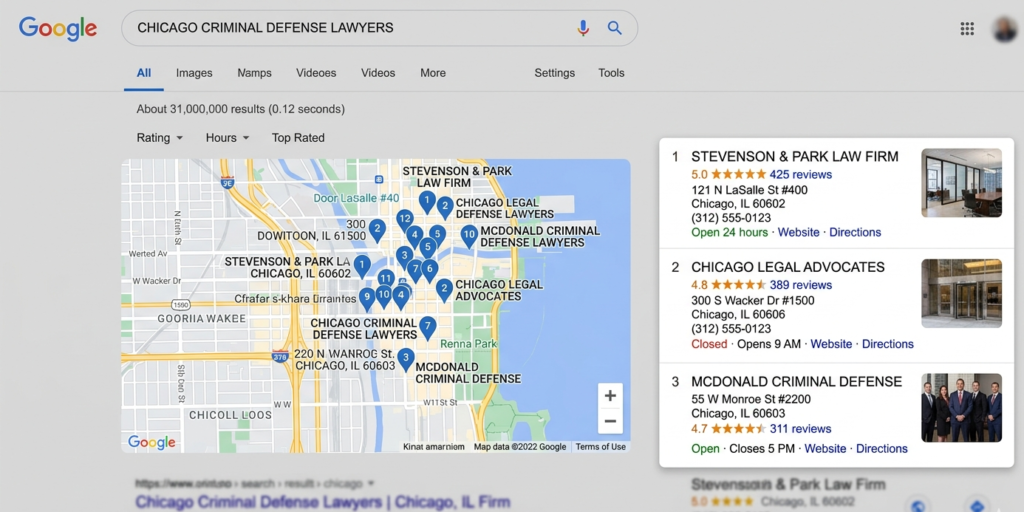
- Local competition is tight: in most cities, 3 to 8 firms dominate the map pack for high-intent queries like “divorce lawyer near me” or “DUI attorney [city]”
According to Google’s Search Quality Evaluator Guidelines, legal content requires demonstrated expertise, real author credentials and accurate, up-to-date information. A page with no author byline, no citations and no specific legal information will not satisfy those signals.
The Biggest Law Firm SEO Mistakes That Kill Rankings
Most attorney websites fail at SEO because of four repeating mistakes: targeting the wrong keywords, publishing one thin practice area page instead of multiple specific ones, neglecting Google Business Profile and skipping structured data markup.
These are not subtle errors. They are the direct reason why a well-funded firm with a beautiful website sits on page four while a smaller competitor with better-structured content takes the top three map pack spots.
Mistake 1: Targeting “personal injury lawyer” instead of specific queries
“Personal injury lawyer” has enormous search volume and enormous competition. A new or mid-size firm cannot win that term against firms with 10 years of domain authority and thousands of backlinks. Instead, target specific queries: “car accident lawyer in [neighbourhood]”, “slip and fall attorney [city]” or “how much compensation for whiplash UK”. These terms have lower competition and higher buying intent.
Mistake 2: One practice area page instead of multiple content pages
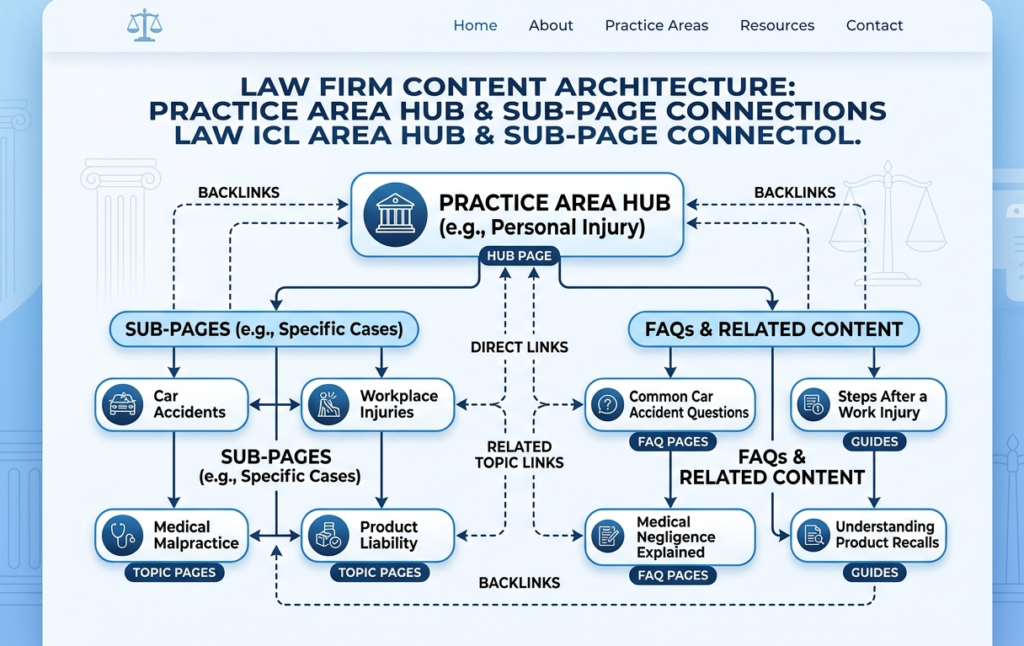
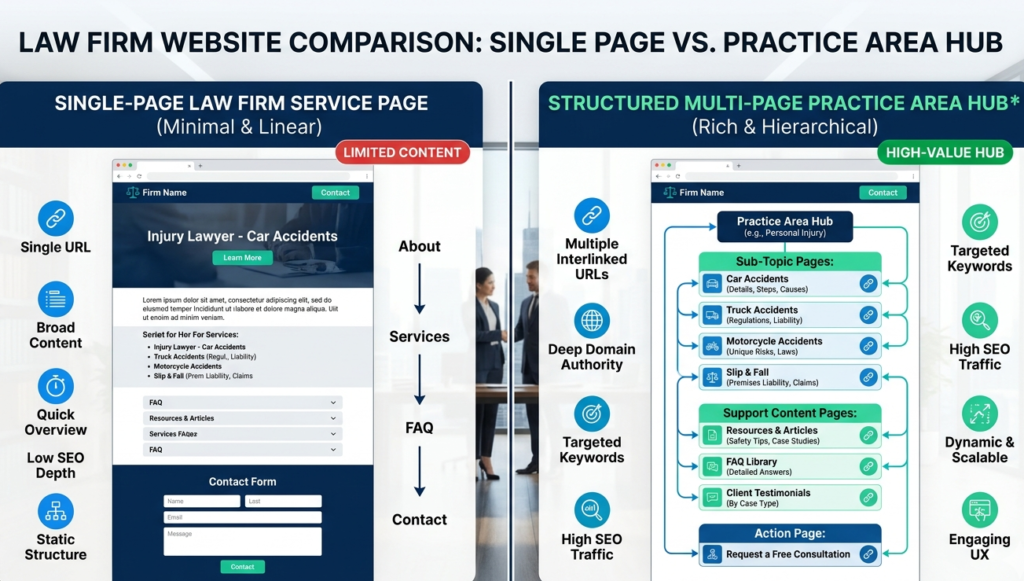
A single “Family Law” page targeting divorce, custody, adoption and financial settlements all at once ranks for none of them well. Each practice area sub-topic needs its own page with a targeted keyword, an answer-capsule introduction and FAQ content structured for featured snippets. This is topical depth, and it is what separates page-one law firms from page-three ones.
Mistake 3: An incomplete or inactive Google Business Profile
For local law firm SEO, the Google Business Profile drives more immediate new client inquiries than any organic ranking. A profile without photos, without recent posts, without Q&A responses and without a steady review stream loses map pack placement to competitors who update theirs weekly.
According to BrightLocal’s 2024 Local Consumer Review Survey, 98 percent of consumers read online reviews for local businesses before contacting them. For legal services, where trust is everything, a sparse review profile signals risk to potential clients before they ever read a word of your content.
How to Build Law Firm SEO Content That Actually Ranks
Law firm SEO content ranks when it answers specific legal questions with accurate, attributed information, uses proper heading structure for AI citation and includes FAQ schema markup for featured snippet eligibility.
The firms that appear in Google AI Overviews for legal queries share a consistent structure: a direct answer in the first 60 words, named legal concepts, cited sources and a clear FAQ section at the bottom of each page. That structure is not accidental. It is the result of building content for both Google and AI answer engines simultaneously.
| Content type | SEO benefit | AI citation benefit |
| Practice area sub-pages | High: specific keyword targeting | Medium: structured answers help |
| Local landing pages by area | High: map pack and local rankings | Low |
| Legal FAQ pages | High: featured snippet eligibility | High: direct answer format |
| “How much does X cost” pages | High: informational intent | High: price data gets cited |
| Attorney bio pages | Medium: E-E-A-T signal | Medium: named entity signal |
According to Princeton’s 2025 research cited by Search Engine Journal, adding named sources and statistics to content lifts AI visibility by over 40 percent. A legal FAQ page that cites specific statutes, names the relevant court or jurisdiction and uses structured heading markup hits all those signals at once.
I cover the broader content strategy behind AI visibility in my blog on SEO and GEO for 2026, including how entity density affects citation probability across industries.

Do Law Firms Need Separate SEO for Each Practice Area?
Yes. Each practice area targets a different audience, a different search intent and a different set of keywords. Combining them onto shared pages dilutes relevance signals for all of them. A family law page and a criminal defence page need to be entirely separate content hubs, each with their own sub-pages, FAQs and internal linking structures.
This is especially true for firms with geographically distinct offices. A firm with offices in Manchester and Leeds needs separate location pages for each city, not one page mentioning both. Google ranks local pages on proximity and relevance. A page that mentions two cities ranks well for neither.
For a clear example of how practice area depth and local page structure work together, take a look at my SEO content writing services page, which outlines the content architecture I use for professional services clients.
What Law Firm SEO Costs and Whether It’s Worth It
Law firm SEO services cost between $2,000 and $10,000 per month for a full-service agency. Freelance legal SEO content writing runs from $0.30 to $0.80 per word for specialist writers. The investment is worth it in legal because the lifetime value of a single retained client is high. One personal injury case or commercial contract client can return 50x the monthly SEO spend.
The question is not whether to invest in law firm SEO. It is whether to invest in SEO that actually works. Generic content from a cheap provider will not move rankings in a YMYL vertical. Google’s documentation on helpful content makes clear that legal content needs first-hand expertise, accurate information and a named, credentialled author to compete.
If you want to see how I approach legal content and attorney SEO, my portfolio includes B2B and professional services work with measurable ranking outcomes.
Want a Law Firm Content Strategy That Earns Rankings?
Most attorney websites have the credibility to rank. They just do not have the content structure to tell Google why they should. I write practice area pages, local landing pages and legal FAQ content built for both Google rankings and AI citation. If you want a straight assessment of where your firm’s content is falling short, take a look at my legal SEO content services or get in touch directly. No jargon, no pitch deck, just a practical conversation about what your site needs
FAQs
How long does SEO take for a law firm to see results?
For local map pack results, a fully optimised Google Business Profile with consistent citations and 15 or more recent reviews typically shows movement within 60 to 90 days. Organic rankings for practice area pages in competitive cities take 4 to 6 months. Specific, lower-competition queries like “probate solicitor [suburb]” or “how to contest a will [city]” can rank faster because fewer firms target them with dedicated pages.
How much should a law firm spend on SEO per month?
A solo or small firm with a focused local practice should budget $1,500 to $3,000 per month for content and optimisation. Mid-size firms competing across 3 or more practice areas in major cities typically spend $4,000 to $8,000 per month. The spend scales with competition level and the number of practice area content hubs the firm needs to build. Underspending in a high-competition vertical like personal injury or criminal defence produces no results.
Should a solo lawyer hire an in-house marketer or a freelance SEO writer?
For most solo and small firm practices, a freelance SEO writer or specialist consultant delivers better value than an in-house hire at the same cost. An in-house junior marketer at $35,000 to $45,000 per year rarely has the legal content expertise or technical SEO knowledge that a specialist freelancer brings. A better model is a specialist writer for content production combined with a technical SEO consultant for site audits and strategy, kept on a flexible monthly basis.
Can a law firm guarantee a number one Google ranking?
No, and you should not trust any agency or consultant that makes that promise. Google does not sell organic rankings and no external party controls the algorithm. What ethical SEO practitioners can promise is a structured, evidence-based approach that improves ranking probability over time. Agencies that guarantee specific positions typically use short-term tactics that trigger Google penalties within 6 to 12 months. Ask for case studies and ranking history instead of guarantees.
Do law firms need different SEO for each practice area?
Yes. Each practice area targets a different search intent, a different client need and a different keyword set. Combining family law, criminal defence and employment law onto shared or thin pages dilutes relevance for all of them. Each practice area needs its own dedicated content hub with sub-pages targeting specific queries, FAQ schema markup and internal links connecting related content. This topical depth is what allows mid-size firms to outrank larger competitors on specific, high-intent queries.