
TL;DR:
When you set out to hire SEO content writer professionals, you must look beyond basic grammar and keyword insertion. True experts understand search intent, balance human creativity against automated tools, and integrate smoothly with your broader marketing goals. This guide breaks down the seven crucial red flags you need to watch for, from suspiciously cheap rates and guaranteed rankings to an over-reliance on AI generation. Spotting these warning signs early saves you time, protects your brand reputation, and ensures your investment drives actual business growth.

The High Stakes When You Hire SEO Content Writer Experts
Finding the right talent to handle your online visibility requires careful vetting. If you want to hire SEO content writer experts, you must understand that the wrong choice can actively harm your brand. Poorly written content hurts your rankings and damages your credibility with prospective clients.
Before you commit to a contract, you must know what to look for in an SEO writer. You need someone who writes persuasively and understands the technical mechanisms of search algorithms. Knowing how to hire an SEO writer involves spotting the warning signs before they drain your marketing budget.
Here are the seven major SEO content writing red flags every business professional must watch for.
1. Guaranteed Number One Rankings
No credible writer or agency can guarantee a number one spot on Google. Search algorithms change constantly, and hundreds of variables influence where a page lands on the search engine results pages (SERPs).
If a freelance SEO content writer promises you the top spot within a week, walk away. This promise often indicates manipulative tactics that violate Google’s spam policies. True professionals focus on sustainable growth, user intent, and high-quality information rather than making empty promises.
Watch for:
- Promises of overnight success
- Guarantees for specific keyword rankings
- Lack of transparency about their methods
2. Unusually Low Rates
Pricing often reflects experience. When you evaluate the cost to hire an SEO writer, extremely low rates should trigger immediate concern. Bargain-basement prices usually mean the writer cuts corners, plagiarizes, or relies entirely on unedited automated tools.
If you want a B2B SEO content writer who grasps complex industry topics, you must pay for that expertise. Experienced writers spend hours researching your industry, analyzing competitors, and crafting compelling narratives. Cheap writers skip these vital steps. If you want high-level strategic insights, visit the homepage of a trusted professional at wajahatamin.com to see the standard of quality you should expect.

3. Ignoring the AI Content vs Human SEO Writer Balance
Automated tools serve a purpose in modern marketing, helping with outlines and research. However, completely removing human oversight leads to disaster.
When analyzing the AI content vs human SEO writer dynamic, look for a balance. A writer who simply copies and pastes prompts into an automated tool without editing, fact-checking, or injecting brand voice will publish generic, inaccurate content. You need a professional SEO copywriter who uses tools to enhance their workflow, not replace their critical thinking. Read more about the impact of original thought on Search Engine Journal.
4. Disregard for Search Intent
Keyword stuffing no longer works. Modern search engines reward content that directly answers the user’s query. If your writer forces keywords into sentences without providing actual value, they show clear signs of a bad SEO strategy.
A qualified writer knows when a user wants to buy a product versus when they want to learn a concept. They structure the article to satisfy that specific need. If you outsource SEO content creation, ask the candidate how they research user intent before writing a single word.
5. No Strategy for Internal and External Linking
Great content does not live in a vacuum. It must connect to other relevant resources. A writer who fails to include internal and external links misses a massive optimization opportunity.
Links help search engines understand website architecture and establish credibility. For instance, linking to high-authority domains like HubSpot for statistics adds weight to your claims. Similarly, linking to your own specific services pages drives readers down the sales funnel. If you hire SEO content writer professionals, they must demonstrate a clear understanding of link placement.
6. Lack of an Impressive Portfolio
Never hire based on a resume alone. You must read their previous work. A professional seeking to provide SEO content writing services USA should possess a robust portfolio spanning multiple topics and formats.
Red flags in a portfolio include:
- Only self-published blogs: They should have published work on reputable industry sites.
- Poor grammar and formatting: The writing should be flawless.
- No data integration: They should use metrics and data to back up their claims, much like the case studies found on Content Marketing Institute.
If they cannot show you successful past campaigns, you should not trust them with your future campaigns. Before allocating funds to unproven talent, learn more about structuring your marketing budget correctly by reading about where to invest your marketing budget in 2026.
7. Zero Questions About Your Target Audience
The biggest mistake a writer can make involves writing blindly. If a candidate accepts an assignment without asking about your ideal customer, your brand voice, or your sales goals, they will fail to connect with your readers.
Expert business professionals need content that speaks directly to other experts. A writer must ask about industry pain points and common objections. If they just take a keyword and start typing, they operate as an order-taker, not a strategic partner.
Final Thoughts
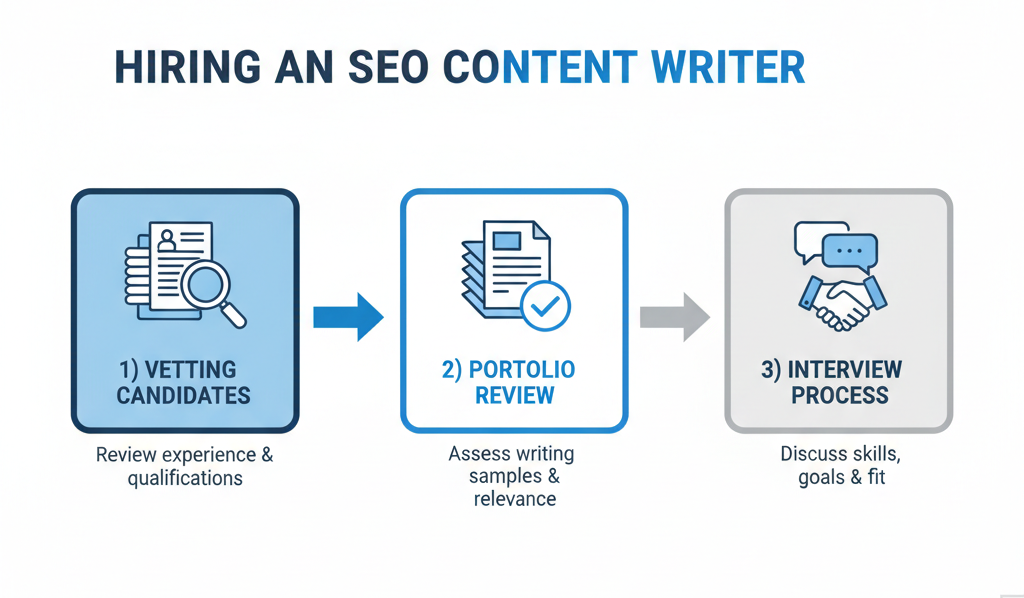
Making the right choice transforms your online presence from a static brochure into an active lead-generation tool. Take the time to vet candidates thoroughly. When you finally hire SEO content writer experts who understand your vision, your business will reap the rewards of sustainable, long-term organic growth.
Key Takeaways
- Avoid guaranteed rankings: No one can promise a number one spot on search engines.
- Quality costs money: Suspiciously low rates often result in stolen or poor-quality work.
- Demand human oversight: Ensure the writer balances automated tools with human editing and fact-checking.
- Focus on search intent: Content must answer the specific questions your users ask.
- Check link strategies: Writers must understand how to weave internal and external links naturally into the text.
- Verify the portfolio: Always review previous published work before signing a contract.
- Require audience alignment: A great writer asks detailed questions about your brand and your target customers.
FAQs
1. What is the biggest red flag to look for when reviewing an SEO writer’s portfolio?
A portfolio that lacks published, real-world examples is a major warning sign. Many amateur writers submit self-published blog posts or standalone word documents that have never faced actual search engine scrutiny.
When you review a portfolio, look for:
- By-lines on reputable industry websites.
- Case studies showing measurable organic growth.
- Data points that prove their writing actually generated traffic or leads.
If a writer cannot show you how their past work performed, you take a massive risk trusting them with your marketing budget.
2. How can we test an SEO writer’s understanding of search intent during the hiring process?
You test this by asking the candidate to map out a brief outline for a specific keyword. Give them a keyword related to your business and ask them who the target reader is and what that reader wants to achieve.
A true expert will immediately categorize the keyword. They will tell you if the user wants to buy a product (transactional), learn a concept (informational), or compare options (commercial). If the writer just gives you a list of subheadings without discussing why the user typed that query into Google, they do not understand search intent.
3. What distinguishes a professional SEO copywriter from a general freelance writer?
A general freelance writer focuses entirely on prose, flow, and storytelling. A professional SEO copywriter combines those creative skills with deep technical knowledge.
An SEO copywriter knows how to:
- Structure headers (H1, H2, H3) for both readers and search crawlers.
- Optimize meta titles and meta descriptions to improve click-through rates.
- Weave primary and secondary keywords naturally into the text without keyword stuffing.
- Format paragraphs and bullet points to capture featured snippets.
You need someone who writes for humans but formats for machines.
4. How should we evaluate a writer’s use of AI tools in their workflow?
You must look for a healthy balance. If a writer claims they never use AI tools, they might be inefficient. If they rely entirely on AI to generate their final drafts, they will deliver generic, inaccurate content that harms your brand.
Ask candidates directly how they use automation. The best writers use these tools to build outlines, brainstorm angles, or perform initial research. However, they rely on their own expertise to write the actual sentences, inject your brand voice, and fact-check every claim. Demand full transparency about their editing process.
5. What pricing models indicate a potential risk when outsourcing SEO content?
Suspiciously low per-word rates often indicate a severe lack of quality. Cheap writers must produce massive volumes of text just to make a living. This means they cannot afford to spend time researching your complex industry or studying your competitors.
Instead of looking for the cheapest rate, look for value. Flat-rate pricing per project or monthly retainers usually yield better results. These models allow the writer to dedicate the necessary hours to research, writing, and editing. Quality content costs money, but bad content costs you customers.
6. How do we assess an SEO writer’s ability to integrate internal and external links?
During the interview, ask the candidate to explain their linking strategy. A novice will tell you they just insert links wherever a keyword appears. An expert will explain that links act as the architecture of your website.
Look for a writer who understands that:
- External links should point to highly authoritative, relevant data sources to build trust.
- Internal links should guide readers logically down your sales funnel.
- Anchor text needs to be descriptive and natural, not forced or repetitive.
7. What questions should an expert SEO writer ask us before starting a project?
A professional writer acts as a strategic partner, not just an order-taker. If a candidate accepts an assignment without asking any questions, consider it a massive red flag.
Before typing a single word, they should ask you:
- What are the main pain points your product or service solves?
- Who is your ideal buyer persona?
- What is your desired brand tone (e.g., authoritative, conversational, academic)?
- What specific action do you want the reader to take at the end of the post?
8. How long does it typically take to see measurable results from a newly hired SEO writer?
You must set realistic expectations. SEO is a long-term investment. If a writer promises you page-one rankings within a week, they are likely using manipulative, spammy tactics that will eventually get your site penalized.
Typically, high-quality content takes three to six months to gain traction and rank consistently. Search engines need time to crawl the new pages, assess user behavior, and adjust their rankings. Hire a writer who focuses on sustainable, long-term growth rather than overnight miracles.
9. What key performance indicators (KPIs) should we use to measure an SEO writer’s success?
You cannot measure an SEO writer’s success solely by their word count or delivery speed. You must track metrics that impact your business goals.
Set up your analytics software to track:
- Organic Traffic: Are their articles bringing new visitors from search engines?
- Time on Page: Are visitors actually reading the content, or do they bounce immediately?
- Keyword Rankings: Are the pages steadily climbing the search results for targeted terms?
- Conversion Rate: Are readers clicking your internal links and moving toward a purchase?
10. Why is industry-specific experience crucial for B2B SEO content writers?
B2B audiences consist of experts and decision-makers. If your writer lacks industry knowledge, your readers will spot the lack of depth immediately. A generic writer will rely on surface-level definitions that bore your advanced audience.
An experienced B2B writer understands industry jargon, current market trends, and specific business challenges. They write with authority. When you hire for a highly technical field, prioritize candidates who can prove they have successfully written for that specific niche before.
11. How do we ensure a freelance SEO writer aligns with our established brand voice?
You achieve alignment through clear documentation and consistent feedback. Never assume a new writer will perfectly guess your tone on the first try.
To ensure a smooth transition:
- Provide a detailed brand style guide before they begin.
- Share links to your best-performing, most representative content.
- Offer a paid trial project to test their adaptability.
- Give detailed, constructive feedback on their first few drafts.
Great writers adapt quickly, but they need clear targets to hit.
12. What role should an SEO writer play in our broader content marketing strategy?
An SEO writer should sit at the core of your digital marketing efforts. They do not work in isolation. The content they produce fuels your other channels.
A strong SEO article can be broken down into social media threads, repurposed into email newsletters, or used as a script for a video. Your writer should understand how their work fits into this larger ecosystem. Encourage them to collaborate with your social media managers and sales teams to ensure the content serves your entire company.